Optimizing Energy Usage on Madiun State Polytechnic Hybrid Trains Using Quadratic Programming and Genetic Algorithms
DOI:
https://doi.org/10.23917/emitor.v26i1.14694Keywords:
Diesel, Genetic Algorithm, Hybrid Train, Pantograph, Quadratic ProgramingAbstract
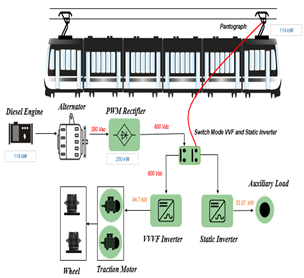
The transportation sector remains heavily dependent on oil-based energy, making the development of environmentally friendly modes essential. Hybrid trains, which combine catenary electricity with diesel engines, offer improved efficiency and reduced emissions. However, managing dual energy sources requires effective optimization to ensure efficient power distribution. This study applies two approaches to optimize power allocation in hybrid trains: Genetic Algorithm (GA) and Quadratic Programming (QP Linear). Simulation results show that both methods yield identical outcomes with a total cost of 2698.80, and similar distribution patterns: the pantograph is kept constant at about 114 kW, while additional demand is supplied by the diesel engine. Results also indicate that during step curves, diesel allocation increases due to additional engine load when the train negotiates turns. The key difference lies in the optimization process: QP Linear provides faster and deterministic solutions, while GA requires hundreds of iterations but offers greater flexibility for non-linear or complex problems.
Downloads
Downloads
Submitted
Accepted
Published
How to Cite
Issue
Section
License
Copyright (c) 2026 Emitor: Jurnal Teknik Elektro

This work is licensed under a Creative Commons Attribution 4.0 International License.