Parasitoid hymenoptera community in cayenne pepper (Capsicum frutescens L.) and peanut (Arachis hypogaea L.) intercropping systems
DOI:
https://doi.org/10.23917/bioeksperimen.v12i2.17542Keywords:
Biological Control Agent, Biodiversity, Ecological Engineering, Hymenoptera, Trophic InteractionAbstract
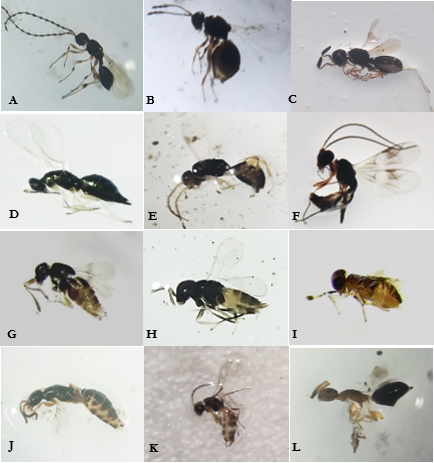
Intercropping systems, an ecological engineering strategy, have the potential to increase the abundance of parasitoid Hymenoptera in agroecosystems. This study aimed to analyze the diversity, relative abundance, and composition of parasitoid Hymenoptera in different intercropping systems of cayenne pepper and peanuts, based on differences in the peanut plant composition. The study was conducted using a randomized block design (RBD) with four treatments and five replicates. Sampling was performed using yellow pan traps and pitfall traps. Data were analyzed using the Shannon-Wiener diversity index (H'), evenness (E), dominance (D), and species richness (R). The results show that the parasitoid Hymenoptera community consisted of 79 individuals belonging to 12 families and 29 morphospecies. The highest relative abundance was found in Trichopria spp. (24 individuals; 30.37%). The Diapriidae family was the most abundant, with 33 individuals (41.77%). The TS2 treatment (ratio 1:3) resulted in the highest diversity (H' = 2.36) and species richness (R = 4.84). However, ANOVA indicated that neither parasitoid abundance (F3,12 = 2.599; P > 0.05) nor morphospecies richness (F3,12 = 3.207; P > 0.05) differed significantly among treatments. These findings suggest that cayenne pepper–peanut intercropping may support parasitoid communities, although the effects of different peanut proportions require further investigation under broader ecological conditions.
Downloads
References
Abang, A. F., Nanga, S. N., Kuate, A. F., Kouebou, C., Suh, C., Masso, C., Saethre, M. G., & Fiaboe, K. K. M. (2021). Natural enemies of fall armyworm Spodoptera frugiperda (Lepidoptera: Noctuidae) in different agro-ecologies. Insects, 12, 509. https://doi.org/10.3390/insects12060509.
Agbodzavu, M. K., Osiemo-Lagat, Z., Gikungu, M., Ekesi, S., & Fiaboe, K. K. M. (2020). Temperature-dependent development, survival and reproduction of Apanteles hemara (Nixon) (Hymenoptera: Braconidae) on Spoladea recurvalis (F.) (Lepidoptera: Crambidae). Bulletin of Entomological Research, 110(5), 577–587. https://doi.org/10.1017/S0007485319000920.
Aguiar, A. P., Deans, A. R., Engel, M. S., Forshage, M., Huber, J. T., & Jennings, J. T. (2013). Order Hymenoptera. Zootaxa, 3703(1), 51–62. https://doi.org/10.11646/zootaxa.3703.1.12.
Aldinas, D., Prabowo, R. A., Buchori, D., & Sahari, B. (2023). Diversity of hymenoptera parasitoid wasp in oil palm with the presence and absence of non-crop vegetation. IOP Conference Series: Earth and Environmental Science, 1220(2023). https://doi.org/10.1088/1755-1315/1220/1/012015.
Al-Hussainawy, K. J., Al-Jassani, A. A. Z., & Jabbar, A. S. (2019). A Taxonomical Study of Aphid Parasitoids (Hymenoptera: Aphidiidae) and Their Host Aphid Associations in Dhi Qar Province. Plant Archives, 19(1), 897–900.
Aprilia, S. D., & Rizali, A. (2026). Effect of Lanskap Composition on Diversity and Abundance of Hymenoptera Parasitoids in Paddy Crops in Malang Regency, East Java. Journal of Tropical Plant Protection, 7(1), 16–27. https://doi.org/10.21776/ub.jtpp.2026.007.1.3.
Asmoro, P. P., Dadang., Pudjianto., & Winasa, I. W. (2021). Screening insectary refugia plants that increase the performance of Diadegma semiclausum Hellen (Hymenoptera: Ichneumonidae) against diamondback moth larvae. Biodiversitas, 22(10), 4254–4260. https://doi.org/10.13057/biodiv/d221016.
Boaventura, D., Martin, M., Pozzebon, A., Mota-Sanchez, D., & Nauen, R. (2020). Monitoring of Target-Site Mutations Conferring Insecticide Resistance in Spodoptera frugiperda. Insects, 11(8), 545. https://doi.org/10.3390/insects11080545.
Boucek, Z., & Rasplus, J. Y. (1991). Illustrated Key to West-Palearctic Genera of Pteromalidae (Hymenoptera: Chalcidoidea). Paris: Institut National De La Recherche Agronomique.
Buchori, D., Priawandiputra, W., Rizali, A., Mubin, N., Sari, A., Azhar, A., Nazarreta, R., Amrulloh, R., Fahmi, F., & Harianto, M. (2023). Rekayasa Ekologis dan Rapid Biodiversity Assessment di Agroekosistem: Untuk Konservasi Serangga Berguna. Bogor: Perhimpunan Entomologi Indonesia.
Burke, G., & Sharanowski, B. (2024). Parasitoid wasps. Current Biology, 34, R438-R488.
Colombari, F., Tonina, L., Battisti, A., & Mori, N. (2020). Performance of Trichopria drosophilae (Hymenoptera: Diapriidae), a Generalist Parasitoids of Drosophila suzukii (Diptera: Drosophilidae), at Low Temperature. Journal of Insect Science, 20(3), 1–5. https://doi.org/10.1093/jisesa/ieaa039.
Dong, Z., Luo, Y., Ge, J., Huang, J., Polaszek, A., & Wang, Z. (2024). The Species of the mali-Group of Aphelinus (Hymenoptera: Aphelinidae), with Descriptions of Three New Species, DNA Sequence Data and One Newly-Recorded Species from China. Insects, 15, 945. https://doi.org/10.3390/insects15120945.
Fataar, S., Kahmen, A., & Luka, H. (2019). Innate and learned olfactory attraction to flowering plants by the parasitoid Cotesia rubecula (Marshall, 1885) (Hymenoptera: Braconidae): Potential impacts on conservation biological control. Biological Control, 132, 16–22. https://doi.org/10.1016/j.biocontrol.2019.01.009.
Fei, M., Gols, R., & Harvey, J. A. (2023). The Biology and Ecology of Parasitoid Wasps of Predatory Arthropods. Annual Review of Entomology, 68, 109–128. https://doi.org/10.1146/annurev-ento-120120-111607.
Ferrer-Suay, M., Barreda, M., Rakhshani, E., Rodrigo, E., Selfa, J., & Polaszek, A. (2025). A Review of Aphid Parasitoids, with an Identification Key to the Genera of Economic Importance. Insects, 16, 648. https://doi.org/10.3390/insects16070648.
Ferrer-Suay, M., Selfa, J., & Pujade-Villar, J. (2023). Revision of the Charipinae species present in India with some taxonomic changes (Hymenoptera, Cynipoidea, Figitidae, Charipinae). Journal of Entomological Society of Iran, 42(3), 223–229. https://doi.org/10.52547/JESI.43.3.6.
Forbes, A. A., Bagley, R. K., Beer, M. A., Hippee, A. C., & Widmayer, H. A. (2018). Quantifying the unquantifiable: why Hymenoptera, not Coleoptera, is the most speciose animal order. BMC ecology, 18(1), 21. https://doi.org/10.1186/s12898-018-0176-x.
Fuller, L., Fuentes-Montemayor, E., Watts, K., Macgregor, N. A., Bitenc, K., & Park, K. J. (2018). Local scale attributes determine the suitability of woodland creation sites for Diptera. Journal of Applied Ecology, 55(3), 1173–1184. https://doi.org/10.1111/1365-2664.13035.
Goulet, H., & Huber, J. T. (1993). Hymenoptera of the World: An Identification Guide to Families. Canada: Agriculture Canada.
Herlinda, S., Suwandi, S., Irsan, C., Adrian, R., Fawwazi, F., & Akbar, F. (2023). Species diversity and abundance of parasitoids of fall armyworm, Spodoptera frugiperda (Lepidoptera: Noctuidae) from South Sumatra, Indonesia. Biodiversitas, 24, 6184–6190. https://doi.org/10.13057/biodiv/d241140.
Honsberger, D. N., Magnacca, K. N., Lorenzo-Elarco, J. H., & Wright, M. G. (2024). Life history of two new species of Procops (Hymenoptera, Bethylidae) ectoparasitic on adult Hypothenemus eruditus beetles (Curculionidae, Scolytinae) in Hawai’i. Journal of Hymenoptera Research, 97, 1221–1256. https://doi.org/10.3897/jhr.97.138113.
Ikhsan, Z., Hidrayani., Yaherwandi., & Hamid, H. (2020). The diversity and abundance of Hymenoptera insects on tidal swamp rice field in Indragiri Hilir District, Indonesia. Biodiversitas, 21(3), 1020–1026. https://doi.org/10.13057/biodiv/d210323.
Januarisya, M. A., Rahardjo, B. T., & Syamsulhadi, M. (2023). Keanekaragaman Hama dan Musuh Alami pada Budidaya Cabai Rawit Monokultur dan Polikultur dengan Memanfaatkan Tanaman Perangkap Baby Blue dan Yellow Sticky Trap. Jurnal Hama Penyakit Tumbuhan, 11(4), 201–216. https://doi.org/10.21776/ub.jurnalhpt.2023.011.4.4.
Kalshoven, L. G. E. (1981). Pests of Crops in Indonesia. Revised and translated by van der Laan PA dan Rothschild GHL. Jakarta: P.T. Ichtiar Baroe Van Hoeve.
Karabo, O., Obopile, M., & Tiroesele, B. (2019). Insect diversity and population dynamics of natural enemies under sorgum–legume intercrops. Transactions of the Royal Society of South Africa, 74(3), 258–267. https://doi.org/10.1080/0035919X.2019.1658654.
Karimi, J., Darsouei, R., & Sharifi, S. (2017). A Bethylid Wasp (Hymenoptera: Bethylidae) as a Promising Biocontrol Agent of Rosaceous Long Horn Beetle Ospheranteria coerulescens (Coleoptera: Cerambycidae). Entomological News, 127(2), 123–132.
Kenis, M., du Plessis, H., Van den Berg, J., Ba, M. N., Goergen, G., Kwadjo, K. E., Baoua, I., Tefera, T., Buddie, A., Cafà, G., Offord, L., Rwomushana, I., & Polaszek, A. (2019). Telenomus remus, a candidate parasitoid for the biological control of Spodoptera frugiperda in Africa, is already present on the continent. Insects, 10, 92. https://doi.org/10.3390/insects10040092.
Kiesmuller, C., Zippel, A., Jung, S. V., Amaral, A. P., Hornig, M. K., Yoshida, T., Iturbe-Ormaeche, B. Y., & Arce, S. I. (2026). An adult wasp of Braconidae entangled with a beetle larva of Silvanidae in Baltic amber. Palaeontologia Electronica, 29(1), a10. https://doi.org/10.26879/1501.
Krebs, C. J. (2000). Ecological Methodology. (2nd ed). New York, United States: Benjamin Cummings.
Kumari, R., Singh, N. N., Raju, S. V. S., & Singh, P. S. (2020). Effect of different temperature on Trichogramma chilonis (Hymenoptera: Trichogrammatidae) parasitizing the eggs of Corcyra cephalonica and Helicoverpa armigera. Journal of Entomology and Zoology Studies, 8(2), 419–423.
Latha, E. S., Prasoona, U. S., & Rajan, S. J. (2022). Major Insect Pests and their Natural Enemy Biodiversity in Ecological Engineering Groundnut (Arachis hypogaea L.) Crop. Biological Forum–An International Journal, 14(4a), 445–448.
Li, L., Duan, R., Li, R., Zou, Y., Liu, J., Chen, F., & Xing, G. (2022). Impact of corn intercropping with soybean, peanut and millet through different planting patterns on population dynamics and community diversity of insects under fertilizer reduction. Frontiers in Plant Science, 13, 936039. https://doi.org/10.3389/fpls.2022.936039
Lizmah, S. F., Buchori, D., Pudjianto., & Rizali, A. (2018). Kompleksitas lanskap pertanian dan pengaruhnya terhadap keanekaragaman Hymenoptera parasitika. Jurnal Entomologi Indonesia, 15(3), 124–133. https://doi.org/10.5994/jei.15.3.124.
Loni, A., Samartsev, K. G., Scaramozzino, P. L., Belokobylskij, S. A., & Lucchi, A. (2016). Braconinae parasitoids (Hymenoptera, Braconidae) emerged from larvae of Lobesia botrana (Denis & Schiffermuller) (Lepidoptera, Tortricidae) feeding on Daphne gnidium L. ZooKeys, 587, 125–150. https://doi.org/10.3897/zookeys.587.8478.
Lotfalizadeh, H., & Mohammadi-Khoramabadi, A. (2015). Two torymid species (Hymenoptera: Chalcidoidea, Torymidae) developing on Artemisia gall midges (Diptera: Cecidomyiidae). Journal of Plant Protection Research, 55(4), 351–353. https://doi.org/10.1515/jppr-2015-0046
Magurran, A. E. (1998). Measuring Biological Diversity. Carleton: Blackwell Publishing Ltd.
Maharani, Y., Maryana, N., Rauf, A., & Hidayat, P. (2020). Insect parasitoid and ant of associated on aphids (Aphididae) colonies on plants in West Java. Cropsaver, 3(2), 59–67.
Marchiori, C. H. (2022). Description of the Diapriidae Family (Insecta: Hymenoptera). International Journal of Frontiers in Science and Technology Research, 02(02), 1–18. https://doi.org/10.53294/ijfstr.2022.2.2.0030.
Marco, F. G., Denis, C., Gabarra, R., Costa, V. A., Molina, P., Riudavets, J., & Arno, J. (2026). Insectary Plant Species Preferences of Predators and Parasitoid Families in a Mediterranean Horticultural Agroecosystem. Journal of Applied Entomology, 150(6), 803–815. https://doi.org/10.1111/jen.70080.
Micheal, M. (2015). A catalogue of the families Ceraphronidae, Megaspilidae (Ceraphronoidea), Diapriidae (Diaproidea) and Proctotrupidae (Proctotrupoidea) of the Malagasy subregion (Insecta: Hymenoptera). Zoological-Botanical Database, 47(1), 621–652.
Molina-Ochoa, J., Hamm, J. J., Lezama-Guttierrez, R., Lopez-Edwards, M., Gonzalez-Ramirez, M., & Pescador-Rubio, A. (2001). A survey of fall armyworm (Lepidoptera: Noctuidae) parasitoids in the Mexican states of Michoacan, Colima, Jalisco, and Tamaulipas. Florida Entomologist, 84, 31–36.
Muliani, Y., & Srimurni, R. R. (2022). Parasitoid dan Predator Pengendali Serangga Hama. Sukabumi: CV Jejak.
Mursyidin, A. H., Jihadi, A., Qudsiah, M. S., Pandya, L. W. A., & Islami, M. (2025). Parasitoid Larva yang Berasosiasi dengan Ulat Penggulung Daun Pisang Erionota thrax Linnaeus (Lepidoptera: Hesperiidae) di Lombok Timur. Jurnal Agrikultura, 36(3), 459–470. https://doi.org/10.24198/agrikultura.v36i3.66903.
Mursyidin, A. H., Suana, I. W., Ubaidillah, R., & Sutrisno, H. (2024). Keanekaragaman dan potensi parasitoid sebagai pengendali alami ulat grayak Spodoptera frugiperda (Smith) (Lepidoptera: Noctuidae) pada pertanaman jagung lahan kering. Jurnal Entomologi Indonesia, 21(3), 200–212. https://doi.org/10.5994/jei.21.3.200.
Noyes, J. S. (2019). Universal Chalcidoidea Database. World Wide Web Electronic Publication. Retrieved Mei 11, 2026, from https://ucd.chalcid.org.
Nugraha, M. N., Buchori, D., Nurmansyah, A., & Rizali, A. (2014). Interaksi tropik antara hama dan parasitoid pada pertanaman sayuran: faktor pembentuk dan implikasinya terhadap keefektifan parasitoid. Jurnal Entomologi Indonesia, 11(2), 103–112. https://doi.org/10.5994/jei.11.2.103.
Odum, E. P. (1998). Dasar-dasar Ekologi. Edisi Ketiga Cetakan Keempat. Yogyakarta: Gadjah Mada University Press.
Oliveira, B. Gd., Gadelha, S. Sd., & Teles, B. R. (2017). Composition of Braconidae (Hymenoptera) fauna in citrus orchards surrounded by Amazonian secondary forest. Biodiversity International Journal, 1(5), 34–39. https://doi.org/10.15406/bij.2017.01.00025.
Otim, M. H., Ajam, A. L., Ogwal, G., Adumo, S. A., Kanyesigye, D., Niassy, S., Hailu, G., Akutse, K. S., & Subramanian, S. (2024). Biorationals and Synthetic Insecticides for Controlling Fall Armyworm and Their Influence on the Abundance and Diversity of Parasitoids. Sustainability, 16, 3118. https://doi.org/10.3390/su16083118.
Parahdiba, D., Husni., & Sapdi. (2023). Komparasi Keanekaragaman Hymenoptera Parasitoid pada Pertanaman Cabai Merah (Capsicum annuum L.) Sistem Monokultur dan Tumpangsari. Jurnal Ilmiah Mahasiswa Pertanian, 8(1), 494–506.
Pilianto, J., Mudjiono, G., & Hadi, M. S. (2021). Strategi Pengelolaan hama Nilaparvata lugens Stål (Hemiptera: Delphacidae) dan populasi musuh alaminya pada tanaman padi lahan irigasi melalui rekayasa ekologi (ecological engineering). Jurnal Hama dan Penyakit Tumbuhan, 9(4), 133–142. https://doi.org/10.21776/ub.jurnalhpt.2021.009.4.3.
Pinto, C. P. G. (2020). Parasitoid wasps as biological agents: A review. Journal of Entomology and Zoology Studies, 8(6), 967–971.
Polaszek, A., & Vilhemsen, L. (2023). Biodiversity of hymenopteran parasitoids. Current Opinion in Insect Science, 56, 101026. https://doi.org/10.1016/j.cois.2023.101026.
Prabowo, H., Rahardjo, B. T., Mudjiono, G., & Rizali, A. (2021). Impact of habitat manipulation on the diversity and abundance of beneficial and pest arthropods in sugarcane ratoon. Biodiversitas, 22(9), 4002–4010. https://doi.org/10.13057/biodiv/d220948.
Puspasari, L. T., Buchori, D., Ubaidillah, R., Triwidodo, H., & Hidayat, P. (2021). Diversity of insect galls associated with Eucalyptus alba & E. urophylla in altitudinal zones in Timor Island, Indonesia. Biodiversitas, 22(7), 2667–2679. https://doi.org/10.13057/biodiv/d220715.
Rahardjo, B. T., Ikawati, S., Prasdianata, M., & Tarno, H. (2018). Effect of refugia on spatial and temporal distribution of arthropods on rice agroecosystem (Oryza sativa Linn). Asian Journal of Crop Science, 10(3), 134–140. https://doi.org/10.3923/ajcs.2018.134.140.
Rasplus, J. Y., Villemant, C., Rosa, P. M., Delvare, G., & Roques, A. (2010). Hymenoptera. BioRisk, 4(2), 669–776. https://doi.org/10.3897/biorisk.4.55.
Sahari, B., Nurmansyah, A., Manuwoto, S., & Buchori, D. (2020). Pattern of Hymenopteran Parasitoid Community in Oil Palm Plantations: Effects of Age Gradient or Sampling Methods?. Advances in Biological Sciences Research, 8, 75–82. https://doi.org/10.2991/absr.k.200513.013.
Santosa, Y. (1995). Pelatihan Teknik Pengukuran dan Monitoring Biodiversity di Hutan Tropika Indonesia. Bogor: Institut Pertanian Bogor.
Sataral, M., Palebang, M., & Qodri, A. (2023). Diversity and ecological role of macro insects on cultivated chili pepper using barrier crops. Comunicata Scientiae Horticultural Journal, 14, e3776. https://doi.org/10.14295/CS.v14.3776.
Shrestha, B., Finke, D. L., & Pinero, J. C. (2019). The ‘Botanical Triad’: The Presence of Insectary Plants Enhances Natural Enemy Abundance on Trap Crop Plants in an Organic Cabbage Agro-Ecosystem. Insects, 10, 181. https://doi.org/10.3390/insects10060181.
Soujanya, P. L., VaniSree, K., Giri, G. S., Mahadik, S., Jat, S. L., Sekhar, J. C., & Jat, H. S. (2024). Intercropping in maize reduces fall armyworm Spodoptera frugiperda (J.E. Smith) infestation, supports natural enemies, and enhances yield. Agriculture, Ecosystems, and Environment, 373, 109130. https://doi.org/10.1016/j.agee.2024.109130.
Souza, I. L., Tomazella, V. B., Santos, A. J. N., Moraes, T., & Silveira, C. P. (2019). Parasitoids diversity in organic Sweet Pepper (Capsicum annuum) associated with Basil (Ocimum basilicum) and Marigold (Tegates erecta). Brazilian Journal of Biology, 79(4), 603–611. https://doi.org/10.1590/1519-6984.185417.
Sulthoni, F. R., Tarno, H., Rizali, A., Priawandiputra, W., Buchori, D., & Johannis, M. (2023). Keanekaragaman dan komposisi spesies laba-laba predator dan parasitoid Hymenoptera pada tanaman jagung dengan dan tanpa refugia pada musim yang berbeda. Jurnal Entomologi Indonesia, 20(3), 258–268. https://doi.org/10.5994/jei.20.3.258.
Supriyadi, S., & Bashir, H. (2024). Effect of Sweet Alyssum (Lobularia maritima) on Parasitoid and Predator Diversity and Abundance in Agroecosystems Especially in Rice. International Journal of Agriculture and Biosciences, 13(3), 347–355. https://doi.org/10.47278/journal.ijab/2024.134.
Taye, R. R., Bathari, M., Borkataki, S., & Rahman, A. (2017). Diversity of Hymenopteran predators and parasitoids in Assam Agricultural University Campus, Jorhat. Journal of Entomology and Zoology Studies, 5(6), 2420–2423.
Togola, A., Meseka, S., Menkir, A., Badu-Apraku, B., Boukar, O., Tamo, M., & Djouaka, R. (2018). Measurement of Pesticide Residues from Chemical Control of the Invasive Spodoptera frugiperda (Lepidoptera: Noctuidae) in a Maize Experimental Field in Mokwa, Nigeria. International Journal of Environmental Research and Public Health, 15, 849. https://doi.org/10.3390/ijerph15050849.
Usman, M., Muhlison, W., Sucipto, I., & Purnomo, H. (2025). Companion flowering plants enhance the preference and fitness of Trichogramma sp. in biological control. Biodiversitas, 26(11), 5671–5678. https://doi.org/10.13057/biodiv/d261126.
Verdadero, F. X. D., Agarap, A. Z., Macatingrao, C. N. E., Ordonez, I. A. Jr., Tavu, L. E. J., Pires, D., & Balendres, M. A. O. (2025). Pesticides in the Environment: Benefits, Harms, and Detection Methods. Sci, 7, 171. https://doi.org/10.3390/sci7040171.
Wagiyana., Alfarisy, F. K., Suharto., Habriantono, B., Khozin, M. N., & Suandana, F. H. (2025). The spesies diversity of arthropods in surjan and conventional farming systems in the Special Region of Yogyakarta. Journal of Tropical Plant Pests and Diseases, 25(1), 1–8. https://doi.org/10.23960/jhptt.1251-8.
Wang, J., Gai, X., Wang, Y., Chang, P., Li, T., Zhang, S., Zhang, H., Li, H., & Zhang, Z. (2025). Effect of pepper–peanut intercropping systems on processed chili yield and rhizospheric soil microecological environment. Frontiers in Plant Science, 16, 1666686. https://doi.org/10.3389/fpls.2025.1666686.
Wang, M-Q., Guo, S-K., Guo, P-F., Yang, J-J., Chen, G-A., Chesters, D., Orr, M. C., Niu, Z-Q., Staab, M., Chen, J-T., Li, Y., Zhou, Q-S., Fornoff, F., Shi, X., Li, S., Martini, M., Klein, A-M., Schuldt, A., Liu, X., Ma, K., Bruelheide, H., Luo, A., & Zhu, C-D. (2024). Multidimensionality of tree communities structure host-parasitoid networks and their phylogenetic composition. eLife, 13, RP100202. https://doi.org/10.7554/eLife.100202.2.
Xia, S., Ma, N., Wang, P., & Lu, Y. (2025). Effect of Temperature and Humidity on the Fitness of Aphid Parasitoid, Binodoxys communis. Insects, 16, 264. https://doi.org/10.3390/insects16030264.
Additional Files
Submitted
Accepted
Published
How to Cite
Issue
Section
License
Copyright (c) 2026 Bioeksperimen: Jurnal Penelitian Biologi

This work is licensed under a Creative Commons Attribution-NonCommercial 4.0 International License.