Altitudinal morphometric variation of Polypedates leucomystax (Gravenhorst, 1829) in Yogyakarta, Indonesia
DOI:
https://doi.org/10.23917/bioeksperimen.v12i2.17538Keywords:
Abiotic Factor, Altitude, Morphometric Variation, Polypedates leucomystaxAbstract
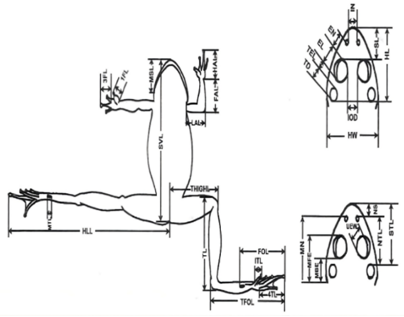
Indonesia is one of the world's megabiodiverse countries due to its tropical climate and diverse geographic landscape. One of the species widely distributed in Indonesia is Polypedates leucomystax. Imogiri Nature Reserve and Merapi Valley represent two locations with contrasting altitudes, which ultimately drive adaptive responses and cause morphometric variation among P. leucomystax populations inhabiting the two areas. The aim of this study was to analyze the morphometric variations of P. leucomystax frogs in the Imogiri Nature Reserve and Merapi Valley and also to analyze the relationship between abiotic factors and differentiated morphometric characters. Morphometric character data were tested using the Mann-Whitney test (p≤0.05), followed by the Spearman correlation test was conducted with abiotic factors. The morphometric characters that differed significantly in males were STL, NS, EN, MBE, THIGHL, and MTI, whereas in females the significant characters were NS, MFE, MBE, IOD, UEW, and 1TL. In addition, temperature, humidity and altitude also have a correlation with the differentiated characters. In male frogs, altitude correlated with the characters EN, MBE, THIGHL, MTI and temperature correlated with MBE, THIGHL, MTI, while in female frogs altitude correlated with the characters NS, MFE, MBE, IOD, UEW, 1TL and temperature correlated with NS, MFE, MBE, IOD. Then humidity correlated with UEW. The conclusion of this study is that there are 6 variations in morphometric characters in male frogs and 6 characters in female frogs found in Merapi Valley and the Imogiri Nature Reserve. Furthermore, abiotic factors are also associated with differentiated morphometric traits.
Downloads
References
Abdul Aziz, M.F., Mohd. Top, Mohd. Tah, M., Shohaimi, S., Ab Ghani, N.I., & Fletcher, C. (2021). Morphometric Study of Kalophrynus palmatissimus at Two Forest Reserves in Malaysia. Ecology and Evolution, 11 (16), 10741–10753. https://doi.org/10.1002/ece3.7721
Addaha, H., Tjong, HD, & Novarino W. (2015). Variasi Morfologi Katak Pohon Bergaris Polypedates leucomystax Gravenhorst, 1829 (Anura: Rhacophoridae) di Sumatera Barat. Journal of Natural Science, 4 (3), 348–354.
Aini, K., Hanifuddin, AS, & Suwartiningsih, N. (2022). Morphometric Variations of Chalcorana chalconota (Schlegel, 1837) in Four Populations in Jatimulyo Kulon Progo. Journal of Biotechnology and Natural Science, 2 (2), 70–76. https://doi.org/10.12928/jbns.v2i2.6965
Alhadi, F., Kaprawi, F., Hamidy, A., & Kirschey, T. (2021). Panduan Bergambar dan Identifikasi Amfibi Pulau Jawa. Perkumpulan Amfibi Reptil Sumatera.
Ashton, K. G. (2002). Do Amphibians Follow Bergmann's Rule?. Canadian Journal of Zoology, 80 (4), 708–716. https://doi.org/10.1139/z02-049
Baraquet, M., Otero Manuel, A., Grenat Raúl, P., Babini Selene, M., & Martino Ludovico, A. (2018). Effect to Age on The Geographic Variation in Morphometric Traits Among Populations of Boana cordobae (Anura: Hylidae). Biology Tropica, 66 (4), 1401–1411.
Bery, P.Y. (1975). The Amphibian Fauna of Peninsular Malaysia. Tropical Press.
Buddhachat, K., & Suwannapoom, C. (2018). Phylogenetic Relationships and Genetic Diversity of The Polypedates leucomystax Complex in Thailand. PeerJ, 1–13. https://doi.org/10.7717/peerj.4263
Castellano, S. & Giacom, C. (1998). Morphologic Variation of The Green Toad, Bufo Viridis, in Italy: A Test of Causatio. Journal of Herpetology, 32 (4), 540–550. https://doi.org/10.2307/1565208
Castro, KMSA, Amado, T.F., Olalla- Tárraga, M., Gouveia, SF, Navas, CA, & Martinez, P.A. (2021). Water Constraints Drive Allometric Patterns in The Body Shape of Tree Frogs. Scientific Reports, 11 (1218), 1–8. https://doi.org/10.1038/s41598-020-80456-1
Chahyadi, E., Titrawani, & Rauf H, W. (2016). Variasi Morfometrik Bufo Asper Gravenhorst (1829) di Kawasan Universitas Riau dan Desa Bencah Kelubi Tapung Kampar. Al-Kauniyah, 9 (2), 104–117. https://doi.org/10.15408/kauniyah.v9i2.3370
Chen, H., Qin, H., Zhao, Z., Liao, J., Wu, Y., Liu, X., Jiang, L., Dayananda, B., & Chen, W. (2023). Body Size but Not Food Size Determined Head Sexual Dimorphism in Rana kukunoris from The Tibetan Plateau. Asian Herpetological Research, 14 (2), 175–181. https://doi.org/10.3724/ahr.2095-0357.2022.0060
Dani, N, D., Kusmardiastuti, Irwanjasmoro, S., Glodias Boggy Sanjaya, E., & Eprilurahman, R. (2025). Herpetofauna Diversity in Bantul Regency, Special Region of Yogyakarta. Regional Research Journal, 25 (1), 27–38. https://doi.org/10.64730/jrdbantul.v25i1.139
Fauzan. (2019). Variasi Morfometri Fejervarya limnocharis (Gravenhorst, 1829) di Sumatera Barat. Menara Ilmu, 13 (1), 72–79. https://jurnal.umsb.ac.id/index.php/menarailmu/article/view/1405
Fauzan. (2023). Pengaruh Ketinggian Terhadap Divergensi Morfologi Katak Fejervarya limnocharis Gravenhorst (1829) di Sumatera Barat. Strofor Journal, 7 (1), 185–192. https://jurnal.umsb.ac.id/index.php/STROFOR/article/view/4421
Fauzan & Widya, N. (2022). Pengaruh Topografi Terhadap Divergensi Fenotip Katak Fejervarya cancrivora di Kabupaten Tanah Datar. Menara Ilmu, 16 (1), 25–31. https://doi.org/10.31869/mi.v16i1.3108
Fu, L., Wang, X., Yang, S., Li, C., & Hu, J. (2022). Morphological Variation and its Environmental Correlates in The Taihangshan Swelled-Vented Frog Across The Qinling Mountains. Animals, 12 (18). https://doi.org/10.3390/ani12182328
Futuyma, D. J. (1986). Evolutionary Biology. Sinauer Associates.
Gouveia, S.F., Dobrovolski, R., Lemes, P., Cassemiro, F.A.S., & Diniz-Filho, J.F. (2013). Environmental gradients, tolerance gradients, and ecogeographic rules in glass frogs (Anura: Centrolenidae). Biological Journal of the Linnean Society, 108 (4), 773–783. https://doi.org/10.1111/bij.12018
Gul, S., Dursun, C., Tabak, C., Buyuksofuoglu, S., & Ozdemir, N. (2024). Age Structure, Body Size, and Sexual Dimorphism in a High-Altitude Population of Pelophylax ridibundus (Pallas, 1771). Animals, 14 (22), 1–16. https://doi.org/10.3390/ani14223230
Hou, D., Jia, T., Ren, Y., Zhu, W., & Liu, P. (2023). Phenotypic Trait Variations in The Frog Nanorana parkeri: Differentiating Adaptive Strategies to Altitude Between Sexes. Journal of Vertebrate Biology, 72 (8), 1–11. https://doi.org/10.25225/jvb.23008
Hsu, F.H., Hsieh, YS, Wu, SH, & Kam, YC (2014). Altitudinal Variation in Body Size and Age Structure of The Sauter's Frog Rana sauteri in Taiwan. Zoological Studies, 53 (1), 1–9. https://doi.org/10.1186/s40555-014-0062-y
Idora, M., Satria, R., & Nugraha, FAD (2023). Diversity of Amphibians Using a Transect Method Implemented in Three Different Habitats. Proceedings of the 3rd International Conference on Biology, Science and Education, 231–239. https://doi.org/10.2991/978-94-6463-166-1_31
Inger, R.F., & Stuebing, R.B. (2005). A Field Guide to The Frogs of Borneo. Natural History Publications.
Inger, R.F., & Voris, H.K. (2001). The Biogeographical Relations of The Frogs and Snakes of Sundaland. Journal of Biogeography, 28 (4), 863–891. https://doi.org/10.1046/j.1365-2699.2001.00580.x
Jiang, C., Chen, C., & Liao, W. (2022). Anuran Interorbital Distance Variation: The Role of Ecological and Behavioral Factors. Integrative Zoology, 17 (5), 777–786. https://doi.org/10.1111/1749-4877.12653
Jin, L., Chen, C., & Liao, B. W. (2017). Altitudinal Variation in Body Size and Age in Male Spot-Legged Treefrog (Polypedates megacephalus). Russian Journal of Ecology, 48 (1), 476–481. https://doi.org/10.1134/S1067413617050083
Kusrini, DM (2013). Panduan Bergambar Identifikasi Amfibi Jawa Barat. Faculty of Forestry, Bogor Agricultural University and Directorate of Biodiversity Conservation.
Kuswantoro, F., Bima Atmaja, M., & Wahyu Permana, R. (2011). Diversity and Feeding Habit of Anura in Plawangan Hill, Yogyakarta After Mount Merapi Eruption 2010. Conference International Knowledge Biology Faculty Biology, Gadjah Mada University, 543–546.
Leung, K. W., Yang, S., Wang, X., Tang, K., & Hu, J. (2021). Ecogeographical Adaptation Revisited: Morphological Variations in The Plateau Brown Frog Along an Elevation Gradient on The Qinghai–Tibetan Plateau. Biology, 10 (11), 1–14. https://doi.org/10.3390/biology10111081
Li, H., Chong, C., Huijun, S., Yanjun, Z., Zhuo, C., & Xiaohong, C. (2023). Morphological Variation and Its Correlation with Bioclimatic Factors in Odorrana graminea Sense Stricto. Frontiers in Ecology and Evolution, 11 (1), 1–11. https://doi.org/10.3389/fevo.2023.1139995
Liao, W.B., Lu, X., Shen, Y.W., & Hu, J.C. (2011). Age Structure and Body Size of Two Populations of The Rice Frog Rana limnocharis from Different Altitudes. Italian Journal of Zoology, 78 (2), 215–221. https://doi.org/10.1080/11250001003639590
Liu, X., Chen, H., Wu, Y., Xiong, H., Liu, S., Ling, H., & Chen, W. (2025). Altitudinal Variation of Limb Size of a High-Altitude Frog. Diversity, 17 (2), 1–9. https://doi.org/10.3390/d17020080
Liu, Zeng, Y., Liao, B.W., Zhou, Q.C., Mi, P. Zh., Mao, M., & Chen, L. (2012). Altitudinal Variation in Body Size in The Rice Frog (Rana limnocharis) in Southwestern China. Acta Herpelogica, 7 (1), 57–68. https://doi.org/10.13128/Acta_Herpetol-9128
Ma, X., Lu, X., & Merila, J. (2009). Altitudinal Decline of Body Size in A Tibetan Frog. Journal of Zoology, 279 (1), 364–371. https://doi.org/10.1111/j.1469-7998.2009.00627.x
Miguel Á, O.-T., & Miguel Á, R. (2007). Energy and Interspecific Body Size Patterns of Amphibian Faunas in Europe and North America: Anurans Follow Bergmann's Rule, Urodeles Its Converse. Global Ecology and Biogeography, 16 (5), 606–617. https://doi.org/10.1111/j.1466-8238.2007.00309.x
Mustofa, I., Ali, NR, & Pamungkas, TK (2021). Panduan Lapangan: Herpetofauna (Amfibi & Reptil) di Kawasan Ekowisata Desa Jatimulyo. Yayasan KEHATI.
Nazarudin, & Sumarni, S. (2024). Keanekaragaman Jenis Herpetofauna pada Kawasan Lindung Bukit Rentap Kabupaten Sintang. Piper, 20 (1). https://doi.org/10.51826/piper.v20i1.1101
Nesty, R., Tjong, D.H., & Heny, H. (2013). Variasi Morfometrik Kodok Duttaphrynus melanostictus (Schneider, 1799) (Anura: Bufonidae) di Sumatera Barat yang Dipisahkan oleh Bukit Barisan. Journal Biology of Andalas University, 2 (1), 38–42.
Pabontongan, S.S., Palloan, P., & Susanto, A. (2024). Analisis Hubungan Suhu, Kelembapan dan Curah Hujan di Tanah Toraja dengan Fenomena Perubahan Iklim. Journal Physics Unand, 13 (4), 557–563. https://doi.org/10.25077/jfu.13.4.557-563.2024
Peng, X., Kang, D., Chen, G., Hu, S., Sun, Z., & Zhao, T. (2025). Intraspecific Variations in Ecomorphological Functional Traits of Montane Stream-Dwelling Frogs Were Driven by Their Microhabitat Conditions. Animals, 15 (15), 1–12. https://doi.org/10.3390/ani15152243
Pramesti, GE, & Suwartiningsih, N. (2025). Morphometric and Genetic Variations of The Poison Frog (Odorrana hosii Boulenger 1891) in Jatimulyo, Kulon Progo, Yogyakarta Using Microsatellite Markers. BIO Web of Conferences, 148, 1–9. https://doi.org/10.1051/bioconf/202414801022
Pranata, AD, Hadi, I., & Syaputra, M. (2023). Pengukuran Morfometrik Pada Amfibi (Ordo Anura) Di Perbatasan (Terluar) Blok Pemanfaatan Taman Wisata Alam Danau Rawa Taliwang. Goldscience, 12 (1), 29–40. https://doi.org/10.5281/zenodo.7861136
Primiani, NC (2021). Keragaman Katak dan Reptil Lokal. Unipma Press.
Riddell, EA, Burger, IJ, Muñoz, MM, Weaver, SJ, & Womack, MC (2024). Amphibians Exhibit Extremely High Hydraulic Costs of Respiration. Symposium "Feel the Flow: How Water Movement Shapes Organisms and Ecosystems," 64 (2), 366–376. https://doi.org/10.1093/icb/icae053
Riyanto, A., Mumpuni, & McGuire A, J. (2011). Morphometry of Striped Tree Frogs, Polypedates leucomystax (Gravenhorst, 1829) from Indonesia with Description of a New Species. Russian Journal of Herpetology, 18 (1), 29–35. http://rjh.folium.ru/index.php/rjh/article/view/4
Simon, N., Top, M.M., Hamzah, M.Z., Aziz, N.A.A., Alias, M.A., Awang, M.R., Ibrahim, Z., Majid, A.F.A., Salleh, M.S.A., & Anuar, A. (2022). Microhabitat and Microclimate Preferences of Anuran Species Inhabiting Restoration and Adjacent Forest of Cameron Highlands, Pahang Darul Makmur, Malaysia. Sains Malaysiana, 51 (6), 1635–1651. https://doi.org/10.17576/jsm-2022-5106-03
Sun, J., Lin, H., Li, H., & Hu, J. (2025). Morphological Variation in Sichuan Spiny Frogs Along Geographic and Environmental Gradients. Asian Herpetological Research, 16 (1), 66–74. https://doi.org/10.3724/ahr.2095-0357.2024.0028
Tarkhnishvili, DN, Arntzen, WJ, & Thorpe S, Ro. (1999). Morphological Variation in Brown Frogs from The Caucasus & The Taxonomy of The Rana macrocnemis Group. Herpetologica, 55 (3), 406–417. www.jstor.org/stable/3893235
Thomas, KN, Gower, DJ, Bell, RC, Fujita, MK, Schott, RK, & Streicher, JW (2020). Eye Size and Investment in Frogs and Toads Correlate with Adult Habitat, Activity Pattern and Breeding Ecology. Biological Sciences, 287 (1935), 30–45. https://doi.org/10.1098/rspb.2020.1393
Trochet, A., Deluen, M., Bertrand, R., Calvez, O., Silvestre, M.A., Foz, VI, Torres, M.M., Souchet, J., Darnet, E., Chevalier, L.H., Guillaume, O., & Aubret, F. (2019). Body Size Increases with Elevation in Pyrenean Newts (Calotriton asper). Herpetologica, 75 (1), 30–37. https://doi.org/10.1655/D-18-00011
Wea, F., Marleni, MEP, & Fadlan, P. (2024). Keanekaragaman Jenis Amfibi Berdasarkan Ketinggian di Hutan Lindung Fatumnasi. Journal of Scientech Research and Development, 6 (1), 1302–1311. https://doi.org/10.56670/jsrd.v6i1.435
Wibowo, A., Tri, M., Makmur, S., & Subagja, D. (2006). Identifikasi Struktur Stok Ikan Belida (Chitala spp.) dan Implikasinya ntuk Manajemen Populasi Alami. Journal Study Indonesian Fisheries, 14 (1), 31–42. https://doi.org/10.15578/jppi.14.1.2008.31-45
Zhang, K., Qiu, D., Zhao, L., Yan, C., Jin, L., & Liao, W. (2023). Geographical Variation in Body Size in the Asian Common Toad (Duttaphrynus melanostictus). Life, 13 (11). https://doi.org/10.3390/life13112219
Additional Files
Submitted
Accepted
Published
How to Cite
Issue
Section
License
Copyright (c) 2026 Bioeksperimen: Jurnal Penelitian Biologi

This work is licensed under a Creative Commons Attribution-NonCommercial 4.0 International License.