Colonization of Streptomyces enissocaesilis on the root system of Zea mays var ceratina
DOI:
https://doi.org/10.23917/bioeksperimen.v12i2.17484Keywords:
Metabolites, plant growth, root colonization, Streptomyces enissocaesilis, Zea mays var. ceratinaAbstract
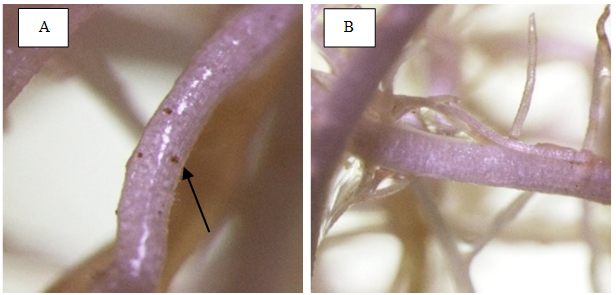
Streptomyces enissocaesilis is a microorganism with diverse biological activities; it is capable of colonizing plant root systems by forming mycelium and adhering to root surfaces.. This study aimed to analyze the colonization of Streptomyces enissocaesilis in the root system of Zea mays var ceratina based on root infection ability, metabolite profiles in growth media, and plant vegetative growth. Zea mays var ceratina was grown hydroponically using the Deep Flow Technique (DFT) for 30 days with inoculation (1.1 × 10⁸ CFU/g) and without inoculation of Streptomyces enissocaesilis as a control. Plant growth was monitored at 7-day intervals, while infectivity and metabolite profiles were assessed at the end of the growth period; metabolite screening in the growth medium was performed using LC-MS.The results showed that Streptomyces enissocaesilis was able to infect plant root tissue, as well as interact on the root surface, as indicated by filamentous structures resembling hyphae on the epidermis of treated plant roots. Analysis of the metabolite profile in growth media inoculated with Streptomyces enissocaesilis using LC-MS revealed peaks detected at retention times of 0.72 and 1.18 minutes. Inoculation of Streptomyces enissocaesilis during the vegetative growth of Zea mays var ceratina, based on plant height and root length data, showed significantly higher values compared to the control; however, no significant differences were observed for the parameters of leaf number, dry weight, and root-to-shoot ratio. Based on these data, inoculation with Streptomyces enissocaesilis has the potential to function as a Plant Growth Promoting Rhizobacteria (PGPR). Based on the research findings, Streptomyces enissocaesilis has the potential to be developed as a plant growth promoter. However, its effectiveness in increasing biomass and overall plant growth still requires further study.
Downloads
References
Arinong, A. R., Nispasari, N., Wahab, A., & Nurcholis, J. (2021). Aplikasi Plant Growth Promoting Rhizobacteria (PGPR) Akar Tumbuhan Putri Malu Terhadap Pertumbuhan Dan Produksi Tanaman Kacang Panjang (Vigna sinensis L.): The Application of Plant Growth Promoting Rhizobacteria (PGPR) of Sensitive Plant Root Toward The Growth and Production of Long Bean (Vigna sinensis L.). Jurnal Agrisistem, 17(1), 10-18.https://doi.org/10.52625/j-agr.v17i1.187
Baltz, R. H. (2016). Genetic manipulation of secondary metabolite biosynthesis for improved production in Streptomyces and other actinomycetes. Journal of Industrial Microbiology and Biotechnology, 43(2-3), 343-370. https://doi.org/10.1007/s10295-015-1682-x
Bashan, Y., & de-Bashan, L. E. (2010). How the plant growth-promoting bacterium Azospirillum promotes plant growth—a critical assessment. Advances in agronomy, 108, 77-136. http://doi.org/10.1016/s0065-2113(10)08002-8
Chauhan, P., Sharma, N., Tapwal, A., Kumar, A., Verma, G. S., Meena, M., ... & Swapnil, P. (2023). Soil microbiome: diversity, benefits and interactions with plants. Sustainability, 15(19), 14643. https://doi.org/10.3390/su151914643
Compant, S., Cassan, F., Kostić, T., Johnson, L., Brader, G., Trognitz, F., & Sessitsch, A. (2025). Harnessing the plant microbiome for sustainable crop production. Nature Reviews Microbiology, 23(1), 9-23.
Ding, T., Yang, L. J., Zhang, W. D., & Shen, Y. H. (2019). The secondary metabolites of rare actinomycetes: chemistry and bioactivity. RSC advances, 9(38), 21964-21988. http://doi.org/10.1039/c9ra03579f
El-Akshar, E. A., Elmeihy, R. M., Tewfike, T. A., & Abou-Aly, H. E. 2022. Endophytic Streptomyces enissocaesilis as a nematicidal and biostimulant agent. Egyptian Academic Journal of Biological Sciences, 14(2), 123–133. https://doi.org/10.21608/eajbsg.2022.262580
Glick, B. R. (2012). Plant growth‐promoting bacteria: mechanisms and applications. Scientifica, 2012(1), 963401. http://doi.org/10.6064/2012/963401
Haldar, S., & Sengupta, S. (2015). Plant-microbe cross-talk in the rhizosphere: insight and biotechnological potential. The open microbiology journal, 9, 1.10.2174/1874285801509010001
Jog, R., Pandya, M., Nareshkumar, G., & Rajkumar, S. 2014. Mechanism of phosphate solubilization and antifungal activity of Streptomyces spp. isolated from wheat roots and rhizosphere and their application in improving plant growth. Microbiology, 160(4), 778-788. http://doi.org/10.1099/mic.0.074146-0
Kandowangko, N. Y. 2019. Solutions to Corn Drought (Utilization of Azospirillum Microorganisms and Arbuscular Mycorrhizae). Ideas Publishing.
Lamuka, A. P., Retnowati, Y., Katili, A. S., Kandowangko, N. Y., & Uno, W. D. (2025). Phosphate Soluting Actinomycetes in the Rhizosfer of Corn (Zea mays) in Gorontalo. MIKHAYLA: Journal of Advanced Research, 2(1), 1-10. https://doi.org/10.61579/mikhayla.v2i1.282
Lanti, S., Retnowati, Y., Kandowangko, N. Y., Hasan, A. M., & Katili, A. S. 2025. Micromonospora Sp. Viability Test from the Rhizosphere of Plants in the Gorontalo Karst Ecosystem on Rice Growth Medium. MIKHAYLA: Journal of Advanced Research, 2(1), 29–34. http://doi.org/10.61579/mikhayla.v2i1.289
Liu, Y., et al. 2024. Root colonization by beneficial rhizobacteria. FEMS Microbiology Reviews, 48(1), fuad066. http://doi.org/10.1093/femsre/fuad066
Muslim, I. A., & Suwandi, I. (2023). PENGENDALIAN HAYATI PATOGEN TANAMAN DENGAN MIKROORGANISME ANTAGONIS EDISI REVISI I.
Poorter, H., Niklas, K. J., Reich, P. B., Oleksyn, J., Poot, P., & Mommer, L. 2012. Biomass allocation to leaves, stems and roots: meta‐analyses of interspecific variation and environmental control. New phytologist, 193(1), 30-50.
Prudence, S., Addington, E., Castaño-Espriu, L., Mark, D., Pintor-Escobar, L., Russell, A., … & McLean, T. 2020. Advances in actinomycete research: an actinobase review of 2019. Microbiology, 166(8), 683-694. http://doi.org/10.1099/mic.0.000944
Rampersad, S. N. 2020. Pathogenomics and management of Fusarium diseases in plants. Pathogens, 9(5), 340. http://doi.org/10.3390/pathogens9050340
Retnowati, Y., Kandowangko, N. Y., Katili, A. S., & Pembengo, W. 2024. Diversity of actinomycetes on plant rhizosphere of karst ecosystem of Gorontalo, Indonesia. Biodiversitas Journal of Biological Diversity, 25(3). http://doi.org/10.13057/biodiv/d250301
Ríos-Ruiz, W. F., Casique-Huamanguli, R. D., Valdez-Nuñez, R. A., Rojas-García, J. C., Calixto-García, A. R., Ríos-Reátegui, F., … & Padilla-Santa-Cruz, E. 2024. Rhizospheric bacteria of cover legumes from acidic soils are capable of solubilizing different inorganic phosphates. Microorganisms, 12(6), 1101. https://doi.org/10.3390/microorganisms12061101
Seepe, H. A., Nxumalo, W., & Amoo, S. O. 2021. Natural products from medicinal plants against phytopathogenic Fusarium species: Current research endeavours, challenges and prospects. Molecules, 26(21), 6539.https://doi.org/10.3390/molecules26216539
Taiz, L., Zeiger, E., Møller, I., & Murphy, A. 2015. Plant physiology and development 6th ed Sinauer Associates Sunderland. MA, USA.
Theowidavitya, B., Muttaqin, M., & Tjahjoleksono, A. 2019. Metabolomic Analysis of the Interaction Between Rice and Bacteria. Journal of Biological Resources, 5(1), 18–24. https://doi.org/10.29244/jsdh.5.1.18-24
Toma, T., Kováč, J., & Ďurkovič, J. 2024. Fast, Easy, and Comprehensive Techniques for Microscopic Observations of Fungal and Oomycete Organisms Inside the Roots of Herbaceous and Woody Plants. Bio-protocol, 14(11), e5013. DOI:https://doi.org/10.21769/BioProtoc.5013
Ullah, S., Muhammad, Z., Jehan, S., Zia, S., Hussain, Z., Hussain, S., … & Ullah, H. 2021. Soil actinomycetes molecular characterization for secondary metabolites production. Journal of Advanced Biomedical and Pharmaceutical Sciences, 0(0), 40-44. https://doi.org/10.21608/jabps.2021.98256.1141
Van Der Heul, H. U., Bilyk, B. L., McDowall, K. J., Seipke, R. F., & Van Wezel, G. P. 2018. Regulation of antibiotic production in Actinobacteria: new perspectives from the post-genomic era. Natural product reports, 35(6), 575-604.
Viana, W., Scharwies, J. D., & Dinneny, J. R. 2022. Deconstructing the root system of grasses through an exploration of development, anatomy and function. Plant, Cell & Environment, 45(3), 602-619. https://doi.org/10.1111/pce.14270
Viaene, T., Langendries, S., Beirinckx, S., Maes, M., & Goormachtig, S. (2016). Streptomyces as a plant's best friend?. FEMS microbiology ecology, 92(8), fiw119. https://doi.org/10.1093/femsec/fiw119
Vurukonda, S. S. K. P., Giovanardi, D., & Stefani, E. 2018. Plant growth promoting and biocontrol activity of Streptomyces spp. as endophytes. International journal of molecular sciences, 19(4), 952.
Widiantini, F., Syahnur, F., Hidayat, Y., & Yulia, E. 2024. Isolation of Potential Nitrogen-Fixing Phylloplane Bacteria and in Vitro Detection of Their Ability to Inhibit the Growth of Colletotrichum. Jurnal Fitopatologi Indonesia, 20(1), 34-46.
Widyati, E. (2013). Memahami interaksi tanaman–mikroba. Tekno Hutan Tanaman, 6(1), 13-20.
Xie, S., Jiang, L., Wu, Q., Wan, W., Gan, Y., Zhao, L., & Wen, J. 2022. Maize root exudates recruit Bacillus amyloliquefaciens OR2-30 to inhibit Fusarium graminearum infection. Phytopathology®, 112(9), 1886-1893. http://doi.org/10.1094/PHYTO-01-22-0028-R
Additional Files
Submitted
Accepted
Published
How to Cite
Issue
Section
License
Copyright (c) 2026 Bioeksperimen: Jurnal Penelitian Biologi

This work is licensed under a Creative Commons Attribution-NonCommercial 4.0 International License.