Effect of topical collagen extract ointment from Oreochromis niloticus L. scales on incision wound healing in Mus musculus L.
DOI:
https://doi.org/10.23917/bioeksperimen.v12i2.16418Keywords:
Collagen, Ointment, Tilapia, Tilapia scales, Wound healingAbstract
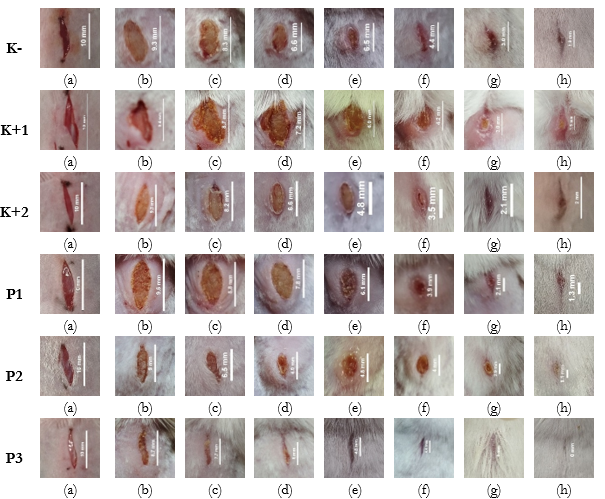
Nile tilapia (Oreochromis niloticus L.) ranks among Indonesia’s most heavily farmed freshwater fish, and the scales discarded during its processing are a rich, underused source of type I collagen, a structural protein of the extracellular matrix that supports skin repair and could serve as a natural ingredient in wound-care ointments. This study evaluated the physical properties of an ointment formulated with tilapia scale collagen extract and examined its effect on incision wound healing in mice (Mus musculus L.). Six groups were compared: K- (untreated), K+1 (bioplacenton), K+2 (ointment base only), and three collagen-ointment concentrations, P1 (5%), P2 (10%), and P3 (15%). Collagen was isolated by the acid-soluble collagen (ASC) method and characterized by Fourier-transform infrared (FTIR) spectroscopy; wound closure, tissue protein content (Lowry method), and hydroxyproline content were assessed over 14 days. All three ointment formulations met the general pharmaceutical standards for topical preparations. Wounds in every group closed gradually, reaching a mean closure of 87.4-98.2% by day 14 without a statistically significant difference among treatments, whereas protein and hydroxyproline assays showed that the 15% collagen ointment produced the lowest tissue protein (397.0 ± 8.55 μg/mL) and hydroxyproline (82.05 ± 4.45 μg/mL) levels, consistent with an accelerated transition into the tissue remodeling phase.
Downloads
References
Abdullah. D. (2022). Penyembuhan Luka Sayat pada Mencit Melalui Pemberian Gel Kefir. Indramayu: Penerbit Adab.
Alberts. A.. Bratu. A. G.. Niculescu. A.-G.. & Grumezescu. A. M. (2025). Collagen-Based Wound Dressings: Innovations. Mechanisms. and Clinical Applications. Gels. 11(4): 271. https://doi.org/10.3390/gels11040271
Afriani. Y.. Rahayu. R.. & Santoso. P. (2024). Black Soldier Fly (Hermetia illucens L.) Larvae Oil Oinment to Accelerate Incision Wound Healing in Mice. Jurnal Biologi Tropis. 24(3): 292-297.
http://doi.org/10.29303/jbt.v24i3.7272
Agustina. S. S. (2015). Isolasi Kitin. Karakterisasi. dan Sintesis Kitosan dari Kulit Udang. Jurnal Kimia. 9(2): 271-278. https://doi.org/10.24843/JCHEM.2015.v09.i02.p19
Anggraeni. F. (2023). Gambaran Penyembuhan Luka Pada Pasien Pasca SC di Poli Kandungan RS Sahabat Sukorejo Kabupaten Pasuruan (Skripsi). Universitas Bina Sehat PPNI.
Baydogan. B.. Kucuk. A.. Kozan. B.. Erdal. M.. Abas. B. I.. & Cevik. O. (2023). Hydrogels Made With Tilapia Fish Skin Increase Collagen Production And Affect MMP-2/MMP-9 Enzymes In Burn Treatment. Biochem. 5(2): 1-16. https://doi.org/10.3390/biochem5020008
Cahya. E. R. P.. Ekowati. D.. & Ningsih. D. (2022). Formulating Oil Emulgel of Nyamplung (Calophyllum inophyllum L.) with Variations of HPMC and Activity Testing for Incision in Rabbit New Zealand. Indonesian Journal of Pharmaceutical Education. 2(3): 161-175. https://doi.org/10.37311/ijpe.v2i3.15455
Ding. P.. Sun. Y.. Jiang. G.. & Nie. L. (2025). Hydroxyproline-Modified Chitosan-Based Hydrogel Dressing Incorporated with Epigallocatechin-3-Gallate Promotes Wound Healing Through Immunomodulation. Gels. 11(9): 1-22. https://doi.org/10.3390/gels11090732
Dira. M. A.. Sari. D. P.. & Sari. R. P. (2018). Pengaruh Pemberian Alfa Mangostin Terhadap Kadar Hidroksiprolin Pada Hari Ke-10 Sesudah Luka Pada Tikus Putih Jantan. Jurnal Ilmiah Mahasiswa Fakultas Kedokteran Universitas Andalas. 7(4): 1–8. DOI:10.36434/scientia.v8i1.143
Dondero. L.. De Negri Atanasio. G.. Lertora. E.. Tardanico. F.. Demori. I.. Storace. P.. Allaria. G.. Rispo. F.. Robino. F.. Perata. E.. Zanotti-Russo. M.. Ferrando. S.. & Grasselli. E. (2025). Effects of a single application of hydrolyzed fish collagen on dermal protein expression and tissue architecture in human skin models. Scientific Reports. 15: 11372. https://doi.org/10.1038/s41598-025-11372-5
Geahchan. S.. Baharlouei. P.. & Rahman. A. (2022). Marine Collagen: A Promising Biomaterial for Wound Healing. Skin Anti-Aging. and Bone Regeneration. Marine drugs. 20(61): 1-16. https://doi.org/10.3390/md20010061
Gehrig. K. A.. & Warshaw. E. M. (2008). Allergic contact dermatitis to topical antibiotics: Epidemiology. responsible allergens. and management. Journal of the American Academy of Dermatology. 58(1): 1-21. https://doi.org/10.1016/j.jaad.2007.07.050
Gupta. R.. Garg. A.. Sharma. P.. & Pandey. P. (2016). Wound Healing and Antioxidant Effect of Calliandra haemotocephala Leaves on Incision and Excision Wound Models. Asian Journal of Pharmacy and Pharmacology. 2(2): 34 – 39.
Meyers. D. S. M.. Andrade. T. A. M.. Caetano. G. F.. Guimaraes. F. R.. Leite. M. N.. Leite. S. N.. & Frade. M. A. C. (2020). Experimental Models and Methods For Cutaneous Wound Healing. International journal of experimental pathology. 101(1):21–37. https://doi.org/10.1111/iep.12346
Hadiyantama. H.. Agustini. L.. Sujipto. Komaratih. E.. Zuhria. I.. Lestari. P.. & Ridholia. (2024). The Role of α-SMA. Type 1 Collagen. and Myofibroblasts in Cicatrizing Conjunctivitis by Alkali Chemical Trauma. Pharmacognosy Journal. 16(3): 591-596. https://doi.org/10.5530/pj.2024.16.92
Jafari. H.. Lista. A.. Siekapen. M. M.. Ghaffari-Bohlouli. P.. Nie. L.. Alimoradi. H.. & Shavandi. A. (2020). Fish collagen: Extraction. characterization. and applications for biomaterials engineering. Polymers. 12(10): 2230.
Kementerian Kelautan dan Perikanan (KKP). (2023). Produksi Perikanan Kelautan dan Perikanan. Jakarta: Direktorat Usaha dan Investasi Kementerian Kelautan dan Perikanan.
Kementerian Kesehatan Republik Indonesia (Kemenkes RI). (1979). Farmakope Jilid 3. Jakarta: Kementerian Kesehatan Republik Indonesia.
Latifah. S. L.. Pudjono. & Rosmi. R. F. (2022). Formulasi dan Evaluasi Mutu Fisik Sediaan Body Scrub Cream Varietas Ubi Jalar dalam Fase Air dan Minyak. Pharmacy Peradaban Journal. 2(1): 20-32. e-ISSN: 2776-6241.
Mahmoud. A. R. H.. Taha. N. M.. Mohamed. E. H.. & Abdelgayed. M. H. (2024). Factors Affecting Wound Healing Post Major Surgeries in Inensive Care Units. Cuest. Fisioter. 53(3): 6295-6308. 10.48047/jocaaa.2024.33.06.131
Mardiansyah. F.. Andrie. M.. & Taurina. W. (2024). Formulasi Sediaan Salep Kombinasi Fase Ekstrak Ikan Gabus (Channa striata) dan Madu Kelulut (Heterotrigona itama) Menggunakan Butil Hidroksil Toluen dan Vitamin C Sebagai Antioksidan. Journal Pharmacy of Tanjungpura. 2(1): 1-15. https://jurnal.untan.ac.id/index.php/JPOP
Mberato. S. P.. Rumengan. I. F. M.. Warouw. V.. Wulur. S.. Rumampuk. N. D. T.. Undap. S. L.. Suptijah. P.. & Luntungan. A. H. (2020). Penentuan Struktur Molekul Kolagen Sisik Ikan Kakatua (Scarus sp) Berdasarkan Serapan Molekul Terhadap Gelombang FTIR (Fourier-Transform Infrared Spectroscopy Analysis). Jurnal Pesisir dan Laut Tropis. 8(1): 7-14. https://doi.org/10.35800/jplt.8.1.2020.27285
Mufidah. A.. Rahayu. W. S.. & Utami. P. I. (2024). Narrative review: Extraction and characterization of collagen from various fish species. Pharmacon: Jurnal Farmasi Indonesia. 21(2): 198-205. https://doi.org/10.23917/pharmacon.v21i2.5391
Nugroho. R. T.. Saputra. G.. Aini. A. N.. Dewia. A. A.. & Tarigan. I. L. (2022). Ointment Formulation from Collagen Extract of Tilapia Fish Skin (Oreochromis niloticus) for Healing Burns in Mus musculus. Pharmaceutical Journal of Indonesia. 8(1): 9-15. https://doi.org/10.21776/ub.pji.2022.008.01.2
Oslan. S. N. H.. Li. C. X.. Shapawi. R.. Mokhtar. R. A. M.. Noordin. W. N. M.. & Huda. N. (2022). Extraction and Characterization of Bioactive Fish By-Product Collagen as Promising for Potential Wound Healing Agent in Pharmaceutical Applications: Current Trend and Future Perspective. Internasional Journal of Food Science. 2022(2): 1-10. https://doi.org/10.1155/2022/9437878
Paudi. R.. Sulistijowati. R.. & Mile. L. (2020). Rendemen Kolagen Kulit Ikan Bandeng (Chanos chanos) Segar Hasil Ekstraksi Asam Asetat. Jambura Fish Processing Journal. 2(1): 21-27. https://doi.org/10.37905/nj.v10i2.21036
Pei. M. (2020). Biocompatibility of synthetic dressings. Journal of Biomaterials Applications. 34(3): 439-451.
Plum. M.. Beier. J. P.. & Ruhi. T. (2025) Delayed Cutaneous Wound Healing in Young and Old Female Mice Is Associated with Differential Growth Factor Release but not Inflammatory Cytokine Secretion. Biogerontology. 16(1): 37-50. https://doi.org/10.1007/s10522-024-10179-7
Ramdhani. G.. & Ariani. A. (2016). Pengambilan Kolagen Pada Sisik Ikan Dari Limbah Pabrik Fillet Ikan Menggunakan Metode Ekstraksi Asam (Skripsi). Institut Teknologi Sepuluh Nopember.
Rodrigues. M.. Kosaric. N.. Bonham. C. A.. & Gurtner. G. C. (2019). Wound healing: A cellular perspective. Physiological Reviews. 99(1): 665-706. https://doi.org/10.1152/physrev.00067.2017
Romadhon. Darmanto. Y. S.. & Kurniasih. R. A. (2019). Karakteristik Kolagen dari Tulang. Kulit. dan Sisik Ikan Nila. Jurnal Pengelolahan Hasil Perikanan Indonesia. 22(2): 403-410. https://ejournal.unsrat.ac.id/index.php/JPKT/index
Safithri. M.. Tarman. K.. Suptijah. P.. & Widowati. N. (2019). Karakteristik fisikokimia kolagen larut asam dari kulit ikan parang-parang (Chirocentrus dorab). Jurnal Pengolahan Hasil Perikanan Indonesia. 22(3): 441-452. https://doi.org/10.17844/jphpi.v22i3.28924
Tambun. R.. Limbong. H. P.. Pinem. C.. & Manurung. E. (2016). Pengaruh ukuran partikel. waktu dan suhu pada ekstraksi fenol dari lengkuas merah. Jurnal Teknik Kimia USU. 5(4): 53-56.
Susanto. Y.. Solehah. F. A.. Fadya. A.. & Khaerani. K. (2023). Potensi Kombinasi Ekstrak Rimpang Kunyit (Curcuma longa L.) dan Kapur Sirih Sebagai Anti Inflamasi dan Penyembuhan Luka Sayat. Journal of Pharmaceutical Science and Clinical Research. 8(1): 32-45. DOI: 10.20961/jpscr.v8i1.60314
Utami. J. P.. Wasiaturrahmah. Y.. Carabelly. A. N.. Aspriyanto. D.. Nahzi. Y. I.. Arfin. R.. Ramadhaniyah. N.. & Jatmiko. H. N. (2025). Investigasi Farmakologis Aktivitas Penyembuhan Luka Mulut Gel Ekstrak Akar Stachytarpheta jamaicensis pada Tikus Wistar. Jurnal Bioteknologi & Biosains Indonesia. 12(1): 85-95. https://doi.org/10.55981/jbbi.2025.9390
Wahid. H.. Karim. S. F.. & Sari. N. (2022). Formulasi Sediaan Krim Anti-aging dari Ekstrak Kolagen Limbah Sisik Ikan Bandeng (Chanos chanos). Jurnal Sains dan Kesehatan. 4(4): 428-436. DOI:10.25026/jsk.v4i4.1289
Wahyuni. W.. Wahid. H.. & Febriani. R. (2022). Formulasi Krim Ekstrak Etanol Tangkai Daun Talas (Colocasia esculanta L.) Terhadap Luka Sayat Pada Tikus Putih (Rattus norvegicus) Galur Wistar. Jurnal Kesehatan Tambusai. 3(3): 338-347. DOI:10.31004/jkt.v3i3.5721
Wati. M. (2024). Nanopartikel Perak (AgNPs) yang Disintesis dari Ekstrak Umbi Sarang Semut (Myrmecodia sp. Jack) sebagai Bahan Salep Untuk Penutupan Luka Sayat Pada Mencit (Skripsi). Universitas Mulawarman.
Yampolsky. M.. Bachelet. I.. & Fuchs. Y. (2024). Reproducible Strategy for Excisional Skin Wound Healing Studies in Mice. Nature protocol. 19(1): 184-206. https://doi.org/10.1038/s41596-023-00899-4
Zaelani. B.. Safitri. M.. Tarman. K.. Setyaningsih. I.. & Meyda. (2019). Collagen Isolation with Acid Soluble Method from the Skin of Red Snapper (lutjanus sp.). IOP Conference series: Earth and Enviromental Science. 241(2019): 1-9. DOI: 10.1088/1755-1315/241/1/012033
Additional Files
Submitted
Accepted
Published
How to Cite
Issue
Section
License
Copyright (c) 2026 Bioeksperimen: Jurnal Penelitian Biologi

This work is licensed under a Creative Commons Attribution-NonCommercial 4.0 International License.