Effect of chicken feet collagen ointment (Gallus gallus domesticus L.) on incision wound healing in mice (Mus musculus L.)
DOI:
https://doi.org/10.23917/bioeksperimen.v12i2.16402Keywords:
ASC, hydroxyproline, collagen, incision wound healing, protein concentrationAbstract
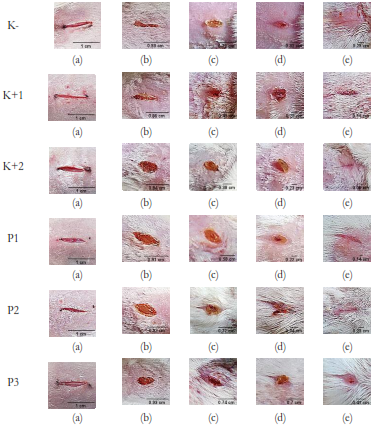
Chicken feet (Gallus gallus domesticus L.) are a by-product of a chicken slaughterhouse that has the potential to be a source of collagen for wound healing therapy. Collagen plays an important role in skin tissue regeneration, protein synthesis, and connective tissue formation during the healing process. This study aimed to characterize chicken feet collagen using Fourier Transform Infrared (FTIR), evaluate the physicochemical properties of collagen ointment preparations, and analyze their effect on the percentage of incision wound closure, protein levels, and hydroxyproline in mice (Mus musculus L.). The study was conducted as a laboratory experiment with a complete randomized design, including negative controls, two positive controls, and three groups of collagen ointment at concentrations of 5%, 10%, and 15%. Collagen is extracted using the Acid Soluble Collagen (ASC) method and is formulated in the form of an ointment. FTIR characterization shows the presence of amide groups A, B, I, II, and III as characteristic of collagen. The ointment preparation meets physical and chemical requirements, including homogeneity, semi-solid consistency, and pH according to the skin. Collagen ointment increased the percentage of incision wound closure across all groups without a significant difference among treatments. Tissue protein levels declined progressively from the untreated control through the treated groups, reaching the lowest value at the 5% concentration (P1). Hydroxyproline levels, by contrast, did not follow a uniform pattern: the 5% ointment (P1) showed hydroxyproline levels comparable to the positive controls, whereas the 10% and 15% ointments (P2, P3) showed hydroxyproline levels comparable to the untreated negative control, suggesting that healing in the P2 and P3 groups remained in an active, collagen-synthesizing phase at the time of sampling. These results suggest that chicken feet collagen has the potential to be an active ingredient in topical preparations to support the healing of incision wounds.
Downloads
References
Ahmed, R., Haq, M., & Chun, B. S. (2019). Characterization of marine derived collagen extracted from the by-products of bigeye tuna (Thunnus obesus). International Journal of Biological Macromolecules, 135, 668–676. https://doi.org/10.1016/j.ijbiomac.2019.05.213
AL-Zubaidy, Z. F. K., & Naqi, M. T. (2022). Effect lanolin extract and vaseline with glycerine mixture totreatment by affecting of il-4 and il-13 level in induced eczema in rats. International Journal of Health Sciences, 6(2), 1606–1612. https://doi.org/10.53730/ijhs.v6nS2.5148
Amfotis, M. L., Made, N., Suarni, R., & Arpiwi, N. L. (2022). Wound healing of cuts in the skin of white rat (Rattus norvegicus) is given kirinyuh (Chromolaena odorata) leaf extract. Journal of Biological Sciences, 9(1), 139–151. 10.24843/metamorfosa.2022.v09.i01.p14.
Araújo, Í. B. D. S., Bezerra, T. K. A., Nascimento, E. S. D., Gadelha, C. A. D. A., Santi-Gadelha, T., & Madruga, M. S. (2018). Optimal conditions for obtaining collagen from chicken and its characterization. Food Science and Technology, 38(1), 167–173. https://doi.org/10.1590/fst.27517
Atianingsih, E. D. (2021). The difference in the dose of broiler chicken crest collagen gel is 5%, 10%, and 15% compared to the wound healing time in rabbits. Thesis. Harapan Polytechnic Bersama Tegal.
Evans, B. S. (2020). Effectiveness of edamame membrane on serial hydroxyproline levels in the healing of IIB degree burns. Thesis. Jember: Faculty of Medicine, University of Jember.
Felician, F. F., Yu, R. H., Li, M. Z., Li, C. J., Chen, H. Q., Jiang, Y., Tang, T., Qi, W. Y., & Xu, H. M. (2019). The wound healing potential of collagen peptides derived from the jellyfish (Rhopilema esculentum). Chinese Journal of Traumatology, 22(1), 12 – 20. https://doi.org/10.1016/j.cjtee.2018.10.004
Gonzalez, A. C. D. O., Costa, T. F., Andrade, Z. D. A., & Medrado, A. R. A. P. (2016). Wound healing: a literature review. Anais Brasileiros de Dermatologia, 91(5), 614–620. https://doi.org/10.1590/abd1806-4841.20164741
Gouletsou, P. G., Zacharopoulou, T., Skampardonis, V., Georgiou, S. G., Doukas, D., Galatos, A. D., Flouraki, E., Dermisiadou, E., Margeti, C., Barbagianni, M., Sideri, A., & Tsioli, V. (2024). First-intention incisional wound healing in dogs and cats: a controlled trial of dermapliq and manuka honey. Veterinary Sciences, 11(64), 1–35. https://doi.org/10.3390/vetsci11020064
Gupta, R., Garg, A., Sharma, P., & Pandey, P. (2016). Wound healing and antioxidant effect of Calliandra haemotocephala leaves on incision and excision wound models. Asian Journal of Pharmacy and Pharmacology, 2(2), 34–39.
Jensen, M. B., Isufi, D., Larsen, C. K., Schwensen, J. F. B., Alinaghi, F., & Johansen, J. D. (2025). Prevalence of contact allergy to neomycin in dermatitis patients: a systematic review and meta-analysis. Contact Dermatitis, 93, 1–15. 10.1111/cod.14784
Kumar Srivastava, A., Khare, P., Kumar Nagar, H., Raghuwanshi, N., & Srivastava, R. (2016). Hydroxyproline: A potential biochemical marker and its role in the pathogenesis of different diseases. Current Protein & Peptide Science, 17(6), 596–602. https://doi.org/10.2174/1389203717666151201192247
Mathew-Steiner, S. S., Roy, S., & Sen, C. K. (2021). Collagen in Wound Healing. Bioengineering, 8(63), 1 – 15. https://doi.org/10.3390/bioengineering8050063
Mirhaj, M., Labbaf, S., Tavakoli, M., & Seifalian, A. M. (2022). Emerging treatment strategies in wound care. International Wound Journal, 19(7), 1934–1954. https://doi.org/10.1111/iwj.13786
Nammas, M. (2024). Systematic review of plant-based excipients in topical drug delivery. Ibnosina Journal of Medicine and Biomedical Sciences, 16(4), 162–168. https://doi.org/10.1055/s-0044-1791500
Nugroho, R. T., Saputra, G., Aini, A. N., Dewia, A. A. I., & Tarigan, I. L. (2022). Ointment formulation from collagen extract of tilapia fish skin (Oreochromis niloticus) for healing burns in Mus musculus. Pharmaceutical Journal of Indonesia, 8(1), 9–15. DOI: 10.21776/ub.pji.2022.008.01.2
Oslan, S. N. H., Shapawi, R., Mokhtar, R. A. M., Noordin, W. N. Md., & Huda, N. (2022). Characterization of acid- and pepsin-soluble collagen extracted from the skin of purple-spotted bigeye snapper. Gels, 8(10), 1–15. https://doi.org/10.3390/gels8100665
Owczarzy, A., Kurasiński, R., Kulig, K., Rogóż, W., Szkudlarek, A., & Maciążek-Jurczyk, M. (2020). Collagen structure, properties and application. Engineering of Biomaterials, 156(2020), 17–23. https://doi.org/10.34821/ENG.BIOMAT.156.2020.17-23
Polverino, G., Russo, F., & D’Andrea, F. (2024). Bioactive dressing: a new algorithm in wound healing. Journal of Clinical Medicine, 13(9), 1–16. https://doi.org/10.3390/jcm13092488.
Pratiwi, L. (2020). The effect of giving fish collagen hydrolysate ointment as a cure for grade iib burns based on the expression of fibroblast growth factor 2 (fgf-2) and fibroblasts in white rats (Rattus norvegicus). Veterinary Medicine, 31(2), 52–63. https://doi.org/10.20473/mkh.v31i2.2020.52-63
Stan, D., Tanase, C., Avram, M., Apetrei, R., Mincu, N., Mateescu, A. L., & Stan, D. (2021). Wound healing applications of creams and smart hydrogels. Experimental Dermatology, 30(9), 1218–1232. https://doi.org/10.1111/exd.14396
Sukmawan, Y. P., Alfiar, I., Nurdianti, L., & Ningsih, W. R. (2021). Wound healing effectivity of the ethanolic extracts of Ageratum conyzoides l. leaf (white and purple flower type) and centella asiatica and astaxanthin combination gel preparation in animal model. Turkish Journal of Pharmaceutical Sciences, 18(5), 609–615. 10.4274/tjps.galenos.2021.34676
Tottoli, E. M., Dorati, R., Genta, I., Chiesa, E., Pisani, S., & Conti, B. (2020). Skin wound healing process and new emerging technologies for skin wound care and regeneration. Pharmaceutics, 12(8), 1–30. https://doi.org/10.3390/pharmaceutics12080735
Wang, X., Yu, Z., Zhou, S., Shen, S., & Chen, W. (2022). The effect of a compound protein on wound healing and nutritional status. Evidence-Based Complementary and Alternative Medicine, 2022, 1–12. https://doi.org/10.1155/2022/4231516
Wardani, L. R., Palupi, D. H. S., & Wijayahadi, N. (2017). The activity of red snapper (Lutjanus argentimaculacus) cystic collagen extract gel on the epithelialization phase in the healing process of rabbit skin burns: macroscopic and microscopic images. Indonesian Pharmaceutical Media, 10(2), 960–970.
Waterborg, J. H. (2009). The Lowry Method for Protein Quantitation. Humana Press.
Zaelani, B., Safithri, M., Tarman, K., Setyaningsih, I., & Meydia. (2019). Collagen isolation with acid soluble method from the skin of red snapper (Lutjanus sp.). IOP Conference Series: Earth and Environmental Science, 241(2019), 1–9. https://doi.org/10.1088/1755-1315/241/1/012033
Zhou, C., Li, Y., Yang, H., Ma, H., Yagoub, A. E. A., Cheng, Y., Hu, J., & Out, P. N. Y. (2016). Extraction and Characterization of Chicken Soluble Collagen. Food Science and Technology, 74, 145–153. https://doi.org/10.1016/j.lwt.2016.07.024
Additional Files
Submitted
Accepted
Published
How to Cite
Issue
Section
License
Copyright (c) 2026 Bioeksperimen: Jurnal Penelitian Biologi

This work is licensed under a Creative Commons Attribution-NonCommercial 4.0 International License.