Daily dynamics and structure of zooplankton communities as bioindicators in Merdada Lake, Dieng Plateau, Central Java, Indonesia
DOI:
https://doi.org/10.23917/bioeksperimen.v12i2.16113Keywords:
Bioindicators, Daily Dynamics, Merdada Lake, Philodina sp., RotifersAbstract
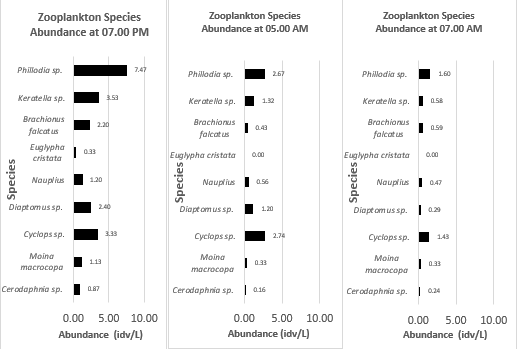
Prolonged anthropogenic disturbance contributes to the degradation of Merdada Lake. Tourism development, intensive water extraction, fertilizer and pesticide application, and the conversion of land into agricultural areas have accelerated soil erosion, sediment accumulation, nutrient loading, and siltation, which ultimately reduce water quality and influence zooplankton communities. This study assessed the suitability of zooplankton as a bioindicator by examining community composition, abundance, daily variation, ecological indices, and key environmental constraints as indicators of trophic conditions. Sampling was carried out randomly in May 2021 at five observation sites with three replicates, conducted during nighttime (7:00 PM), early morning (5:00 AM), and morning (9:00 AM). The zooplankton community consisted of several functional groups, including Cladocerans, Copepods, Nauplius, Protozoa, and Rotifers. Abundance ranged from 5.51 to 22.47 individuals per liter, with Rotifers, particularly Philodina sp., being the most dominant group. Peak abundance was recorded at night, reflecting diel movement patterns associated with vertical migration and food availability. Ecological index analysis revealed poor-moderate diversity (H’ = 1.76–1.90), moderate -high evenness (E = 0.72–0.80), and high dominance (C = 0.79–0.82), which indicates an unstable community structure and ecological. Variations in zooplankton structure and daily dynamics were strongly associated with light intensity, nitrate concentration, dissolved oxygen, and alkalinity. Overall, the findings demonstrate that zooplankton communities are sensitive to environmental changes and can serve as effective bioindicators of water quality in Merdada Lake. Overall, zooplankton communities are responsive to water quality conditions in Merdada Lake.
Downloads
References
Abd Ellah, R. G. (2020). Physical properties of inland lakes and their interaction with global warming: A case study of Lake Nasser, Egypt. In Egyptian Journal of Aquatic Research, 46 (2), 103–115. https://doi.org/10.1016/j.ejar.2020.05.004
Adamczuk, M. (2022). Spatial Distribution of Cladocerans in a Stratified Palaearctic Lake. Water (Switzerland), 14(17). https://doi.org/10.3390/w14172667
Adamczuk, M. (2024). The Responses of Cladoceransn Communities to the Single and Simultaneous Effects of Environmentally Relevant Increases in Temperature and Phosphorus Concentration in Freshwater Ecosystems. Water (Switzerland), 16(2). https://doi.org/10.3390/w16020249
Adebayo, A. T., Adewole, H. A., Akindele, E. O., & Olaleye, V. F. (2021). Planktonic flora and fauna of Opa Reservoir wetlands, Obafemi Awolowo University, Ile-Ife, Nigeria. The Journal of Basic and Applied Zoology, 82, Article 40. https://doi.org/10.1186/s41936-021-00237-8
APHA. (2017). Standard methods for the examination of water and wastewater. Baird, R.B., Eaton, A.D., Rice, E.W. (eds.) American Public Health Association, Washington. https://www.academia.edu/105197442/Standard_Metho ds_For_the_Examination_23th_edition?auto=download
Berta, C., Tóthmérész, B., Wojewódka, M., Augustyniuk, O., Korponai, J., Bertalan-Balázs, B., Nagy, A. S., Grigorszky, I., & Gyulai, I. (2019). Community response of Cladocerans to trophic stress by biomanipulation in a shallow oxbow lake. Water (Switzerland), 11(5). https://doi.org/10.3390/w11050929
Bhateria, R., & Jain, D. (2016). Water quality assessment of lake water: a review. Sustainable Water Resources Management, 2(2), 161–173. https://doi.org/10.1007/s40899-015-0014-7
Boldrocchi, G., Villa, B., Monticelli, D., Spanu, D., Magni, G., Pachner, J., Mastore, M., & Bettinetti, R. (2023). Zooplankton as an indicator of the status of contamination of the Mediterranean Sea and temporal trends. Marine Pollution Bulletin, 197. https://doi.org/10.1016/j.marpolbul.2023.115732
Boonmak, P., & Sanoamuang, L. (2022). Diversity of Freshwater Calanoid Copepods (Crustacea: Copepods: Calanoida) in Southern Vietnam with an Updated Checklist for the Country. Diversity, 14(7). https://doi.org/10.3390/d14070523
Cieplinski, A., Weisse, T., & Obertegger, U. (2017). High diversity in Keratella cochlearis (Rotifers, Monogononta): morphological and genetic evidence. Hydrobiologia, 796(1), 145–159. https://doi.org/10.1007/s10750-016-2781-z
Conroy, J. A., Steinberg, D. K., Thibodeau, P. S., & Schofield, O. (2020). Zooplankton diel vertical migration during Antarctic summer. Deep-Sea Research Part I: Oceanographic Research Papers, 162. https://doi.org/10.1016/j.dsr.2020.103324
Devkota, N., Salis, R. K., & Hansson, L. A. (2025). Warming of shallow temperate lakes: consequences for rotifer community composition and population dynamics. Hydrobiologia, 852(4), 971–985. https://doi.org/10.1007/s10750-024-05744-7
Díaz-Astudillo, M., Cáceres, M. A., & Landaeta, M. F. (2017). Zooplankton structure and vertical migration: Using acoustics and biomass to compare stratified and mixed fjord systems. Continental Shelf Research, 148, 208–218. https://doi.org/10.1016/j.csr.2017.09.004
Domingues, R. B., Guerra, C. C., Barbosa, A. B., & Galvão, H. M. (2017). Will nutrient and light limitation prevent eutrophication in an anthropogenically-impacted coastal lagoon? Continental Shelf Research, 141, 11–25. https://doi.org/10.1016/j.csr.2017.05.003
El-Tohamy, W. S., Taher, M. E., Ghoneim, A. M., & Hopcroft, R. R. (2024). Protozoan communities serve as a strong indicator of water quality in the Nile River. Scientific Reports, 14(1). https://doi.org/10.1038/s41598-024-66583-z
Engdaw, F., Kifle, D., & Fetahi, T. (2025). Water quality parameters influence temporal dynamics of zooplankton community structure in a tropical highland lake, Lake Tana, Ethiopia. Marine Pollution Bulletin, 218. https://doi.org/10.1016/j.marpolbul.2025.118239
García-Avila, F., Loja-Suco, P., Siguenza-Jeton, C., Jiménez-Ordoñez, M., Valdiviezo-Gonzales, L., Cabello-Torres, R., & Aviles-Añazco, A. (2023). Evaluation of the water quality of a high Andean lake using different quantitative approaches. Ecological Indicators, 154. https://doi.org/10.1016/j.ecolind.2023.110924
Gebrehiwot, M., Kifle, D., & Triest, L. (2017). Emergent Macrophytes Support Zooplankton in a Shallow Tropical Lake: A Basis for Wetland Conservation. Environmental Management, 60(6), 1127–1138. https://doi.org/10.1007/s00267-017-0935-z
Geraldes, A. M., & Boavida, M. J. (2004). Do littoral macrophytes influence crustacean zooplankton distribution? Limnetica, 23(1–2), 57–64. https://doi.org/10.23818/limn.23.05
Ginatullina, E. N., Kurbanov, A. R., & Tuychiev, K. S. (2023). Influence of environmental factors on the formation of zooplankton communities in a large lake system in Uzbekistan. E3S Web of Conferences, 407. https://doi.org/10.1051/e3sconf/202340701004
Glandon, H. L., Reed, E. M., Peterson, S. D., Roswell, C. R., Schmidt, A. R., Chick, J. H., Thomas, S. M., Forsythe, P. S., Ruetz, C. R., & Czesny, S. J. (2024). Nearshore and embayment zooplankton community structure in Lake Michigan, implications for invasion by bigheaded carps. Journal of Great Lakes Research, 50(5). https://doi.org/10.1016/j.jglr.2024.102405
Goździejewska, A. M., Cymes, I., & Glińska-Lewczuk, K. (2024). Zooplankton functional diversity as a bioindicator of freshwater ecosystem health across land use gradient. Scientific Reports, 14(1). https://doi.org/10.1038/s41598-024-69577-z
Houssou, A. M., Bonou, C. A., & Montchowui, E. (2018). Brachionus falcatus and Platyias patulus indicating organic pollution in Ouémé River’s basin, Republic of Benin. Int. J. Aquat. Biol, 6(5), 258–264. https://doi.org/10.22034/ijab.v6i5.465
Houssou, A. M., Daguégué, E. J., & Montchowui, E. (2017). Lethal and sub-lethal effects of cypermethrin and glyphosate on the freshwater’s copepod, Acanthocyclops robustus. In ISJ, 14 (1), 140-148. View of Lethal and sub-lethal effects of cypermethrin and glyphosate on the freshwater’s copepod, Acanthocyclops robustus
Houssou, A. M., Montchowui, E., & Bonou, C. A. (2017). Composition and structure of zooplankton community in ouémé river basin, republic of Benin. ~ 336 ~ Journal of Entomology and Zoology Studies, 5(6), 336-344. Composition and structure of zooplankton community in ouémé river basin, republic of Benin
Huang, T., Yu, C., Zhang, K., Liu, X., Zhen, J., & Wang, L. (2023). Complex pattern dynamics and synchronization in a coupled spatiotemporal plankton system with zooplankton vertical migration. Chaos, Solitons and Fractals, 175. https://doi.org/10.1016/j.chaos.2023.114063
Kahsay, A., Lemmens, P., Triest, L., De Meester, L., Kibret, M., Verleyen, E., Adgo, E., Wondie, A., & Stiers, I. (2022). Plankton Diversity in Tropical Wetlands Under Different Hydrological Conditions (Lake Tana, Ethiopia). Frontiers in Environmental Science, 10. https://doi.org/10.3389/fenvs.2022.816892
Karpowicz, M., Kuczyńska-Kippen, N., Sługocki, Ł., Czerniawski, R., Bogacka-Kapusta, E., & Ejsmont-Karabin, J. (2025). Zooplankton as indicators of lake trophic status: Novel universal metrics from 224 temperate lakes. Ecological Indicators, 179. https://doi.org/10.1016/j.ecolind.2025.114236
Khan, M. S., Monir, K. M. S., Nupur, F., Milon, A. I., Himel, I. A., Sarkar, A., Shimul, S. A., Nahid, S. A. Al, & Rana, S. (2025). Assessment of plankton dynamics of Kaptai Lake, Bangladesh: Insights on the largest manmade lake ecosystems in Southeast Asia. Heliyon, 11(15). https://doi.org/10.1016/j.heliyon.2025.e43920
Kour, Sarbjeet, Slathia, D., Sharma, N., Kour, Supreet, & Verma, R. (2022). Zooplankton as Bioindicators of Trophic Status of a Lentic Water Source, Jammu (J&K) with Remarks on First Reports. Proceedings of the National Academy of Sciences India Section B - Biological Sciences, 92(2), 393–404. https://doi.org/10.1007/s40011-022-01349-z
Krylov, A. V., Zelalem, W., Prokin, A. A., & Shkil, F. N. (2020). Zooplankton in the Lake Tana Shore Zone (Ethiopia) at the Beginning of the Dry Season. Inland Water Biology, 13(4), 605–612. https://doi.org/10.1134/S1995082920040057
Kuczyńska-Kippen, N., & Joniak, T. (2016). Zooplankton diversity and macrophyte biometry in shallow water bodies of various trophic state. Hydrobiologia, 774(1), 39–51. https://doi.org/10.1007/s10750-015-2595-4
Kuczyńska-Kippen, N., Zhang, C., Mleczek, M., & Špoljar, M. (2025). Rotifers as indicators of trophic state in small water bodies with different catchments (field vs. forest). Hydrobiologia, 852(10), 2669–2685. https://doi.org/10.1007/s10750-024-05760-7
Kusumawati, A., Santosa, L. W., & Hadisusanto, S. (2010). Kajian status trofik sebagai dasar strategi penataan lingkungan di telaga merdada, Majalah Geografi Indonesia, 24(1), 10-15. https://doi.org/10.22146/mgi.13338
Lennox, R. J., Westrelin, S., Souza, A. T., Šmejkal, M., Říha, M., Prchalová, M., Nathan, R., Koeck, B., Killen, S., Jarić, I., Gjelland, K., Hollins, J., Hellstrom, G., Hansen, H., Cooke, S. J., Boukal, D., Brooks, J. L., Brodin, T., Baktoft, H., … Arlinghaus, R. (2021). A role for lakes in revealing the nature of animal movement using high dimensional telemetry systems. In Movement Ecology, 9 (1), https://doi.org/10.1186/s40462-021-00244-y
Li, C., Xiao, G., Long, H., Ai, T., Tang, F., Ju, J., Yang, S., Pi, Y., Gao, L., Ma, L., Fan, W., Zhao, M., Zheng, H., & Jiang, K. (2025). Comparative analysis of phytoplankton community structure and stability in the Arabian Sea and Bay of Bengal using eDNA metabarcoding. Marine Environmental Research, 210. https://doi.org/10.1016/j.marenvres.2025.107333
Madoni, P. (2011). Protozoa in wastewater treatment processes: A minireview. In Italian Journal of Zoology, 78 (1), 3–11. https://doi.org/10.1080/11250000903373797
Melese, H., & Debella, H. J. (2025). Zooplankton community comparisons among four tropical soda lakes: Insights into habitat preferences. Global Ecology and Conservation, 64. https://doi.org/10.1016/j.gecco.2025.e03967
Mequanent, D., Mingist, M., Getahun, A., Anteneh, W., Getnet, B., & Birie, S. (2022). The investigation of the zooplankton community in the newly formed Ribb Reservoir, Ethiopia: the tropical highland reservoir. Heliyon, 8(9). https://doi.org/10.1016/j.heliyon.2022.e10533
Mohammed, A., Mengistou, S., & Fetahi, T. (2023). The effects of water quality parameters, water level changes, and mixing on zooplankton community dynamics in a tropical high-mountain Lake Ardibo, Ethiopia. Environmental Monitoring and Assessment, 195(8). https://doi.org/10.1007/s10661-023-11500-6
Moreira, R. A., Mansano, A. S., & Rocha, O. (2016). Life cycle traits of philodina roseola ehrenberg, 1830 (rotifera, bdelloidea), a model organism for bioassays. Anais Da Academia Brasileira de Ciencias, 88, 579–588. https://doi.org/10.1590/0001-3765201620140729
Musialik-Koszarowska, M., Dzierzbicka Gowacka, L., & Weydmann, A. (2019). Influence of environmental factors on the population dynamics of key zooplankton species in the Gulf of Gdańsk (southern Baltic Sea). Oceanologia, 61(1), 17–25. https://doi.org/10.1016/j.oceano.2018.06.001
Ndah, A. B., Meunier, C. L., Kirstein, I. V., Göbel, J., Rönn, L., & Boersma, M. (2022). A systematic study of zooplankton-based indices of marine ecological change and water quality: Application to the European marine strategy framework Directive (MSFD). In Ecological Indicators, 135. https://doi.org/10.1016/j.ecolind.2022.108587
Odum, E. . (1971). Foundamentals of Ecology. Third Edition. Sounders Company: Philadelphia.
Odum, E. P. (1993). Fundamentals of ecology (T. Samingan, Trans.; 3rd ed.). Yogyakarta, Indonesia: Gadjah Mada University Press.
Oh, W. S., Park, G. C., Choi, J. H., Lee, H. B., & Lee, K. (2023). Density estimation of euphausiids and copepods by using a multi-frequency method. Fisheries and Aquatic Sciences, 26(12), 689–697. https://doi.org/10.47853/FAS.2023.e61
Paquette, C., Gagné, S., Gaudet-Boulay, M., Leclerc, V., Bégin, P. N., Taranu, Z. E., Beisner, B. E., & Fugère, V. (2025). Crustacean zooplankton communities as indicators of game fish occurrence and abundance in Québec lakes. Ecological Indicators, 173. https://doi.org/10.1016/j.ecolind.2025.113405
Parysek, M., & Pietrzak, B. (2021). Weak swimming response of a bdelloid rotifer to chemical cues of a native copepod predator. Journal of Ethology, 39(1), 135–139. https://doi.org/10.1007/s10164-020-00676-w
Perbiche-Neves, G., Previattelli, D., Pie, M. R., Duran, A., Suárez-Morales, E., Boxshall, G. A., Nogueira, M. G., & da Rocha, C. E. F. (2014). Historical biogeography of the neotropical Diaptomidae (Crustacea: Copepods). Frontiers in Zoology, 11(1). https://doi.org/10.1186/1742-9994-11-36
Pielou, E.C., 1966. The measurement of diversity in different types of biological collections. J. Theor. Biol. 13, 131–144. https://doi.org/10.1016/0022-5193(66) 90013-0
Phan, N. T., Duong, Q. H., Tran-Nguyen, Q. A., & Trinh-Dang, M. (2021). The species diversity of tropical freshwater rotifers (Rotifers: Monogononta) in relation to environmental factors. Water (Switzerland), 13(9). https://doi.org/10.3390/w13091156
Sarma, S. S. S., Nandini, S., & Gulati, R. D. (2005). Life history strategies of Cladoceransns: Comparisons of tropical and temperate taxa. In Hydrobiologia, 542(1), 315-333. https://doi.org/10.1007/s10750-004-3247-2
Sterner, R. W., Keeler, B., Polasky, S., Poudel, R., Rhude, K., & Rogers, M. (2020). Ecosystem services of Earth’s largest freshwater lakes. Ecosystem Services, 41. https://doi.org/10.1016/j.ecoser.2019.101046
Sudarmadji, S., Suprayogi, S., Lestari, S., & Malawani, M. N. (2019). Water quality and sustainability of Merdada Lake, Dieng, Indonesia. E3S Web of Conferences, 76. https://doi.org/10.1051/e3sconf/20197602003
Sudarmadji, S., Supriyono, H., & Lestari, S. (2015). danau-danau volkanik di dataran tinggi dieng: pemanfaatan dan masalah lingkungan yang dihadapi. Jurnal Teknosains, 5(1), 36. https://doi.org/10.22146/teknosains.26856
Sun, Z., Xue, W., Kang, D., & Peng, Z. (2024). Assessment of Ecosystem Service Values of Urban Wetland: Taking East Lake Scenic Area in Wuhan as an Example. Land, 13(7). https://doi.org/10.3390/land13071013
Tahraoui, H., Belhadj, A. E., Moula, N., Bouranene, S., & Amrane, A. (2021). Optimisation and Prediction of the Coagulant Dose for the Elimination of Organic Micropollutants Based on Turbidity. Kemija u Industriji, (11–12). https://doi.org/10.15255/kui.2021.001
Tahraoui, H., Bouallouche, R., Madi, K., Benkouachi, O. R., Boudraa, R., Belkacemi, H., Lekmine, S., Moussa, H., Touzout, N., Ola, M. S., Triki, Z., Zamouche, M., Kebir, M., Nasrallah, N., Assadi, A. A., Benguerba, Y., Zhang, J., & Amrane, A. (2025). Modeling Total Alkalinity in Aquatic Ecosystems by Decision Trees: Anticipation of pH Stability and Identification of Main Contributors. Water (Switzerland), 17(20). https://doi.org/10.3390/w17202939
Tahraoui, H., Toumi, S., Boudoukhani, M., Touzout, N., Sid, A. N. E. H., Amrane, A., Belhadj, A. E., Hadjadj, M., Laichi, Y., Aboumustapha, M., Kebir, M., Bouguettoucha, A., Chebli, D., Assadi, A. A., & Zhang, J. (2024). Evaluating the Effectiveness of Coagulation–Flocculation Treatment Using Aluminum Sulfate on a Polluted Surface Water Source: A Year-Long Study. Water (Switzerland), 16(3). https://doi.org/10.3390/w16030400
Tiberti, R., Dory, F., Arthaud, F., Augé, V., Birk, C., Cavalli, L., Fontaneto, D., Napoleoni, R., Perga, M. E., Sabás, I., Sagot, C., & Sommaruga, R. (2025). Long-term changes of zooplankton in alpine lakes result from a combination of local and global threats. Biological Conservation, 308. https://doi.org/10.1016/j.biocon.2025.111222
T-Krasznai, E., Török, P., Borics, G., Lukács, Á., Kókai, Z., Lerf, V., Görgényi, J., & B-Béres, V. (2022). Functional dynamics of phytoplankton assemblages in hypertrophic lakes: Functional- and species diversity is highly resistant to cyanobacterial blooms. Ecological Indicators, 145. https://doi.org/10.1016/j.ecolind.2022.109583
Vasistha, P., & Ganguly, R. (2020). Water quality assessment of natural lakes and its importance: An overview. Materials Today: Proceedings, 32, 544–552. https://doi.org/10.1016/j.matpr.2020.02.092
Walker, C., Lampard, J. L., Roiko, A., Tindale, N., Wiegand, A., & Duncan, P. (2013). Community well-being as a critical component of urban lake ecosystem health. Urban Ecosystems, 16(2), 313–326. https://doi.org/10.1007/s11252-012-0256-1
Weaver, W. and Shannon, C., 1963. The mathematical theory of communication University of Illinois Press Urbana. 10.1002/j.1538-7305.1948.tb01338.x.
Xiong, W., Huang, X., Chen, Y., Fu, R., Du, X., Chen, X., & Zhan, A. (2020). Zooplankton biodiversity monitoring in polluted freshwater ecosystems: A technical review. In Environmental Science and Ecotechnology, 1.. https://doi.org/10.1016/j.ese.2019.100008
Yan, G., Yin, X., Huang, M., Wang, X., Huang, D., & Li, D. (2023). Dynamics of phytoplankton functional groups in river-connected lakes and the major influencing factors: A case study of Dongting Lake, China. Ecological Indicators, 149. https://doi.org/10.1016/j.ecolind.2023.110177
Yuan, G., Chen, Y., Wang, Y., Zhang, H., Wang, H., Jiang, M., Zhang, X., Gong, Y., & Yuan, S. (2024). Responses of Protozoan Communities to Multiple Environmental Stresses (Warming, Eutrophication, and Pesticide Pollution). Animals, 14(9). https://doi.org/10.3390/ani14091293
Additional Files
Submitted
Accepted
Published
How to Cite
Issue
Section
License
Copyright (c) 2026 Bioeksperimen: Jurnal Penelitian Biologi

This work is licensed under a Creative Commons Attribution-NonCommercial 4.0 International License.