Isolation and screening of halotolerant protease-producing bacteria from Lampung fermented shrimp paste
DOI:
https://doi.org/10.23917/bioeksperimen.v12i1.14593Keywords:
Halotolerant, Lampung, Proteolytic Index, Protease, TerasiAbstract
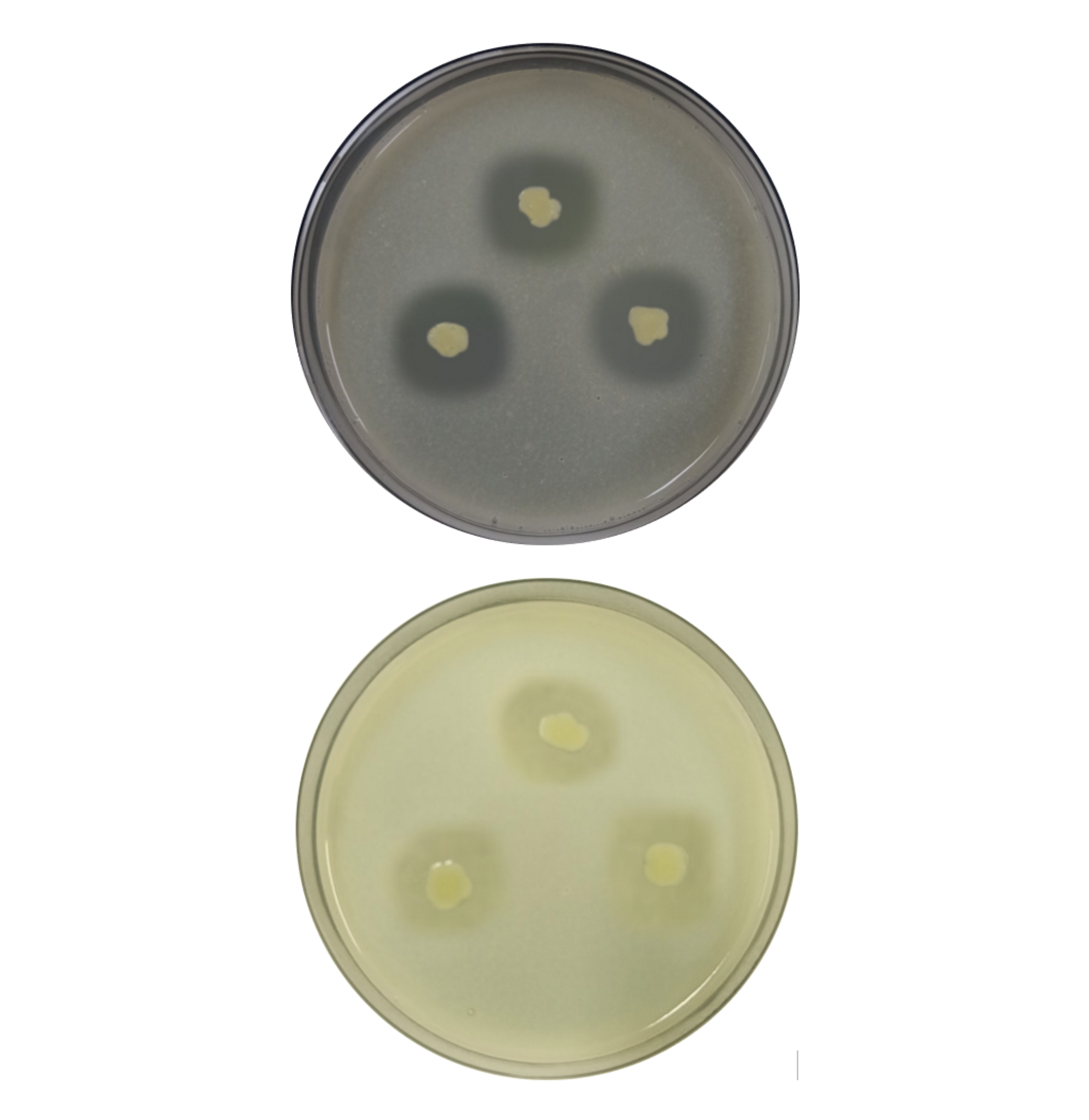
Protease are class of degradative enzymes that hydrolyze proteins, breaking its peptide bond, into smaller peptides and amino acids. Microbial proteases have gained increasing attention due to its productivity and utilization in various industries. Proteolytic bacteria derived from fermented shrimp paste from Lampung have great potential to meet this need. However, studies on these bacteria are still limited, so further research is needed to explore and optimally utilize their potential. This study aims to explore the diversity of proteolytic bacteria from Lampung terasi.. The methods employed included isolation stages using Nutrient Agar supplemented with 5% and 10% NaCl (w/v), followed by proteolytic screening properties using Skim Milk Agar media. A total of 20 bacterial isolates were obtained from terasi using Nutrient Agar supplemented with 5% (w/v) NaCl, and 15 isolates were obtained from Nutrient Agar (NA) supplemented with 10% (w/v) NaCl. Screening results showed that 85% and 67% of the isolates obtained from NA supplemented with 5% and 10% NaCl, respectively, exhibited proteolytic activity. Halotolerant bacterial isolates isolated using NA + 5% NaCl exhibited a proteolytic index ranging from 0.3 – 3.0, while those isolated with NA + 10% NaCl showed values ranging from 0.18 to 3.06. The screening results revealed that isolates BTCL5-07 and BTCL10-05 exhibited the highest proteolytic activity, with proteolytic indices of 3.0 and 3.06, respectively. These findings indicate that halotolerant bacteria from Lampung terasi represent a promising source of potential proteolytic enzymes. Further research is required to optimize enzyme production.
Downloads
References
Abd Samad, N. S., Amid, A., Jimat, D. N., & Ab. Shukor, N. A. (2017). Isolation and identification of halophilic bacteria producing halotolerant protease. Science Heritage Journal, 1(1), 7–9. https://doi.org/10.26480/gws.01.2017.07.09
Ali, N., Ullah, N., Qasim, M., Rahman, H., Khan, S. N., Sadiq, A., & Adnan, M. (2016). Molecular characterization and growth optimization of halo-tolerant protease producing Bacillus subtilis Strain BLK-1.5 isolated from salt mines of Karak, Pakistan. Extremophiles, 20(4), 395–402. https://doi.org/10.1007/s00792-016-0830-1
Amin, M. (2018). Marine protease-producing bacterium and its potential use as an abalone probiont. Aquaculture Reports, 12, 30–35. https://doi.org/10.1016/j.aqrep.2018.09.004
Artha, O., Sudarno, Pramono, H., & Sari, L. (2019). Identification of extracellular enzyme-producing bacteria (proteolytic, cellulolytic, and amylolytic) in the sediment of extensive ponds in Tanggulrejo, Gresik. IOP Conference Series: Earth and Environmental Science, 236, 012003. https://doi.org/10.1088/1755-1315/236/1/012003
Asar, A. R., Abdel-Salam, M. S., & Kahil, T. (2016). Halotolerant Alkaline Protease Production by New Isolate Halophilic Bacillus cereus NRC-1. Middle East Journal of Applied Sciences, 6(4), 964–976.
Ayuningrum, D., Sabdaningsih, A., & Jati, O. E. (2022). The Potential of Phylogenetically Diverse Culturable Actinobacteria from Litopenaeus vannamei Pond Sediment as Extracellular Proteolytic and Lipolytic Enzyme Producers. Tropical Life Sciences Research, 33(3), 165–192. https://doi.org/10.21315/tlsr2022.33.3.10
Barzkar, N., Jahromi, S. T., & Vianello, F. (2022). Marine Microbial Fibrinolytic Enzymes: An Overview of Source, Production, Biochemical Properties and Thrombolytic Activity. Marine Drugs, 20(1), 46. https://doi.org/10.3390/md20010046
Benmebarek, H., & Kharroub, K. (2023). Production Assay and Partial Characterization of a Protease Produced by Idiomarina loihiensis, a Moderately Halophilic Bacterium Strain. ECM 2023, 18. https://doi.org/10.3390/ECM2023-16464
BPS Lampung. (n.d.). Export Value of Agricultural and Forestry Commodity (thousands US $), 2012-2014. Retrieved April 2, 2025, from https://lampung.bps.go.id/en/statistics-table/2/MzE5IzI%3D/export-value-of-agricultural-and-forestry-commodity.html
Cahyaningrum, E., Wijanarka, W., & Lunggani, A. T. (2021). Isolasi dan Pengaruh Monosodium Glutamat terhadap Pertumbuhan Bakteri Proteolitik Limbah Cair Tahu. Bioma : Berkala Ilmiah Biologi, 23(2), 84–90. https://doi.org/10.14710/bioma.23.2.84-90
Cappuccino, J. G., & Sherman, N. (2008). Microbiology: A Laboratory Manual. Pearson.
Chung, D., Yu, W.-J., Lim, J.-Y., Kang, N.-S., Kwon, Y.-M., Choi, G., Bae, S.-S., Cho, K., & Lee, D.-S. (2021). Characterization of the Proteolytic Activity of a Halophilic Aspergillus reticulatus Strain SK1-1 Isolated from a Solar Saltern. Microorganisms, 10(1), 29. https://doi.org/10.3390/microorganisms10010029
Decimo, M., Morandi, S., Silvetti, T., & Brasca, M. (2014). Characterization of Gram‐Negative Psychrotrophic Bacteria isolated from Italian Bulk Tank Milk. Journal of Food Science, 79(10). https://doi.org/10.1111/1750-3841.12645
Dos Santos Aguilar, J. G., & Sato, H. H. (2018). Microbial proteases: Production and application in obtaining protein hydrolysates. Food Research International, 103, 253–262. https://doi.org/10.1016/j.foodres.2017.10.044
Handayani, R., Boing Sitanggang, A., Sulistiani, Hasanah, U., & Kusumaningrum, H. D. (2025). Screening of protease-producing bacteria from fermented shrimp products (terasi) for meat tenderization. BIO Web of Conferences, 169, 02005. https://doi.org/10.1051/bioconf/202516902005
Ibrahim, A. S. S., Elbadawi, Y. B., El-Tayeb, M. A., Al-maary, K. S., Maany, D. A. F., Ibrahim, S. S. S., & Elagib, A. A. (2019). Alkaline serine protease from the new halotolerant alkaliphilic Salipaludibacillus agaradhaerens strain AK-R: Purification and properties. 3 Biotech, 9(11), 391. https://doi.org/10.1007/s13205-019-1928-9
Kobayashi, T., Kajiwara, M., Wahyuni, M., Kitakado, T., Hamada-Sato, N., Imada, C., & Watanabe, E. (2003). Isolation and characterization of halophilic lactic acid bacteria isolated from “terasi” shrimp paste: A traditional fermented seafood product in Indonesia. The Journal of General and Applied Microbiology, 49(5), 279–286. https://doi.org/10.2323/jgam.49.279
Kochhar, N., I․K, K., Shrivastava, S., Ghosh, A., Rawat, V. S., Sodhi, K. K., & Kumar, M. (2022). Perspectives on the microorganism of extreme environments and their applications. Current Research in Microbial Sciences, 3, 100134. https://doi.org/10.1016/j.crmicr.2022.100134
Li, X., Zhang, S., Zhang, Q., Gan, L., Jiang, G., Tian, Y., & Shi, B. (2022). Characterization and application of a novel halotolerant protease with no collagenase activity for cleaner dehairing of goatskin. Process Biochemistry, 113, 203–215. https://doi.org/10.1016/j.procbio.2022.01.006
Mamangkey, J., & Suryanto, D. (2021). Aktivitas Proteolitik Bakteri Lokal Yang Di Isolasi Dari Tempat Penangkaran Buaya. Pro-Life, 8(2), 112–121. https://doi.org/10.33541/pro-life.v8i2.3204
Mokashe, N., Chaudhari, B., & Patil, U. (2017). Detergent‐Compatible Robust Alkaline Protease from Newly Isolated Halotolerant Salinicoccus sp. UN‐12. Journal of Surfactants and Detergents, 20(6), 1377–1393. https://doi.org/10.1007/s11743-017-2024-y
Naveed, M., Nadeem, F., Mehmood, T., Bilal, M., Anwar, Z., & Amjad, F. (2021). Protease—A Versatile and Ecofriendly Biocatalyst with Multi-Industrial Applications: An Updated Review. Catalysis Letters, 151(2), 307–323. https://doi.org/10.1007/s10562-020-03316-7
Oktavia, Y., Lestari, S. D., Lestari, S., Herpandi, ., & Jannah, M. (2018). Optimasi Waktu Inkubasi Produksi Protease Dan Amilase Isolat Bakteri Asal Terasi Ikan Teri Stolephorus sp. Jurnal Ilmu Dan Teknologi Kelautan Tropis, 10(3), 719–725. https://doi.org/10.29244/jitkt.v10i3.18840
Prihanto, A. A., Nurdiani, R., Jatmiko, Y. D., Firdaus, M., & Kusuma, T. S. (2021). Physicochemical and sensory properties of terasi (an Indonesian fermented shrimp paste) produced using Lactobacillus plantarum and Bacillus amyloliquefaciens. Microbiological Research, 242, 126619. https://doi.org/10.1016/j.micres.2020.126619
Proca, I. G., Diguță, C. F., & Jurcoane, Ş. (2020). Screening Of Halotolerant Bacteria Producing Hydrolytic Enzymes With Biotechnological Applications. Scientific Bulletin. Series F. Biotechnologies, XXIV(1).
Ramadhan, A. R., Bachruddin, Z., Widodo, Erwanto, Y., & Hanim, C. (2021). Isolation and selection of proteolytic lactic acid bacteria from colostrum of dairy cattle. IOP Conference Series: Earth and Environmental Science, 788(1), 012077. https://doi.org/10.1088/1755-1315/788/1/012077
Rohman, M. S., Prijambada, I. D., Indriyani, Y. A., & Hendrosatriyo, H. (2012). Identification of Protease Producing Halophilic Bacteria from Bledug KuwuMud Volcano. Indonesian Journal of Biotechnology, 17(1), 35. https://doi.org/10.22146/ijbiotech.15995
Ruginescu, R., Gomoiu, I., Popescu, O., Cojoc, R., Neagu, S., Lucaci, I., Batrinescu-Moteau, C., & Enache, M. (2020). Bioprospecting for Novel Halophilic and Halotolerant Sources of Hydrolytic Enzymes in Brackish, Saline and Hypersaline Lakes of Romania. Microorganisms, 8(12), 1903. https://doi.org/10.3390/microorganisms8121903
Singh, J., & Panesar, P. S. (2023). Industrial enzymes: Basic information, assay, and applications. In Basic Biotechniques for Bioprocess and Bioentrepreneurship (pp. 295–309). Elsevier. https://doi.org/10.1016/B978-0-12-816109-8.00020-9
Solanki, P., Putatunda, C., Kumar, A., Bhatia, R., & Walia, A. (2021). Microbial proteases: Ubiquitous enzymes with innumerable uses. 3 Biotech, 11(10), 428. https://doi.org/10.1007/s13205-021-02928-z
Susanti, A. E., Suharti, S., Wahab, R., Chusniyah, N., & Paramitha, S. T. (2021). Isolation And Screening Of Proteolytic Bacteria From Sidoarjo Shrimp Paste As Protease Source To Extract The Collagen From Milkfish Scales (Chanos Chanos). Jurnal Teknologi, 84(1), 211–218. https://doi.org/10.11113/jurnalteknologi.v84.17583
Taprig, T. (2013). Screening and characterization of protease-producing Virgibacillus, Halobacillus and Oceanobacillus strains from Thai fermented fish. Journal of Applied Pharmaceutical Science. https://doi.org/10.7324/JAPS.2013.30205
Yao, H., Liu, S., Liu, T., Ma, D., Han, X., Zhou, Z., Chang, R., Zhang, Z., & Mao, J. (2025). Protease- and lipase-producing halotolerant/halophilic strains: Prediction, screening, and heterogeneous visualization of fermented shrimp paste. Food Science and Human Wellness. https://doi.org/10.26599/FSHW.2025.9250479
Yuan, L., Zhang, Q., Zheng, Z., Zhou, J., Cui, Y., Jin, W., & Gao, R. (2022). Isolation of Protease-Producing Bacteria from Shrimp Paste and the Characteristics of Fermenting Catfish Paste. Journal of Aquatic Food Product Technology, 31(4), 332–343. https://doi.org/10.1080/10498850.2022.2048154.
Submitted
Accepted
Published
How to Cite
Issue
Section
License
Copyright (c) 2025 Bioeksperimen: Jurnal Penelitian Biologi

This work is licensed under a Creative Commons Attribution-NonCommercial 4.0 International License.