The Phylogenetic analysis of representative mammalian MUC16 supported by comparative SEA domain and tandem repeat variation
DOI:
https://doi.org/10.23917/bioeksperimen.v12i1.14233Keywords:
MUC16, SEA domain, tandem repeat, mammalian evolution, phylogenetics, comparative genomicsAbstract
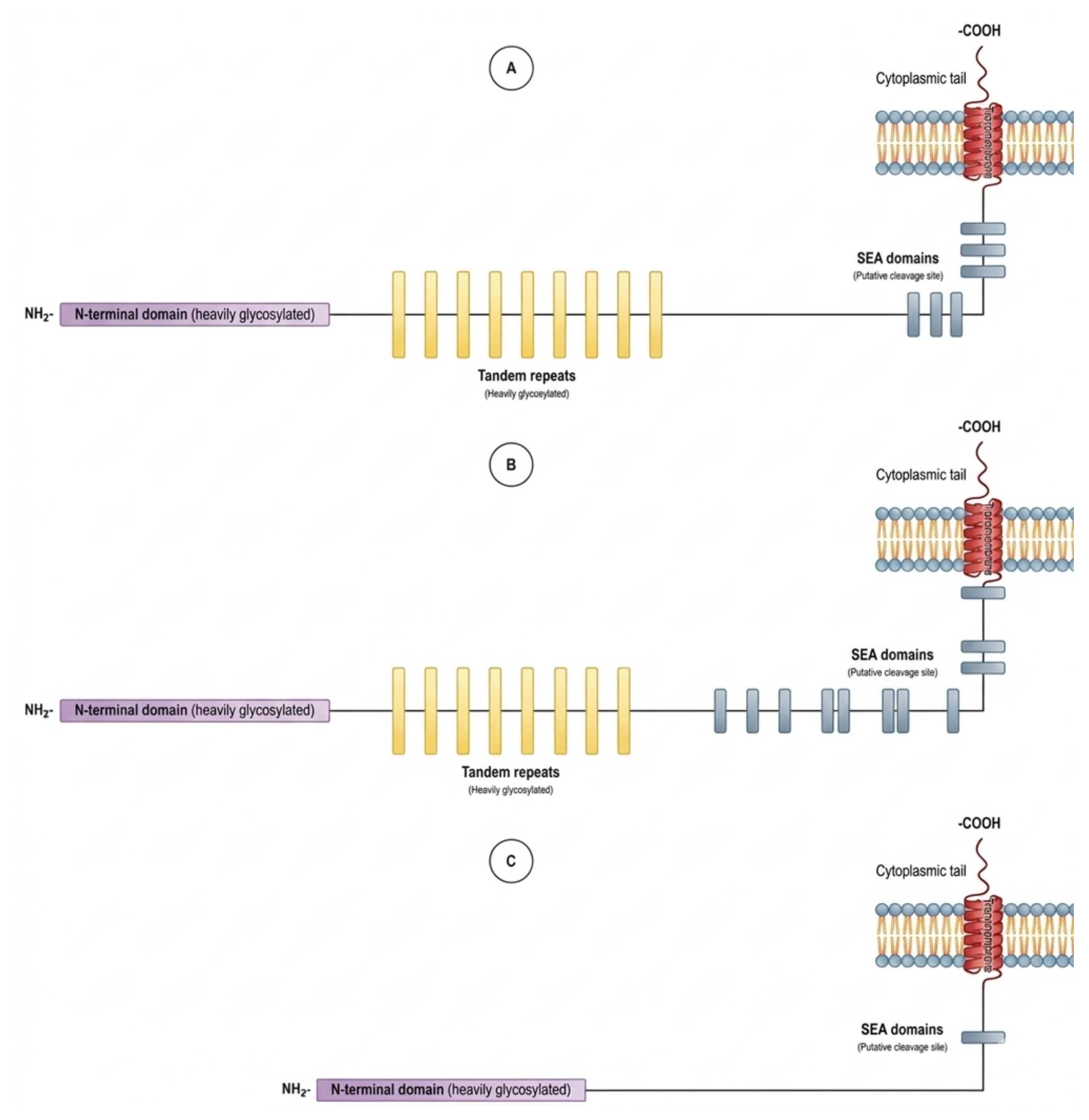
MUC16 is one of the largest mammalian mucins and exhibits substantial evolutionary variation in both sequence composition and structural modularity. Comparative analysis of SEA domain composition and tandem repeat architecture is therefore essential for understanding the evolutionary diversification of this gene across mammals. This study investigates the phylogenetic relationships of mammalian MUC16 and examines how variation in SEA domains and tandem repeats contributes to lineage-specific structural divergence. MUC16 nucleotide and protein sequences from 20 mammalian species representing Primates and Rodentia were retrieved from public databases. Multiple sequence alignment and phylogenetic reconstruction were conducted using the Neighbor-Joining method with 1,000 bootstrap replicates. SEA domains were annotated using the SMART database, while tandem repeats were identified with Tandem Repeats Finder. Structural features were evaluated using descriptive statistics, hierarchical clustering, and Spearman’s rank correlation analysis. Phylogenetic reconstruction revealed a clear molecular separation between Primates and Rodentia with strong bootstrap support. Primate species generally exhibited conserved sequences and expanded SEA domain and tandem repeat architectures, whereas rodents displayed higher sequence divergence and reduced structural complexity. A moderate positive association between SEA domain number and tandem repeat count (ρ = 0.44) was observed, although this relationship did not reach statistical significance and is therefore interpreted as a biologically suggestive trend rather than evidence of coordinated evolution. Overall, the results indicate that MUC16 evolution follows lineage-dependent patterns shaped by both sequence divergence and domain-level remodeling. This comparative framework provides an evolutionary context for understanding structural diversity in mammalian mucins and offers a foundation for future functional and genomic investigations.
Downloads
References
Adams, D., & Collyer, M. (2019). Phylogenetic Comparative Methods and the Evolution of Multivariate Phenotypes. Annual Review of Ecology, Evolution, and Systematics, 50(1): 1-21. https://doi.org/10.1146/annurev-ecolsys-110218-024555.
Ahmad, S., Singchat, W., Jehangir, M., Suntronpong, A., Panthum, T., Malaivijitnond, S., & Srikulnath, K. (2020). Dark Matter of Primate Genomes: Satellite DNA Repeats and Their Evolutionary Dynamics. Cells, 9(12): 2714. https://doi.org/10.3390/cells9122714.
Aithal, A., Rauth, S., Kshirsagar, P., Shah, A., Lakshmanan, I., Junker, W., Jain, M., Ponnusamy, M., & Batra, S. (2018). MUC16 as a novel target for cancer therapy. Expert Opinion on Therapeutic Targets, 22: 675-686. https://doi.org/10.1080/14728222.2018.1498845.
Arabfard, M., Salesi, M., Nourian, Y., Arabipour, I., Maddi, A., Kavousi, K., & Ohadi, M. (2022). Global abundance of short tandem repeats is non-random in rodents and primates. BMC Genomic Data, 23(1): 77. https://doi.org/10.1186/s12863-022-01092-4.
Das, S., Majhi, P., Al‐Mugotir, M., Rachagani, S., Sorgen, P., & Batra, S. (2015). Membrane proximal ectodomain cleavage of MUC16 occurs in the acidifying Golgi/post-Golgi compartments. Scientific Reports, 5: 9759. https://doi.org/10.1038/srep09759.
Dhar, P., & McAuley, J. (2019). The Role of the Cell Surface Mucin MUC1 as a Barrier to Infection and Regulator of Inflammation. Frontiers in Cellular and Infection Microbiology, 9: 117. https://doi.org/10.3389/fcimb.2019.00117.
Duraisamy, S., Ramasamy, S., Kharbanda, S., & Kufe, D. (2007). Distinct evolution of the human carcinoma-associated transmembrane mucins, MUC1, MUC4 AND MUC16. Gene. 373: 28-34. https://doi.org/10.1016/j.gene.2005.12.021.
Faruque, M., Medha, M.M., Mahfuz, A.M.U.B., Islam, M.M. and Siraj, M.A. (2025), Deciphering Deleterious nsSNPs in MUC16's SEA Domain: Structural and Functional Implications in Cancer Metastasis via Computational Analysis. J Cell Mol Med, 29: e70633. https://doi.org/10.1111/jcmm.70633
Felsenstein, J. (1985). Confidence limits on phylogenies: An approach using the bootstrap. Evolution, 39: 783-791.
Fotsing, S., Margoliash, J., Wang, C., Saini, S., Yanicky, R., Shleizer-Burko, S., Goren, A., & Gymrek, M. (2019). The impact of short tandem repeat variation on gene expression. Nature genetics, 51: 1652-1659. https://doi.org/10.1038/s41588-019-0521-9.
Ganguly, K., Rauth, S., Marimuthu, S., Kumar, S., & Batra, S. K. (2020). Unraveling mucin domains in cancer and metastasis: when protectors become predators. Cancer metastasis reviews, 39(3): 647–659. https://doi.org/10.1007/s10555-020-09896-5
Gipson, I., Spurr-Michaud, S., Tisdale, A., & Menon, B. (2014). Comparison of the Transmembrane Mucins MUC1 and MUC16 in Epithelial Barrier Function. PLoS ONE, 9(6): e100393. https://doi.org/10.1371/journal.pone.0100393.
Gipson, I., Blalock, T., Tisdale, A., Spurr-Michaud, S., Allcorn, S., Stavreus-Evers, A., & Gemzell, K. (2008). MUC16 Is Lost from the Uterodome (Pinopode) Surface of the Receptive Human Endometrium: In Vitro Evidence That MUC16 Is a Barrier to Trophoblast Adherence1, 78(1): 134 - 142. https://doi.org/10.1095/biolreprod.106.058347.
Kufe, D. W. (2022). Chronic activation of MUC1-C in wound repair promotes progression to cancer stem cells. J Cancer Metastasis Treat. 8: 12. http://dx.doi.org/10.20517/2394-4722.2022.03
Kumar, S., Stecher, G., Suleski, M., Sanderford, M., Sharma, S., and Tamura. (2024). Molecular Evolutionary Genetics Analysis Version 12 for adaptive and green computing. Molecular Biology and Evolution. 41(12): msae263. https://doi.org/10.1093/molbev/msae263
Kurt, S., Bouchard-Côté, A., & Lagergren, J. (2024). Sparse Neighbor Joining: rapid phylogenetic inference using a sparse distance matrix. Bioinformatics, 40(12): btae701. https://doi.org/10.1093/bioinformatics/btae701.
Maeda, T., Inoue, M., Koshiba, S., Yabuki, T., Aoki, M., Nunokawa, E., Seki, E., Matsuda, T., Motoda, Y., Kobayashi, A., Hiroyasu, F., Shirouzu, M., Terada, T., Hayami, N., Ishizuka, Y., Shinya, N., Tatsuguchi, A., Yoshida, M., Hirota, H., Matsuo, Y., Tani, K., Arakawa, T., Carninci, P., Kawai, J., Hayashizaki, Y., Kigawa, T., & Yokoyama, S. (2004). Solution Structure of the SEA Domain from the Murine Homologue of Ovarian Cancer Antigen CA125 (MUC16)*. Journal of Biological Chemistry, 279(13): 13174 - 13182. https://doi.org/10.1074/jbc.m309417200.
McLemore, M. R., & Aouizerat, B. (2005). Introducing the MUC16 gene: implications for prevention and early detection in epithelial ovarian cancer. Biological Research for Nursing, 6(4): 262–267. https://doi.org/10.1177/1099800404274445
Pajic, P., Shen, S., Qu, J., May, A., Knox, S., Ruhl, S., & Gokcumen, O. (2022). A mechanism of gene evolution generating mucin function. Science Advances, 8: eabm8757. https://doi.org/10.1126/sciadv.abm8757.
Pei, J. and Grishin, N.V. (2017), Expansion of divergent SEA domains in cell surface proteins and nucleoporin 54. Protein Science, 26(3): 617-630. https://doi.org/10.1002/pro.3096
Perez, B., & Gipson, I. (2008). Focus on Molecules: human mucin MUC16. Experimental Eye Research, 87(5): 400-401. https://doi.org/10.1016/j.exer.2007.12.008.
Plender, E., Prodanov, T., Hsieh, P., Nizamis, E., Harvey, W., Sulovari, A., Munson, K., Kaufman, E., O’Neal, W., Valdmanis, P., Marschall, T., Bloom, J., & Eichler, E. (2024). Structural and genetic diversity in the secreted mucins MUC5AC and MUC5B. American Journal of Human Genetics, 111(8): 1700-1716. https://doi.org/10.1016/j.ajhg.2024.06.007.
Saito, N. and Nei, M. (1987). The neighbor-joining method: A new method for reconstructing phhylogenetic trees. Molecular Biology and Evolution, 4(4): 406-425. https://doi.org/10.1093/oxfordjournals.molbev.a040454
Roycroft, E., Achmadi, A., Callahan, C., Esselstyn, J., Good, J., Moussalli, A., & Rowe, K. (2021). Molecular Evolution of Ecological Specialisation: Genomic Insights from the Diversification of Murine Rodents. Genome Biology and Evolution, 13(7): evab103. https://doi.org/10.1093/gbe/evab103.
Shen, W., & Li, Y. (2016). A novel algorithm for detecting multiple covariance and clustering of biological sequences. Scientific Reports, 6: 30425. https://doi.org/10.1038/srep30425.
Sulovari, A., Li, R., Audano, P., Porubsky, D., Vollger, M., Logsdon, G., Warren, W., Pollen, A., Chaisson, M., & Eichler, E. (2019). Human-specific tandem repeat expansion and differential gene expression during primate evolution. Proceedings of the National Academy of Sciences, 116(46): 23243-23253. https://doi.org/10.1073/pnas.1912175116.
Taniguchi, T., Woodward, A., Magnelli, P., McColgan, N., Lehoux, S., Jacobo, S., Mauris, J., & Argüeso, P. (2017). N-Glycosylation affects the stability and barrier function of the MUC16 mucin. The Journal of Biological Chemistry, 292(26): 11079-11090. https://doi.org/10.1074/jbc.m116.770123.
Verbiest, M., Maksimov, M., Jin, Y., Anisimova, M., Gymrek, M., & Sonay, T. (2022). Mutation and selection processes regulating short tandem repeats give rise to genetic and phenotypic diversity across species. Journal of Evolutionary Biology, 36(2): 321-336. https://doi.org/10.1111/jeb.14106.
Wang, C., Weaver, S., Boonpattrawong, N., Schuster-Little, N., Pantakar, M., & Whelan, R. (2024). A Revised Molecular Model of Ovarian Cancer Biomarker CA125 (MUC16) Enabled by Long-read Sequencing. Cancer Research Communications, 4(1): 253-263. https://doi.org/10.1158/2767-9764.crc-23-0327.
White, B., Patterson, M., Karnwal, S., & Brooks, C. (2022). Crystal structure of a human MUC16 SEA domain reveals insight into the nature of the CA125 tumor marker. Proteins: Structure. 90(5): 1210-1218. https://doi.org/10.1002/prot.26303.
Yoshida, R., & Nei, M. (2016). Efficiencies of the NJp, Maximum Likelihood, and Bayesian Methods of Phylogenetic Construction for Compositional and Noncompositional Genes. Molecular biology and evolution, 33(6): 1618-1624 . https://doi.org/10.1093/molbev/msw042.
Zhang, X., Hong, L., & Ling, Z. (2024). MUC16: clinical targets with great potential. Clinical and Experimental Medicine, 24: 101. https://doi.org/10.1007/s10238-024-01365-5.
Submitted
Accepted
Published
How to Cite
Issue
Section
License
Copyright (c) 2026 Bioeksperimen: Jurnal Penelitian Biologi

This work is licensed under a Creative Commons Attribution-NonCommercial 4.0 International License.