In vitro antifungal activity of Mimosa pudica rhizosphere bacteria against Fusarium spp.
DOI:
https://doi.org/10.23917/bioeksperimen.v12i1.13509Keywords:
Antifungal activity, Biocontrol, Fusarium spp., In Vitro, Mimosa pudicaAbstract
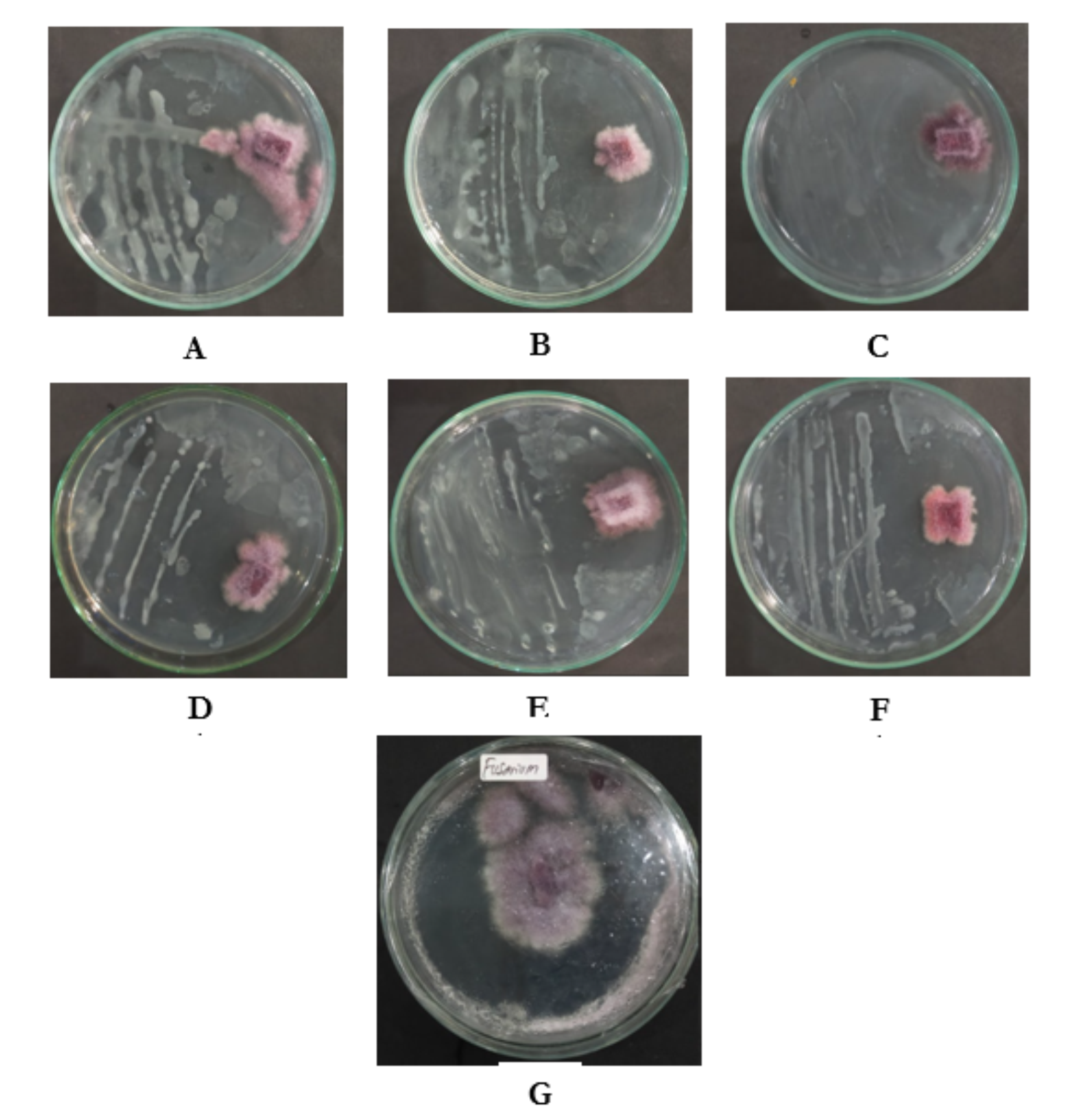
This study aims to explore rhizosphere bacteria from Mimosa pudica L. as a source of antagonistic bacteria against Fusarium spp. Rhizosphere soil samples were collected, isolated, morphologically characterized, and tested for antifungal activity in vitro against Fusarium spp. The percentage of inhibition (PI) was calculated after 7 days. Six bacterial isolates were obtained and tentatively identified as Bacillus, Cellulomonas, Arthrobacter, and Micrococcus species. All isolates exhibited antagonistic activity against Fusarium spp., with inhibition percentages ranging from 61.99% to 81.83%. Isolate PM2 (tentatively identified as Cellulomonas) demonstrated the strongest inhibition at 81.83%, followed by isolate PM6 (tentatively identified as Micrococcus) at 79.25%. These results confirm the potential of Mimosa pudica L. as a source of biocontrol agents and warrant further investigation into their molecular identification, mechanisms of action, and in vivo efficacy.
Downloads
References
Abdullahi, S., Haris, H., Zarkasi, K. Z., & Amir, H. G. (2020). Beneficial bacteria associated with Mimosa pudica and potential to sustain plant growth-promoting traits under heavy metals stress. Bioremediation Journal, 25(1), 1–21.
Alawiye, T. T., & Babalola, O. O. (2019). Bacterial diversity and community structure in typical plant rhizosphere. Diversity, 11(10), 179.
Awuchi, C. G., Ondari, E. N., Ogbonna, C. U., Upadhyay, A. K., Baran, K., Okpala, C. O. R., Korzeniowska, M., & Guiné, R. P. F. (2021). Mycotoxins affecting animals, foods, humans, and plants: Types, occurrence, toxicities, action mechanisms, prevention, and detoxification strategies—A revisit. Foods, 10(6), 1279.
Azeem, H., Ali, A., Zeshan, M. A., Iftikhar, Y., Ashraf, W., Ghani, M. U., Sajid, A., Tariq, A., & Sajid, M. (2020). Biological control of plant pathogens by using antagonistic bacteria: a review. Pakistan Journal of Phytopathology, 32(2).
Bergey, D. H. (1994). Bergey’s manual of determinative bacteriology. Lippincott Williams & Wilkins.
Bonaterra, A., Badosa, E., Daranas, N., Francés, J., Roselló, G., & Montesinos, E. (2022). Bacteria as biological control agents of plant diseases. Microorganisms, 10(9), 1759.
Boulahouat, S., Cherif-Silini, H., Silini, A., Bouket, A. C., Luptakova, L., Alenezi, F. N., & Belbahri, L. (2023). Biocontrol efficiency of rhizospheric Bacillus against the plant pathogen Fusarium oxysporum: A promising approach for sustainable agriculture. Microbiology Research, 14(3), 892–908.
Busse, H., Wieser, M., & Buczolits, S. (2015). Arthrobacter. Bergey’s Manual of Systematics of Archaea and Bacteria, 1–70.
Chowdhury, F. T., Zaman, N. R., Islam, M. R., & Khan, H. (2020). Anti-fungal secondary metabolites and hydrolytic enzymes from rhizospheric bacteria in crop protection: A review. Journal of Bangladesh Academy of Sciences, 44(2), 69–84.
Dawoud, T. M., Alharbi, N. S., Theruvinthalakal, A. M., Thekkangil, A., Kadaikunnan, S., Khaled, J. M., Almanaa, T. N., Sankar, K., Innasimuthu, G. M., & Alanzi, K. F. (2020). Characterization and antifungal activity of the yellow pigment produced by a Bacillus sp. DBS4 isolated from the lichen Dirinaria agealita. Saudi Journal of Biological Sciences, 27(5), 1403–1411.
Ekwomadu, T. I., & Mwanza, M. (2023). Fusarium fungi pathogens, identification, adverse effects, disease management, and global food security: A review of the latest research. Agriculture, 13(9), 1810.
Febriyantiningrum, K., Sriwulan, S., & Nurfitria, N. (2023). Karakterisasi Bakteri Rhizosfer Putri Malu (Mimosa pudica) yang Berpotensi sebagai Dekomposer dalam Pembuatan Biourin. Bioscientist: Jurnal Ilmiah Biologi, 11(2), 1239–1245.
Fenta, L., & Mekonnen, H. (2024). Microbial biofungicides as a substitute for chemical fungicides in the control of phytopathogens: Current perspectives and research directions. Scientifica, 2024(1), 5322696.
Flori, F., Mukarlina, M., & Rahmawati, R. (2020). Potensi antagonis isolat bakteri Bacillus spp. asal rizosfer tanaman lada (Piper nigrum L.) sebagai agen pengendali jamur Fusarium sp. Jdf. Bioma: Jurnal Biologi Makassar, 5(1), 111–120.
Ishii, H. (2024). New chemical fungicides in relation to risk for resistance development. Tropical Plant Pathology, 49(1), 18–35.
Jie, W., Tan, Y., Lin, H., Zhang, M., & Kan, L. (2025). Effectiveness of Rhizophagus intraradices and Acinetobacter calcoaceticus on soybean growth and thiram residues in soybean grains and rhizosphere soil. PeerJ, 13, e19701.
Khairani, K., Aini, F., & Riany, H. (2019). Karakterisasi Dan Identifikasi Bakteri Rizosfer Tanaman Sawit Jambi. Al-Kauniyah: Jurnal Biologi, 12(2), 198–206. https://doi.org/10.15408/kauniyah.v12i2.11723
Koyama, T., Murakami, S., Karasawa, T., Ejiri, M., & Shiono, K. (2021). Complete root specimen of plants grown in soil-filled root box: sampling, measuring, and staining method. Plant Methods, 17(1), 97.
Kristianti, D., Siahaan, P., & Tangapo, A. M. (2023). Karakterisasi dan Uji Produksi IAA Bakteri Rizosfer dari Tanaman Putri Malu (Mimosa pudica L.). Jurnal Ilmu Alam Dan Lingkungan, 14(2).
Luo, L., Zhao, C., Wang, E., Raza, A., & Yin, C. (2022). Bacillus amyloliquefaciens as an excellent agent for biofertilizer and biocontrol in agriculture: An overview for its mechanisms. Microbiological Research, 259, 127016.
Méndez-Santiago, E. W., Gomez-Rodriguez, O., Sanchez-Cruz, R., Folch-Mallol, J. L., Hernández-Velázquez, V. M., Villar-Luna, E., Aguilar-Marcelino, L., & Wong-Villarreal, A. (2021). Serratia sp., an endophyte of Mimosa pudica nodules with nematicidal, antifungal activity and growth-promoting characteristics. Archives of Microbiology, 203(2), 549–559.
Nasution, S. S., & Saryanah, A. (2023). Eksplorasi Bakteri Antagonis Asal Jaringan dan Rizosfer Tanaman Celosia argantea Untuk Menekan Pertumbuhan Fusarium sp. Secara In Vitro. Jurnal Media Pertanian, 8(1), 21–25.
Ngalimat, M. S., Yahaya, R. S. R., Baharudin, M. M. A., Yaminudin, S. M., Karim, M., Ahmad, S. A., & Sabri, S. (2021). A review on the biotechnological applications of the operational group Bacillus amyloliquefaciens. Microorganisms, 9(3), 614.
Nikitin, D. A., Ivanova, E. A., Semenov, M. V, Zhelezova, A. D., Ksenofontova, N. A., Tkhakakhova, A. K., & Kholodov, V. A. (2023). Diversity, ecological characteristics and identification of some problematic phytopathogenic Fusarium in soil: a review. Diversity, 15(1), 49.
Ontañon, O. M., Bedő, S., Ghio, S., Garrido, M. M., Topalian, J., Jahola, D., Fehér, A., Valacco, M. P., Campos, E., & Fehér, C. (2021). Optimisation of xylanases production by two Cellulomonas strains and their use for biomass deconstruction. Applied Microbiology and Biotechnology, 105(11), 4577–4588.
Perincherry, L., Lalak-Kańczugowska, J., & Stępień, Ł. (2019). Fusarium-produced mycotoxins in plant-pathogen interactions. Toxins, 11(11), 664.
Petronaitis, T., Simpfendorfer, S., & Hüberli, D. (2021). Importance of Fusarium spp. in wheat to food security: A global perspective. Plant Diseases and Food Security in the 21st Century, 127–159.
Puspitasari, I. D. (2023). Antagonisme Bacillus Rizosfer Bawang Merah Isolat Tanah Supresif terhadap Patogen Moler dari Brebes Jawa Tengah.
Riseh, R. S., Vatankhah, M., Hassanisaadi, M., & Ait Barka, E. (2024). Unveiling the role of hydrolytic enzymes from soil biocontrol bacteria in sustainable phytopathogen management. Frontiers in Bioscience-Landmark, 29(3), 105.
Roy, P., & Kumar, A. (2020). Arthrobacter. In Beneficial microbes in agro-ecology (pp. 3–11). Elsevier.
Sanchez-Cruz, R., Vázquez, I. T., Batista-García, R. A., Méndez-Santiago, E. W., del Rayo Sanchez-Carbente, M., Leija, A., Lira-Ruan, V., Hernandez, G., Wong-Villarreal, A., & Folch-Mallol, J. L. (2019). Isolation and characterization of endophytes from nodules of Mimosa pudica with biotechnological potential. Microbiological Research, 218, 76–86.
Sapiña-Solano, A., Gambera, A. P., Boscaiu, M., Vicente, O., & Ruiz-González, M. X. (2024). Does the soil microbial community facilitate Mimosa pudica’s biological performance under abiotic stress? Growth, tolerance mechanisms, and seismonastic behaviour. Plant Physiology and Biochemistry, 215, 108971.
Shabeer, S., Tahira, R., & Jamal, A. (2021). Fusarium spp. mycotoxin production, diseases and their management: An overview. Pakistan Journal of Agricultural Research, 34(2), 278.
Sharma, L., & Goswami, G. K. (2020). Identification and Biochemical Characterization of β-Rhizobia isolated from Root Nodules of Mimosa pudica. Journal of Academia and Industrial Research (JAIR), 8(11), 173.
Shukla, S., Upadhyay, D., Mishra, A., Jindal, T., & Shukla, K. (2022). Challenges faced by farmers in crops production due to fungal pathogens and their effect on Indian economy. In Fungal diversity, ecology and control management (pp. 495–505). Springer.
Sriwulan, S., Andriani, R., Anggraini, S. D., Kurniahu, H., & Rahmawati, A. (2022). Bakteri Tanah Di Sekitar Rhizosfer Tumbuhan Pioner Pada Lahan Bekas Tambang Kapur. Bioeksperimen: Jurnal Penelitian Biologi, 8(1), 30–35.
Sriwulan, S., Kurniahu, H., & Andriani, R. (2019a). Appropiate Dose of PGPR Aantifungal to Inhibit Fungi That Cause Rotten on The Rhizome of Red Ginger (Zingiber officinale var . Rubra). Pena Sains, 6(2), 110–115. https://doi.org/10.2110/jps.v6i2.5135
Sriwulan, S., Kurniahu, H., & Andriani, R. (2019b). Appropriate Dose of PGPR Antifungal to Inhibit Fungi that Cause Rotten on The Rhizome of Red Ginger (Zingiber officinale var. Rubra). Jurnal Pena Sains, 6(2), 109–115.
Vives-Peris, V., De Ollas, C., Gómez-Cadenas, A., & Pérez-Clemente, R. M. (2020). Root exudates: from plant to rhizosphere and beyond. Plant Cell Reports, 39(1), 3–17.
Wang, H., Liu, R., You, M. P., Barbetti, M. J., & Chen, Y. (2021). Pathogen biocontrol using plant growth-promoting bacteria (PGPR): Role of bacterial diversity. Microorganisms, 9(9), 1988.
Wang, S., Jin, P., Zheng, Y., Kangkang, W., Chen, J., Liu, J., & Li, Y. (2024). Bacillus velezensis B105-8, a potential and efficient biocontrol agent in control of maize stalk rot caused by Fusarium graminearum. Frontiers in Microbiology, 15, 1462992.
Wang, Y., Shi, J., Tang, L., Zhang, Y., Zhang, Y., Wang, X., & Zhang, X. (2021). Evaluation of Rpf protein of Micrococcus luteus for cultivation of soil actinobacteria. Systematic and Applied Microbiology, 44(5), 126234.
Williamson-Benavides, B. A., & Dhingra, A. (2021). Understanding root rot disease in agricultural crops. Horticulturae, 7(2), 33.
Wu, L., Che, S., Qin, X., Xu, Y., Tian, S., Zhu, Y., Song, J., Guan, Y., Wang, D., & Wu, M. (2023). Identification, characteristics and rice growth promotion of a highly efficient cellulolytic bacterial strain, Cellulomonas iranensis ZJW-6, isolated from paddy soil in central China. Frontiers in Microbiology, 14, 1152966.
Zalila-Kolsi, I., Ben-Mahmoud, A., & Al-Barazie, R. (2023). Bacillus amyloliquefaciens: harnessing its potential for industrial, medical, and agricultural applications—a comprehensive review. Microorganisms, 11(9), 2215.
Zunairoh, A., Syauqi, A., & Rahayu, T. (2019). Isolasi dan Analisis Koloni Bakteri Rizosfer Untuk Agen Pengendali Penyakit Layu Fusarium Pada Tanaman Stroberi (Fragaria sp): Isolation and Analysis of Rhizosphere Bacterial Colony for Controlling Agents of Fusarium Wilt in Strawberry Plants (Fragaria sp. Jurnal Ilmiah Biosaintropis (Bioscience-Tropic), 5(1), 45–52.
Submitted
Accepted
Published
How to Cite
Issue
Section
License
Copyright (c) 2025 Bioeksperimen: Jurnal Penelitian Biologi

This work is licensed under a Creative Commons Attribution-NonCommercial 4.0 International License.