Synergistic cultures for resilient mercury bioremediation in ASGM leveraging microbial interactions for sustainable pollutant removal
DOI:
https://doi.org/10.23917/bioeksperimen.v12i1.11967Keywords:
Artisanal gold mining, Bioremediation, Mercury, Mixed cultures, StabilityAbstract
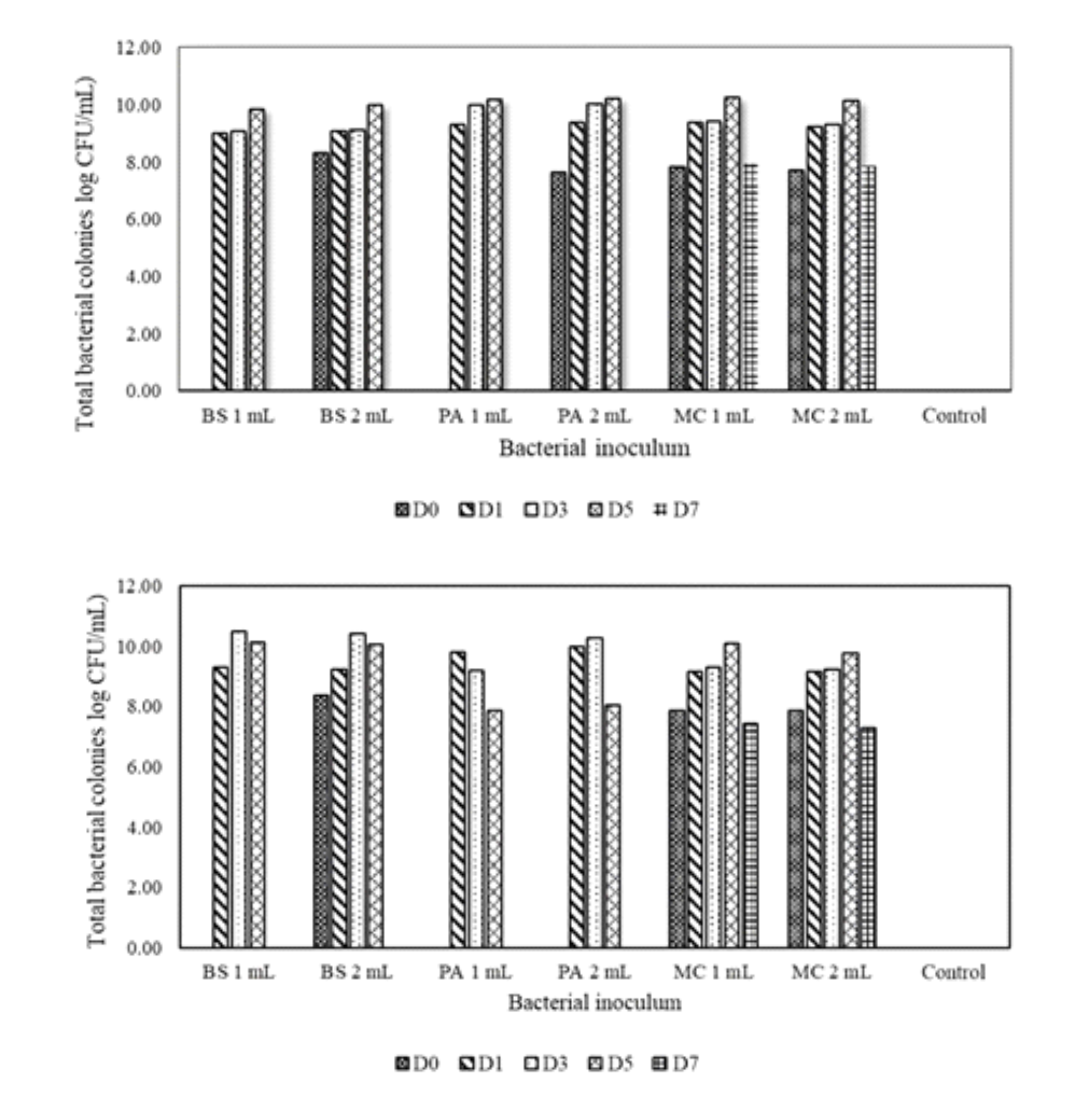
The widespread use of mercury (Hg) in artisanal and small-scale gold mining (ASGM) necessitates effective bioremediation strategies. This study evaluated the mercury reduction capabilities of two bacterial strains, Bacillus subtilis and Pseudomonas aeruginosa, using real-world ASGM liquid waste. In a seven-day laboratory-scale experiment, we assessed the performance of single and mixed bacterial cultures under varying pH conditions. Our results show that B. subtilis was particularly effective, achieving a maximum Hg2+ removal efficiency of 90.07%. Critically, while the cell viability of single cultures declined significantly over the study period, mixed cultures maintained superior population stability, reaching 7.4 log CFU/mL on day 7, especially under alkaline conditions. This stability suggests a beneficial synergistic relationship between the two species. The enhanced long-term viability and robust detoxification mechanisms observed in the mixed culture system underscore the high potential of this approach for developing sustainable bioremediation solutions for the ASGM sector.
Downloads
References
Abu-Tahon, M. A., Al-Askar, A. A., & Arishi, A. A. (2025). A holistic perspective on the efficiency of microbial enzymes in bioremediation process: Mechanism and challenges: A review. International Journal of Biological Macromolecules, 308, 142278.
Amin, A., Sarwar, A., Saleem, M. A., Latif, Z., & Opella, S. J. (2019). Expression and Purification of Transmembrane Protein MerE from Mercury-Resistant Bacillus cereus. Journal of Microbiology and Biotechnology, 29(2), 274–282.
Barkay, T., Miller, S. M., & Summers, A. O. (2003). Bacterial mercury resistance from atoms to ecosystems. FEMS Microbiology Reviews, 27(2-3), 355–384. https://doi.org/10.1016/s0168-6445(03)00046-9
Bhowmick, K., Bhowmick, B., & Bhowmick, S. (2024). Potential microbes in bioremediation: A review. Materials Today Sustainability, 28, 101032.
Castilhos, Z. C., Rodrigues-Filho, S., Rodrigues, A. P. C., Villas-Bôas, R. C., Siegel, S., Veiga, M. M., & Beinhoff, C. (2006). Mercury contamination in fish from gold mining areas in Indonesia and human health risk assessment. Science of the Total Environment, 368(1), 320–325.
Eras-Muñoz, E., Farré, A., Sánchez, A., Font, X., & Gea, T. (2022). Microbial biosurfactants: a review of recent environmental applications. Bioengineered, 13(5), 12365–12391.
Hassan, M. S., El-Sayed, E., & Hammad, A. M. (2018). Isolation and molecular characterization of mercury-resistant bacteria from contaminated industrial effluents in Egypt. Journal of Basic and Applied Sciences, 7(1), 1-8.
Hui, C., Ma, B., Hu, S., & Wu, C. (2024). Tailored bacteria tackling with environmental mercury: Inspired by natural mercuric detoxification operons. Environmental Pollution, 341, 123016.
Hsu-Kim, H., Kucharzyk, K. H., Zhang, T., & Deshusses, M. A. (2013). Mechanisms Regulating Mercury Bioavailability for Methylating Microorganisms in the Aquatic Environment: A Critical Review. Environmental Science & Technology, 47(6), 2441–2456. https://doi.org/10.1021/es304370g
Imron, M. F., Kurniawan, S. B., & Soegianto, A. (2019). Characterization of mercury-reducing potential bacteria isolated from Keputih non-active sanitary landfill leachate, Surabaya, Indonesia under different saline conditions. Journal of Environmental Management, 241, 113–122.
Kothe, E., & Reinicke, M. (2017). Microbial Communities in Metal-Contaminated Environments. Handbook of Metal-Microbe Interactions and Bioremediation, 233–243. https://doi.org/10.1201/9781315153353-16
Li, X., Wu, S., Dong, Y., Fan, H., Bai, Z., & Zhuang, X. (2021). Engineering Microbial Consortia towards Bioremediation. Water, 13(20), 2928. https://doi.org/10.3390/w13202928
Ministry of Energy and Mineral Resources of the Republic of Indonesia. (2021). Report on the National Action Plan for the Elimination of Mercury. Jakarta.
Mukherjee, A., Gupta, P., & Mandal, T. (2021). "Role of Biosurfactants in Bioremediation of Heavy Metals and Hydrocarbons." Applied Biochemistry and Biotechnology, 193(1), 164-184.
Qian, X., Chen, L., Sui, Y., Chen, C., Zhang, W., Zhou, J., Dong, W., Jiang, M., Xin, F., & Ochsenreither, K. (2020). Biotechnological potential and applications of microbial consortia. Biotechnology Advances, 40, 107500. https://doi.org/10.1016/j.biotechadv.2019.107500
Sharma, S., Singh, R., & Singh, N. (2018). Bioremediation of heavy metals: A review. Journal of Applied Microbiology, 124(1), 1-17.
Silodia, K., Kumar, S., Gupta, P., & Saxena, A. K. (2025). Strategies for bioremediation of emerging pollutants: A green and sustainable environment. In Advances in Chemical Pollution, Environmental Management and Protection, 12, 419–440.
Titah, H. S., Pratikno, H., Moesriati, A., Imron, M. F., & Putera, R. I. (2018). Isolation and Screening of Diesel Degrading Bacteria from Ship Dismantling Facility at Tanjungjati, Madura, Indonesia. J. Eng. Technol. Sci., 50(1), 99–109.
UNEP (2019). Global Mercury Assessment 2018. United Nations Environment Programme, Geneva, Switzerland.
Vasanthi, S., Senthil Kumar, R., & Seshadri, S. (2020). Isolation and Characterization of Mercury-Resistant Bacillus cereus Strain for Bioremediation of Mercury. Bioremediation Journal, 24(2), 127-136.
Wang, D., Chen, Y., Yu, D., Ma, C., Li, S., & Wu, C. (2020). Visual detection of Hg2+ by manipulation of pyocyanin biosynthesis through the Hg2+-dependent transcriptional activator MerR in microbial cells. Journal of Bioscience and Bioengineering, 129(2), 223–228.
Wibowo, S., & Purwanti, I. F. (2023). Microbial Mercury Reduction Potential in Gold Mining Waste: Bacillus subtilis and Pseudomonas aeruginosa Study. Asian Journal of Engineering, Social and Health, 2(7), 436–443. https://doi.org/10.46799/ajesh.v2i7.77
Wu, M. S., Xu, X., Zhao, Q., & Wang, Z. Y. (2017). Simultaneous removal of heavy metals and biodegradation of organic matter with sediment microbial fuel cells. RSC Advances, 7(84), 53433–53438.
Submitted
Accepted
Published
How to Cite
Issue
Section
License
Copyright (c) 2025 Bioeksperimen: Jurnal Penelitian Biologi

This work is licensed under a Creative Commons Attribution-NonCommercial 4.0 International License.