High Performance Liquid Chromatography Validation of Isoniazid Analysis Method in 2 Fixed-Dose Combination Dispersible Tablet
DOI:
https://doi.org/10.23917/pharmacon.v23i1.6912Keywords:
FDC, HPLC, Isoniazid, TBC, Validation of Analytical MethodAbstract
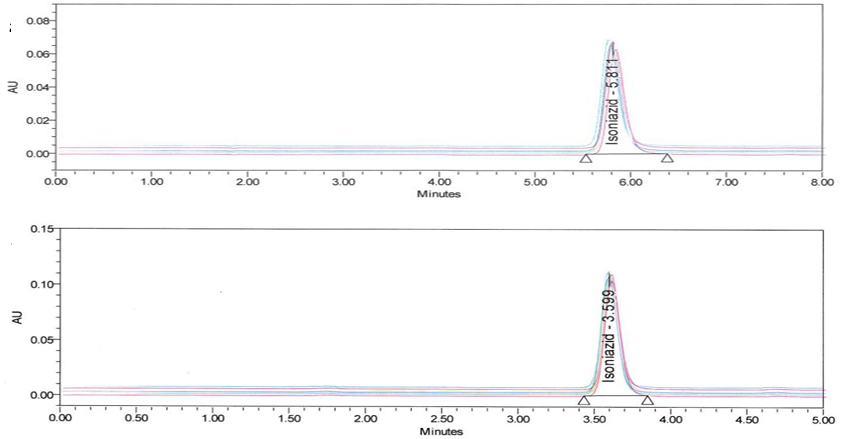
Tuberculosis (TB) is a severe disease that causes significant morbidity and mortality worldwide, including in children. Combination therapy of isoniazid and rifampicin (two-fixed drug combination (2 FDC)) is recommended for children in the advanced stage, based on body weight. The dissolving test requirements for producing two FDC dispersible tablets, however, are not listed in the Indonesian Pharmacopoeia or other standard book. Because the only method of analysis presently in use is the ratio of the outcomes of the rifampicin and isoniazid dissolutions in the capsules, new methods of analysis must be developed and validated for dispersible tablets. This research aims to develop analytical methods for determining isoniazid levels in 2 FDC dispersible tablet formulations. The method uses High Performance Liquid Chromatography (HPLC) with a C18 column (4.6 mm x 250 mm, 5 µm) and UV-Vis detectors at 254 nm. The mobile phase is Water:Phosphate Buffer:Methanol (850:50:10), which is delivered at a flow rate of 1.5 ml/min. The validation parameter test results in correlation coefficients (r) 0.9995, LOD 0,00038724 mg/mL, LOQ 0.00117346 mg/mL, % recovery 99.51% in the accuracy test, and %RSD 0.41% in the precision tests. The results of the selectivity tests show that this method is selective, as no other drugs respond at the same time as isoniazid. Based on the validation parameters and the determination of isoniazid level, it was determined that the HPLC method may be used to determine the amount of isoniazid in the 2 FDC dispersible tablet formulation resulting from the dissolution test.
Downloads
References
Alvarez-Segura, T., Subirats, X., & Rosés, M. (2019). Retention-pH Profiles of Acids and Bases in Hydrophilic Interaction Liquid Chromatography. Analytica Chimica Acta, 1050, 176–184. https://doi.org/https://doi.org/10.1016/j.aca.2018.11.021 DOI: https://doi.org/10.1016/j.aca.2018.11.021
Dewi, I. I., Prabamurti, P. N., & Indraswari, R. (2019). Hubungan Persepsi Kerentanan dan Persepsi Ancaman dengan Peran PMO dalam Pemberian Obat TB Pada Anak Terhadap Penegahan Kejadian Drop Out. Jurnal Kesehatan Masyarakat, 7(4), 434–440. https://doi.org/https://doi.org/10.14710/jkm.v7i4.24902
Gandjar, I. ., & Rohman, A. (2012). Analisis Obat Secara Spektrofotometri dan Kromatografi. Pustaka Pelajar.
Hakkimane, S. S., & Guru, B. R. (2017). Nano Formulation Analysis: Analytical Method Development of Isoniazid and Simultaneous Estimation of Antitubercular Drugs Isoniazid and Rifampicin by Reverse Phase High Pressure Liquid Chromatography. Asian Journal of Pharmaceutical and Clinical Research, 10(5), 330–335. https://doi.org/10.22159/ajpcr.2017.v10i5.17582 DOI: https://doi.org/10.22159/ajpcr.2017.v10i5.17582
Indonesian Food and Drug Authority. (2014). Pedoman Uji Disolusi dan Tanya Jawab.
Marson, B. M., Concentino, V., Junkert, A. M., Fachi, M. M., Vilhena, R. O., & Pontarolo, R. (2020). Validation of Analytical Methods in A Pharmaceutical Quality System: An Overview Focused on HPLC
Methods. In Química Nova (Vol. 43). scielo. https://doi.org/https://doi.org/10.21577/0100-4042.20170589 DOI: https://doi.org/10.21577/0100-4042.20170589
Mishra, P., Albiol-Chiva, J., Bose, D., Durgbanshi, A., Peris-Vicente, J., Carda-Broch, S., & Esteve-Romero, J. (2018). Optimization and Validation of a Chromatographic Method for the Quantification of Isoniazid in Urine of Tuberculosis Patients According to the European Medicines Agency Guideline. In Antibiotics (Vol. 7, Issue 4). https://doi.org/10.3390/antibiotics7040107 DOI: https://doi.org/10.3390/antibiotics7040107
Nasution, L. R., Muchlisyam, & Effendy De Lux Putra. (2020). Aplikasi Pengembangan Metode Spektrofotometri UV-Vis pada Analisis Simultan Isoniazid (INH) dan Vitamin B6 di dalam Sediaan Tablet. Jurnal Farmasi Indonesia, 12(2), 194–202. https://doi.org/10.35617/jfionline.v12i2.47 DOI: https://doi.org/10.35617/jfionline.v12i2.47
Prasanthi, B., Ratna, J. V., & Phani, R. S. C. (2015). Development and Validation of RP-HPLC Method for Simultaneous Estimation of Rifampicin, Isoniazid and Pyrazinamide in Human Plasma. Journal of Analytical Chemistry, 70(8), 1015–1022. https://doi.org/10.1134/S1061934815080146 DOI: https://doi.org/10.1134/S1061934815080146
Raposo, F., & Ibelli-Bianco, C. (2020). Performance Parameters for Analytical Method Validation: Controversies and Discrepancies among Numerous Guidelines. TrAC - Trends in Analytical Chemistry, 129, 115913. https://doi.org/10.1016/j.trac.2020.115913 DOI: https://doi.org/10.1016/j.trac.2020.115913
Riyanto, S. (2014). Validasi dan Verifikasi Metode Uji Sesuai dengan ISO/IEC 17025 Laboratorium Pengujian dan Kalibrasi (1st ed.). Deepublish.
Rusli, H., Putri, R. M., & Alni, A. (2022). Recent Developments of Liquid Chromatography Stationary Phases for Compound Separation: From Proteins to Small Organic Compounds. In Molecules (Vol. 27, Issue 3). https://doi.org/10.3390/molecules27030907 DOI: https://doi.org/10.3390/molecules27030907
The Ministry of Health. (2020a). Farmakope Indonesia (VI).
The Ministry of Health. (2020b). Pedoman Nasional Pelayanan Kedokteran Tata Laksana Tuberkulosis.
The Ministry of Health. (2022). Laporan Program Penanggulangan Tuberkulosis Padang Pariaman.
van der Merwe, J., Steenekamp, J., Steyn, D., & Hamman, J. (2020). The Role of Functional Excipients in Solid Oral Dosage Forms to Overcome Poor Drug Dissolution and Bioavailability. In Pharmaceutics (Vol. 12, Issue 5). https://doi.org/10.3390/pharmaceutics12050393 DOI: https://doi.org/10.3390/pharmaceutics12050393
Vilvamani, S., Mahalingam, S., Nhavilthodi, S., Murugesan, D., & Jeyakumar, S. M. (2024). Development and Validation of a Simple High-Pressure Liquid Chromatography-Ultraviolet Detection Method for Simultaneous Quantitation of First-Line Anti-Tuberculosis Drugs in Formulations of Fixed-Dose
Combination. Journal of Chromatographic Science, 62(9), 821–828. https://doi.org/10.1093/chromsci/bmae023 DOI: https://doi.org/10.1093/chromsci/bmae023
Visconti, G., Boccard, J., Feinberg, M., & Rudaz, S. (2023). From Fundamentals in Calibration to Modern Methodologies: A Tutorial for Small Molecules Quantification in Liquid Chromatography–Mass Spectrometry Bioanalysis. Analytica Chimica Acta, 1240, 340711. https://doi.org/https://doi.org/10.1016/j.aca.2022.340711 DOI: https://doi.org/10.1016/j.aca.2022.340711
World Health Organization. (2024). Global Tuberculosis Report. In WHO (Issue September). https://doi.org/978 92 4 156450 2