Understanding Heterogeneity in Islamic Banking Stability: Explaining Divergent Evidence from Global Studies
DOI:
https://doi.org/10.23917/jisel.v9i01.17348Keywords:
Stability, Liquidity, Risk Management, Risk Sharing, Literature ReviewAbstract
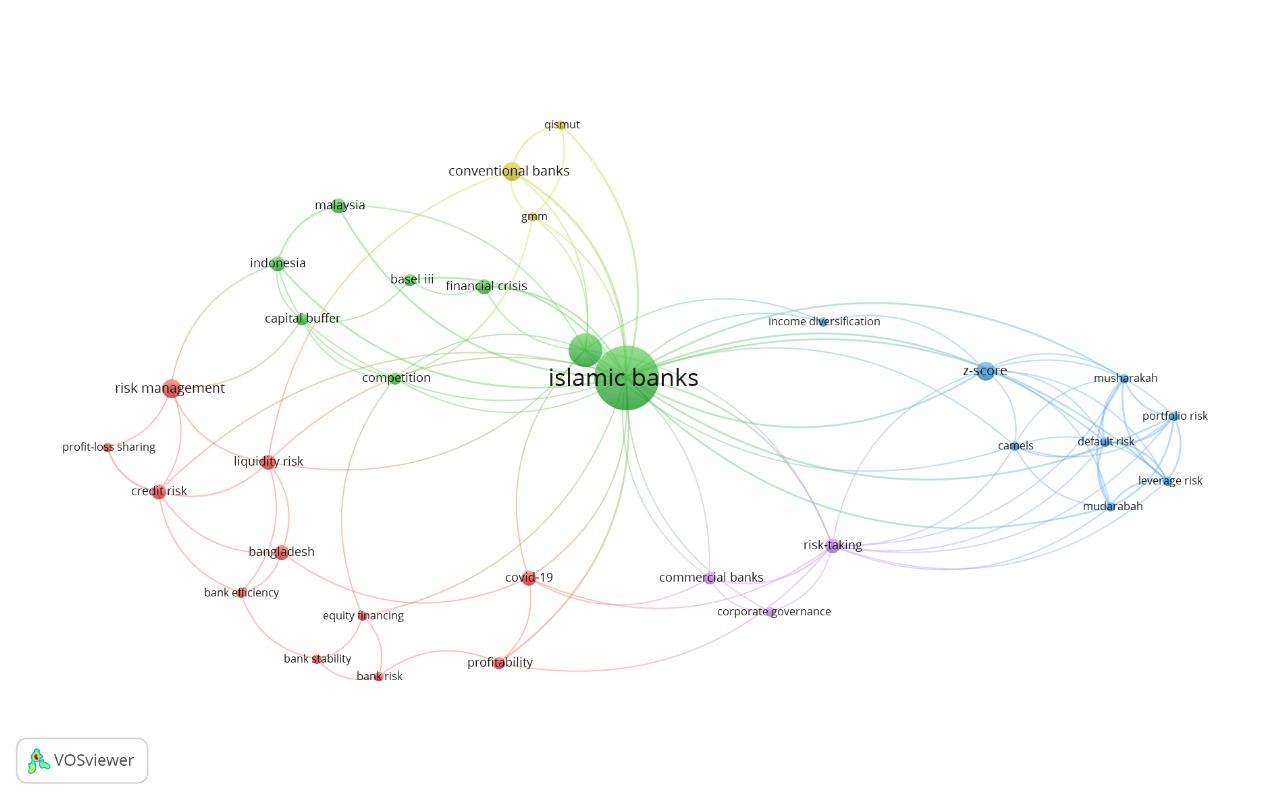
Financial stability is essential for sustaining economic systems, yet empirical evidence on Islamic banking stability remains heterogeneous across studies. This study aims to provide a comprehensive understanding of Islamic banking stability by emphasizing the conditionality of previous evidence. This study applies a systematic literature review under the PRISMA framework combined with bibliometric mapping based on Scopus-indexed publications to address the ambiguity and differences surrounding the determinants of Islamic banking stability. The fin dings reveal that the literature is dominated by panel data and dynamic estimation approaches, particularly GMM, while the Z-score remains the most frequently used stability proxy. The results also indicate that research is geographically concentrated in countries with well-developed Islamic financial systems. Furthermore, the study finds that empirical evidence on Islamic banking stability is heterogeneous, showing positive, negative, and mixed relationships depending on the choice of stability proxies, macroeconomic conditions, and research design. The findings suggest that Islamic banking stability is not inherently determined by its Islamic principles, but rather by the effectiveness of risk-sharing mechanisms within a supportive institutional and regulatory environment. This study contributes by providing a structured synthesis of fragmented literature and offers directions for future research to explore underexamined areas such as deposit contracts, Islamic window banks, and Islamic rural banks.
Downloads
References
Abedifar, P., Molyneux, P., & Tarazi, A. (2013). Risk in Islamic Banking. Review of Finance, 17(6), 2035–2096. https://doi.org/10.1093/rof/rfs041
Alam, N., Hamid, B. A., & Tan, D. T. (2019). Does competition make banks riskier in dual banking system? Borsa Istanbul Review, 19, S34–S43.
Ali, M., Gernowo, R., Warsito, B., & Muthmainah, F. (2025). Enhancing Bank Financial Performance Assessment: A Literature Review of Deep Learning Applications Using the Kitchenham Method. Register: Jurnal Ilmiah Teknologi Sistem Informasi, 11(1), 54–65.
AlKhazali, O., Aguir, I., Helmi, M., & Mirzaei, A. (2024). Impact of capital inflows on bank profitability: A comparative analysis of dual banking systems. International Journal of Islamic and Middle Eastern Finance and Management, 17(3), 401–422. https://doi.org/10.1108/IMEFM-04-2023-0148
AlKhouri, R., & Arouri, H. (2019). The effect of diversification on risk and return in banking sector: Evidence from the Gulf Cooperation Council countries. International Journal of Managerial Finance, 15(1), 100–128. https://doi.org/10.1108/IJMF-01-2018-0024
AlQudah, M. Z., & Bariviera, A. F. (2026). Systematic and bibliometric reviews of cryptocurrency market regulation: Trends, influential contributions, and future directions. Journal of Financial Regulation and Compliance, 34(1), 1–37.
Alshubiri, F., & Al Ani, M. K. (2023). Financing and returns of Shari’ah-compliant contracts and sustainable investing in the Islamic banking of Oman. Economic Change and Restructuring, 56(4), 2455–2491. https://doi.org/10.1007/s10644-023-09522-8
Altăr-Samuel, A. (2017). Chaos and stability of the financial system. International Conference on Applied Physics, System Science and Computers, 230–236.
Archer, S., & Abdel Karim, R. A. (2019). When benchmark rates change: The case of Islamic banks. Journal of Financial Regulation and Compliance, 27(2), 197–214. https://doi.org/10.1108/JFRC-11-2017-0104
Asif, R., & Nasir, A. (2024). Financial stability nexus of Islamic banks: An influential and intellectual science mapping structure. Journal of Islamic Accounting and Business Research, 15(4), 569–589. https://doi.org/10.1108/JIABR-07-2022-0167
Athief, F. H. N., Anisa, D., Hadi, M. Q. A., & Alam, A. (2024). Profit-loss sharing principle in the Islamic finance industry: Current pattern and future direction. International Journal of Advanced and Applied Sciences, 11(9), 23–35. https://doi.org/10.21833/ijaas.2024.09.004
Athief, F. H. N., Herianingrum, S., Furqani, H., Rusydiana, A. S., & Marwini. (2025). Understanding the dynamics of criticism in Islamic economics and finance: Trends and insights. International Journal of Ethics and Systems, 1–27.
Aversa, D. (2024). Disclosures of Banks’sustainability Reports, Climate Change and Central Banks: An Empirical Analysis with Unstructured Data. Risk Governance & Control: Financial Markets & Institutions, 14(1).
Babajide, A. A., & Olokoyo, F. O. (2017). Assessment of financial stability in emerging economies: Evidence from Nigeria. In Global Financial Crisis and Its Ramifications on Capital Markets: Opportunities and Threats in Volatile Economic Conditions (pp. 191–207). Springer.
Barwell, R. (2013). Macroprudential policy: Taming the wild gyrations of credit flows, debt stocks and asset prices. Springer.
Beck, T., Demirgüç-Kunt, A., & Merrouche, O. (2013). Islamic vs. conventional banking: Business model, efficiency and stability. Journal of Banking & Finance, 37(2), 433–447. https://doi.org/10.1016/j.jbankfin.2012.09.016
Ben Ayed, W., Lamouchi, R. A., & M. Alawi, S. (2021). Does the deposit structure affect Islamic bank’s maturity transformation activities? The implications of IFSB liquidity guidelines. International Journal of Islamic and Middle Eastern Finance and Management, 14(3), 444–462. https://doi.org/10.1108/IMEFM-05-2019-0209
Ben Jedidia, K., & Hamza, H. (2024). Does PLS in Islamic banking limit excessive money creation? Journal of Islamic Accounting and Business Research, 15(3), 422–442. https://doi.org/10.1108/JIABR-02-2022-0047
Boubakri, N., Chen, R. R., Guedhami, O., & Li, X. (2025). Islamic Banking during Crises: A Review of the Empirical Literature on Resilience and Stability.
Boulila Taktak, N. (2011). The nature of smoothing returns practices: The case of Islamic banks. Journal of Islamic Accounting and Business Research, 2(2), 142–152. https://doi.org/10.1108/17590811111170548
Chakraborty, B., & Das, A. K. (2024). Mergers and acquisitions in the banking sector: A systematic literature review. Vision, 09722629241275326.
Chhabra Roy, N., & Prabhakaran, S. (2025). Cyber fraud (CF) in banking: A dual-layer, blockchain-enabled approach for prevention and managerial response. Managerial Finance, 51(5), 765–796.
Chowdhury, Md. A. I., Uddin, M. S., Ahmmed, M., Hassan, Md. R., & Kabir, M. J. (2023). Potential risks of liquidity and credit affecting the efficiency of Islamic banks in Bangladesh. Cogent Economics & Finance, 11(1), 2209950. https://doi.org/10.1080/23322039.2023.2209950
Čihák, M., & Hesse, H. (2008). Islamic Banks and Financial Stability: An Empirical Analysis. International Monetary Fund.
Čihák, M., & Hesse, H. (2010). Islamic Banks and Financial Stability: An Empirical Analysis. Journal of Financial Services Research, 38(2–3), 95–113. https://doi.org/10.1007/s10693-010-0089-0
Danlami, M. R., Abduh, M., & Abdul Razak, L. (2022). CAMELS, risk-sharing financing, institutional quality and stability of Islamic banks: Evidence from 6 OIC countries. Journal of Islamic Accounting and Business Research, 13(8), 1155–1175. https://doi.org/10.1108/JIABR-08-2021-0227
Danlami, M. R., Abduh, M., & Abdul Razak, L. (2023). Social finance, institutional quality and stability of Islamic banks: Evidence from four countries. International Journal of Social Economics, 50(8), 1186–1216. https://doi.org/10.1108/IJSE-06-2022-0441
Danlami, M. R., Abduh, M., & Razak, L. A. (2023). Social Finance , Institutional Quality and Stability of Islamic Banks: Evidence from Four Countries. International Journal of Social Economics, 50(8), 1186–1216. https://doi.org/10.1108/IJSE-06-2022-0441
Dolgun, M. H., Ng, A., & Mirakhor, A. (2020). Need for calibration: Applying a maximum threshold to liquidity ratio for Islamic banks. International Journal of Islamic and Middle Eastern Finance and Management, 13(1), 56–74. https://doi.org/10.1108/IMEFM-03-2018-0098
El-Chaarani, H. (2023). The Impact of COVID-19 on the Performance of Islamic Banks in the MENA Region. ISRA International Journal of Islamic Finance, 15(1), 109–129. https://doi.org/10.55188/ijif.v15i1.488
Fakhrunnas, F., Karina Tumewang, Y., & B. Hendrie Anto, M. (2021). The impact of inflation on Islamic banks’ home financing risk: Before and during the COVID-19 outbreak. Banks and Bank Systems, 16(2), 78–90. https://doi.org/10.21511/bbs.16(2).2021.08
Farook, S., Hassan, M. K., & Clinch, G. (2012). Profit Distribution Management by Islamic Banks: An Empirical Investigation. Quarterly Review of Economics and Finance, 52(3), 333–347. https://doi.org/10.1016/j.qref.2012.04.007
Farooq, M., & Zaheer, S. (2015). Are Islamic banks more resilient during financial panics? Pacific Economic Review, 20(1), 101–124.
Ghassan, H. B., & Guendouz, A. A. (2019). Panel modeling of z-score: Evidence from Islamic and conventional Saudi banks. International Journal of Islamic and Middle Eastern Finance and Management, ahead-of-print(ahead-of-print). https://doi.org/10.1108/IMEFM-04-2018-0122
Ghenimi, A., Chaibi, H., & Omri, M. A. B. (2017). The effects of liquidity risk and credit risk on bank stability: Evidence from the MENA region. Borsa Istanbul Review, 17(4), 238–248.
Grassa, R., Moumen, N., & Hussainey, K. (2021). Do ownership structures affect risk disclosure in Islamic banks? International evidence. Journal of Financial Reporting and Accounting, 19(3), 369–391. https://doi.org/10.1108/JFRA-02-2020-0036
Grira, J., & Labidi, C. (2021). Banks, Funds, and Risks in Islamic Finance: Literature & Future Research Avenues. Finance Research Letters, 41(March 2020), 101815. https://doi.org/10.1016/j.frl.2020.101815
Gulzar, R., Ibrahim, M. H., & Ariff, M. (2020). Are Islamic Banks Suffering from A Model Misfit? A Comparison with Cooperative Banks. Journal of Islamic Monetary Economics and Finance, 6(2), 325–352. https://doi.org/10.21098/jimf.v6i2.1086
Haddad, A., El Ammari, A., & Bouri, A. (2022). The effect of audit committee quality on the conventional and Islamic banks’ financial performance between subprime and Corona crises. Asian Journal of Accounting Research, 7(3), 230–251.
Haddou, S., & Mkhinini, S. (2023). Investigating the linkage between Shariah board size, liquidity risk and bank stability through an asymmetric lens. Journal of Islamic Accounting and Business Research, 14(4), 652–674. https://doi.org/10.1108/JIABR-03-2022-0074
Hadian, M. (2017). Procyclicality and The Intensity of Basel III Measures in Islamic Banking: Some Evidence from Iran. Journal of King Abdulaziz University-Islamic Economics, 30(2). https://doi.org/10.4197/Islec.30-2.3
Halim, M. A., Moudud-Ul-Huq, S., Sobhani, F. A., Karim, Z., & Nesa, Z. (2023). The nexus of banks’ competition, ownership structure, and economic growth on credit risk and financial stability. Economies, 11(8), 203.
Hamid, M. E. F., & Hassan, M. (2023). Inconvertibility Loss and Murabaha: A Recovery Option for Islamic Political Risk Insurers. Malaysian Journal of Syariah and Law, 11(2), 202–214. https://doi.org/10.33102/mjsl.vol11no2.435
Hanif, M. (2019). Islamic mortgages: Principles and practice. International Journal of Emerging Markets, 14(5), 967–987. https://doi.org/10.1108/IJOEM-02-2018-0088
Hanim Kamil, K., Abdullah, M., Shahimi, S., & Ghafar Ismail, A. (2010). The subprime mortgages crisis and Islamic securitization. International Journal of Islamic and Middle Eastern Finance and Management, 3(4), 386–401. https://doi.org/10.1108/17538391011093315
Hasan, Z. (2016). Risk-Sharing: The Sole Basis of Islamic Finance? Time for a Serious Rethink. Journal of King Abdulaziz University-Islamic Economics, 29(2). https://doi.org/10.4197/Islec.29-2.2
Hassan-Bello, A. B. (2018). Riba and Islamic banking, examining the practices of Jaiz Bank PLC, Nigeria. AHKAM: Jurnal Ilmu Syariah, 18(1).
Hertrampf, P., Brunner-Kirchmair, T. M., Hiebl, M. R., & Wiedemann, A. (2025). The Relationship Between CEO Characteristics and Banks’ Risk-Taking: Review and Research Directions. Schmalenbach Journal of Business Research, 77(1), 127–178.
Hoang, Y. H., Ngo, V. M., & Vu, N. B. (2023). Central bank digital currency: A systematic literature review using text mining approach. Research in International Business and Finance, 64, 101889.
Ibrahim, M. H., & Rizvi, S. A. R. (2018). Bank Lending, Deposits and Risk-Taking in Times of Crisis: A Panel Analysis of Islamic and Conventional Banks. Emerging Markets Review, 35, 31–47. https://doi.org/10.1016/j.ememar.2017.12.003
Ibrahim, M. H., Salim, K., Abojeib, M., & Yeap, L. W. (2019). Structural changes, competition and bank stability in Malaysia’s dual banking system. Economic Systems, 43(1), 111–129. https://doi.org/10.1016/j.ecosys.2018.09.001
Ismal, R. (2010). Assesing The Demand and Supply of Liquidity in Islamic Banking (The Case of Indonesia). ISRA International Journal of Islamic Finance, 2(1), 85–110. https://doi.org/10.55188/ijif.v2i1.92
Jaiwani, M., Chopra, R., Bhardwaj, S., & Gopalkrishnan, S. (2026). A Systematic Review and Bibliometric Analysis of Asset Reconstruction Companies: A Panacea or A Plight for Non-Performing Assets. Asia-Pacific Financial Markets, 33(1), 1–24.
Kabir, M. N., Worthington, A., & Gupta, R. (2015). Comparative credit risk in Islamic and conventional bank. Pacific-Basin Finance Journal, 34, 327–353.
Katehakis, M. N. (2021). WSEAS Transactions on Business and Economics [PhD Thesis]. Stanford University Stanford, CA 94305-6072 USA.
Landu, M., Mota, J. H., Moreira, A. C., & Bandeira, A. M. (2025). Factors influencing the quality of financial information: A systematic literature review. South African Journal of Accounting Research, 39(2), 149–176.
Ma’ruf, A., Yandhi, A., & Athief, F. (2024). Bibliometric and visual analysis of research on ethical finance. Multidisciplinary Reviews, 7(5), 2024099.
Merabet, M. (2025). Determinants of Banking Stability in the G8: An Interaction Analysis under Competition and Economic Policy Uncertainty. Economic Research Guardian, 15(2).
Meslier, C., Risfandy, T., & Tarazi, A. (2017). Dual Market Competition and Deposit Rate Setting in Islamic and Conventional Banks. In Economic Modelling (Vol. 63, Issue March). Elsevier. https://doi.org/10.1016/j.econmod.2017.02.013
Mirza, N., Rahat, B., & Reddy, K. (2015). Business dynamics, efficiency, asset quality and stability: The case of financial intermediaries in Pakistan. Economic Modelling, 46, 358–363. https://doi.org/10.1016/j.econmod.2015.02.006
Moch, N. (2018). The contribution of large banking institutions to systemic risk: What do we know? A literature review. Review of Economics, 69(3), 231–257.
Mohd Fuzi, N., & Baki, N. U. (2025). Understanding Turnover Intentions in the Financial Services Sector: A Systematic Review of the Quit Mindset. Sage Open, 15(4), 21582440251385892.
Mollah, S., Hassan, M. K., Al Farooque, O., & Mobarek, A. (2017). The governance, risk-taking, and performance of Islamic banks. Journal of Financial Services Research, 51(2), 195–219.
Montani, G. (2016). From national to supranational: A paradigm shift in political economy. In After the Financial Crisis: Shifting Legal, Economic and Political Paradigms (pp. 109–138). Springer.
Moudud-Ul-Huq, S., Ahmed, K., Chowdhury, M. A. F., M. Sohail, H., Biswas, T., & Abbas, F. (2022). How do banks’ capital regulation and risk-taking respond to COVID-19? Empirical insights of ownership structure. International Journal of Islamic and Middle Eastern Finance and Management, 15(2), 406–424. https://doi.org/10.1108/IMEFM-07-2020-0372
Muhri, A., Habbe, A. H., & Rura, Y. (2023). Analisis Perbandingan Stabilitas Bank Syariah dan Bank Konvensional. Owner: Riset Dan Jurnal Akuntansi, 7(1), 346–366.
Mushafiq, M., & Sehar, T. (2021). Reality of Short-Term Causality of Islamic and Conventional Banking Term Deposit Rates in Pakistan. Asian Journal of Economics and Banking, 5(1), 66–78. https://doi.org/10.1108/ajeb-10-2020-0072
Naouar, A., Boulanouar, Z., & Grassa, R. (2024). Islamic banks and capital buffer behavior: A view from the Gulf cooperation council markets. Pacific-Basin Finance Journal, 83, 102257. https://doi.org/10.1016/j.pacfin.2024.102257
Nawaz, T. (2018). Lifting the Lid on Financial Inclusion: Evidence from Emerging Economies. International Journal of Financial Studies, 6(2), 59. https://doi.org/10.3390/ijfs6020059
Nugraha, K., Arief, M., Abdinagoro, S. B., & Heriyati, P. (2022). Factors Influencing Bank Customers’ Orientations toward Islamic Banks: Indonesian Banking Perspective. Sustainability, 14(19), 12506. https://doi.org/10.3390/su141912506
Onoyere, I. (2014). An investigation of activities of microfinance banks as a veritable tool for reducing poverty and unemployment in developing economies. The evidence from Nigeria. Mediterranean Journal of Social Sciences, 5(6), 99–107.
Othman, N., Abdul-Majid, M., & Abdul-Rahman, A. (2023). Equity financing and Islamic bank stability: Evidence from Malaysia and Indonesia. International Journal of Islamic and Middle Eastern Finance and Management, 16(6), 1248–1268. https://doi.org/10.1108/IMEFM-03-2022-0106
Özdemir, M., & Selçuk, M. (2021). A Bibliometric Analysis of The International Journal of Islamic and Middle Eastern Finance and Management. International Journal of Islamic and Middle Eastern Finance and Management, 14(4), 767–791. https://doi.org/10.1108/IMEFM-06-2020-0277
Paltrinieri, A., Dreassi, A., Rossi, S., & Khan, A. (2021). Risk-adjusted profitability and stability of Islamic and conventional banks: Does revenue diversification matter? Global Finance Journal, 50, 100517. https://doi.org/10.1016/j.gfj.2020.100517
Parmankulova, I., Issakhova, P., Zhanabayeva, Z., Faizulayev, A., & Orazymbetova, K. (2022). The drivers of financial vulnerability and profitability: Evidence from conventional and Islamic banks in Islamic finance-oriented countries. Journal of Islamic Accounting and Business Research, 13(6), 902–919. https://doi.org/10.1108/JIABR-06-2021-0155
Polyzos, E., Samitas, A., & Syriopoulos, K. (2023). Islamic banking, efficiency and societal welfare: A machine-learning, agent-based study. International Journal of Islamic and Middle Eastern Finance and Management, 16(4), 777–801. https://doi.org/10.1108/IMEFM-04-2022-0144
Prasojo, Yadiati, W., Fitrijanti, T., & Sueb, M. (2022). The relationship between risk-taking and maqasid shariah-based performance in Islamic banks: Does shariah governance matter? Banks and Bank Systems, 17(1), 137–149. https://doi.org/10.21511/bbs.17(1).2022.12
Qadri, H. M.-D., Bhatti, M. I., & Omar, M. A. (2025). Role of Islamic Economics, Business, and Finance in a Contemporary Global Context. In The Routledge Handbook of Islamic Economics and Finance (pp. 3–14). Routledge.
Risfandy, T., Harahap, B., Hakim, A. R., Sutaryo, S., Nugroho, L. I., & Trinugroho, I. (2020). Equity Financing at Islamic Banks: Do Competition and Bank Fundamentals Matter? Emerging Markets Finance and Trade, 56(2), 314–328. https://doi.org/10.1080/1540496X.2018.1553160
Rouetbi, M., Ftiti, Z., & Omri, A. (2023). The Impact of Displaced Commercial Risk on The Performance of Islamic Banks. Pacific Basin Finance Journal, 79(August 2020), 102022. https://doi.org/10.1016/j.pacfin.2023.102022
Saif-Alyousfi, A. Y. H., & Saha, A. (2021). Determinants of banks’ risk-taking behavior, stability and profitability: Evidence from GCC countries. International Journal of Islamic and Middle Eastern Finance and Management, 14(5), 874–907. https://doi.org/10.1108/IMEFM-03-2019-0129
Sardana, V., Singhania, S., & Mohapatra, A. K. (2025). Macroeconomic Perspectives in Banking: A Systematic Review and Conceptual Framework. South Asian Journal of Business and Management Cases, 14(2), 87–105.
Satyamoorthy, A., Brand, H., & van Kessel, R. (2021). How to minimize negative health effects in the European Union due to the Economic recession caused by the COVID-19 Pandemic. South Eastern European Journal of Public Health, 16(June), 1–15.
Sawafta, O. (2021a). Risk Management in Conventional and Islamic Banks in Palestine: A Comparative Analysis. Banks and Bank Systems, 16(2), 182–189. https://doi.org/10.21511/bbs.16(2).2021.17
Sawafta, O. (2021b). Risk management in conventional and Islamic banks in Palestine: A comparative analysis. Banks and Bank Systems, 16(2), 182–189. https://doi.org/10.21511/bbs.16(2).2021.17
Šeho, M., Bacha, O. I., & Smolo, E. (2024). Bank financing diversification, market structure, and stability in a dual-banking system. Pacific-Basin Finance Journal, 86, 102461. https://doi.org/10.1016/j.pacfin.2024.102461
Shah, S. A. A., Sukmana, R., & Fianto, B. A. (2021). Stage-I Shariah compliant Macaulay’s duration model testing. Journal of Islamic Accounting and Business Research, 12(7), 941–964. https://doi.org/10.1108/JIABR-05-2020-0158
Shilbayeh, S., & Grassa, R. (2024). Creditworthiness pattern prediction and detection for GCC Islamic banks using machine learning techniques. International Journal of Islamic and Middle Eastern Finance and Management, 17(2), 345–365. https://doi.org/10.1108/IMEFM-02-2023-0057
Sim, B. (2026). Islamic finance in the system of national accounts and balance of payments: Recommendations and policy implications. Statistical Journal of the IAOS, 18747655261424332.
SKanojia S.; Kaur S.; Bhavya, D. (2024). Business sustainability in the era of Fintech and Regtech: A systematic.
Soedarmono, W., & Yusgiantoro, I. (2023). Islamic Bank Procyclicality in an Emerging Market Economy: Do Bank Size and Financing Contracts Matter? Quarterly Review of Economics and Finance, 92(June), 132–141. https://doi.org/10.1016/j.qref.2023.09.003
Song, F. (2021). Reflections on the global financial crisis: A comparison of US and China policies. China and the West, 29–38.
Sotelsek, D., & Pavón, L. (2008). The relation between foreign-exchange and banking crises in emerging countries: Information and expectations problems. CEPAL Review, 2008(95), 67–81.
Susamto, A. A., Octavio, D. Q., & Wardani, D. T. K. (2020). Comparing Credit Risk in Islamic and Conventional Banking Using Bank-Level Panel Data. 11, 235–262.
Sutrisno, S., & Widarjono, A. (2024). Determinants of capital buffer in Islamic banks: The lesson from Indonesia. Cogent Business & Management, 11(1), 2331707. https://doi.org/10.1080/23311975.2024.2331707
Suzuki, Y., Barai, M. K., & Uddin, S. M. S. (2013). Islamic banking and the Grameen mode of microcredit in Bangladesh: An institutional comparison. Contemporary South Asia, 21(4), 413–428. https://doi.org/10.1080/09584935.2013.856378
Tekdogan, O. F., & Atasoy, B. S. (2021). Does Islamic banking promote financial stability? Evidence from an agent-based model. Journal of Islamic Monetary Economics and Finance, 7(2), 201–232.
Tekin, H., Atasoy, B. S., & Ertugrul, H. M. (2017). The Relationship between Conventional Deposit and Islamic Profit Share Rates: An Analysis of the Turkish Banking Sector. Journal of King Abdulaziz University, Islamic Economics, 30(Specialissue), 103–117. https://doi.org/10.4197/Islec.30-SI.7
Trad, N., Trabelsi, M. A., & Goux, J. F. (2017). Risk and profitability of Islamic banks: A religious deception or an alternative solution? European Research on Management and Business Economics, 23(1), 40–45.
U-Din, S. (2025). What drives the credit risk in the banking sector? A systematic literature review. Journal of Risk Management in Financial Institutions, 18(4), 411–426.
Wicaksono, S. A., Wulandari, P., & Hendranastiti, N. D. (2024). The Effect of Industry Sector and Profit-Loss Sharing Financing on Credit Risk of Islamic Banks in Indonesia Considering COVID-19 Pandemic. Journal of Islamic Accounting and Business Research. https://doi.org/10.1108/JIABR-04-2023-0135
Widiyanti, S., Siregar, H., Ratnawati, A., & Suwandi, S. (2025). The Missing Link in Bank Behavior: Deposit Interest Rate Setting Under a Dual-Benchmark Framework—A Literature Review. Journal of Risk and Financial Management, 18(11), 638.
Yihua, W., Meng, F., Farrukh, M., Raza, A., & Alam, I. (2023). Twelve Years of Research in The International Journal of Islamic and Middle Eastern Finance and Management: A Bibliometric Analysis. International Journal of Islamic and Middle Eastern Finance and Management, 16(1), 154–174. https://doi.org/10.1108/IMEFM-03-2020-0134
Zheng, C., Moudud-Ul-Huq, S., Rahman, M. M., & Ashraf, B. N. (2017). Does the ownership structure matter for banks’ capital regulation and risk-taking behavior? Empirical evidence from a developing country. Research in International Business and Finance, 42, 404–421. https://doi.org/10.1016/j.ribaf.2017.07.035
Zouaoui, H., & Zoghlami, F. (2023). What do we know about the impact of income diversification on bank performance? A systematic literature review. Journal of Banking Regulation, 24(3), 286–309.
Downloads
Submitted
Accepted
Published
How to Cite
Issue
Section
License
Copyright (c) 2026 Journal of Islamic Economic Laws

This work is licensed under a Creative Commons Attribution-ShareAlike 4.0 International License.