When Religious Signals Backfire: Consumer Apriorism and the Buffering Role of Itqan in Sharia Retail
DOI:
https://doi.org/10.23917/jisel.v9i02.17279Keywords:
Sharia-branded identity, Consumer apriorism, Perceived Itqan, Retail sustainability, Signaling theoryAbstract
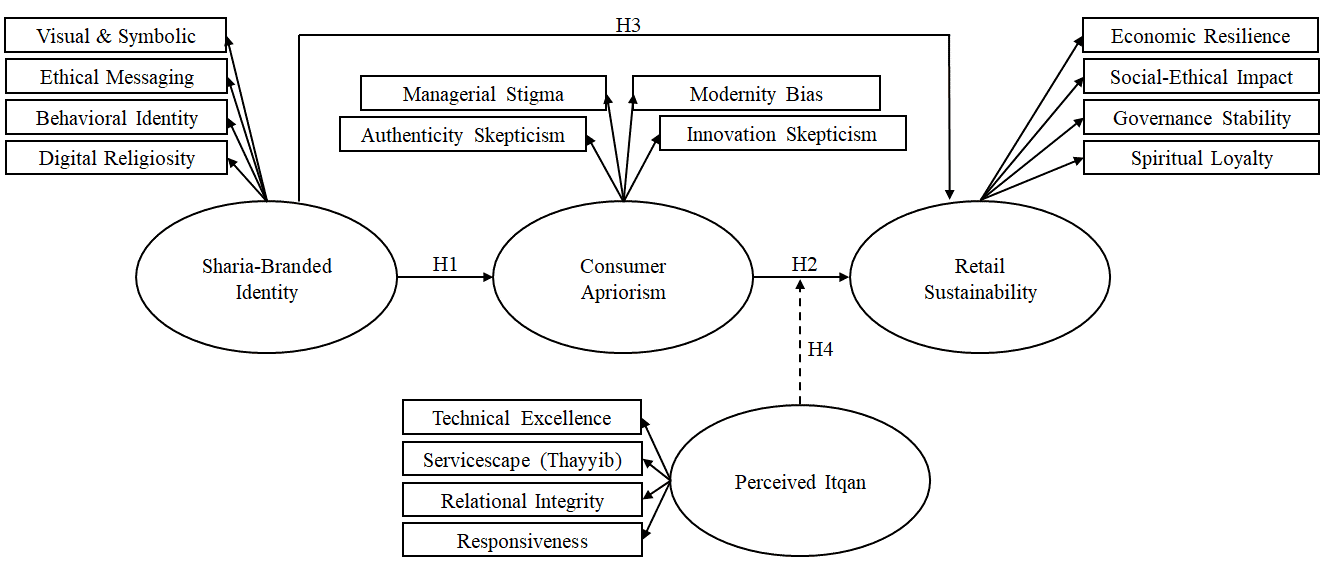
This study examines the impact of religious signaling on Sharia retail through the identity-service paradox. Adopting a quantitative explanatory design and PLS-SEM analysis of 251 Muslim consumers in Indonesia, the study investigates the mediation-moderation model that connects Sharia-branded identity, consumer apriorism, perceived Itqan, and retail sustainability. The findings reveal that Sharia-branded identity considerably enhances consumer apriorism, a pre-evaluative cognitive bias that significantly undermines retail sustainability. A religious signal does not necessarily boost trust pervasively, but can bolster suspicion when considered at odds with certain expectations around performance. This finding further demonstrates that perceived Itqan represents operational excellence, and thus mitigates apriorism by restoring the credibility of religious signals. Mediation analysis confirms that the relationship between Sharia-branded identity and retail sustainability partly operates through consumer apriorism, whereas moderation analysis underscores the contingent role of perceived Itqan as perceived operational excellence. This study extends signaling theory by proposing a nonlinear, performance-contingent process in which the credibility of religious identity depends on cognitive assessment and observable operational capability. The results hold implications for the implementation of competence-driven religious branding in competitive retail settings.
Downloads
References
Abror, A., Patrisia, D., Engriani, Y., Evanita, S., Yasri, Y., & Dastgir, S. (2020). Service quality, religiosity, customer satisfaction, customer engagement and Islamic bank’s customer loyalty. Journal of Islamic Marketing, 11(6), 1691 – 1705. https://doi.org/10.1108/JIMA-03-2019-0044
Afifah, & Kurniawati, N. A. (2021). Influence of Service Quality Dimensions of Islamic Banks on Customer Satisfaction and Their Impact on Customer Loyalty. Journal of Islamic Economic Laws, 4(2), 105–136. https://doi.org/10.23917/jisel.v4i2.15089
Ahmat, M. A. H., Razak, M. R. A., Said, A.-M. A., & Jumain, R. S. A. (2026). Conceptual Framework of Halal Brand Trust and Halal Brand Love in the Context of Brand Resonance Model. In Studies in Systems, Decision and Control (Vol. 612, pp. 1049–1054). Springer Science and Business Media Deutschland GmbH. https://doi.org/10.1007/978-3-031-99466-1_94
Akkaya, Ö., & Kurnaz, G. (2025). Brand personality and theory of planned behavior relation: an Islamic banking brand personality context insights from Türkiye. Journal of Islamic Marketing, 1–32. https://doi.org/10.1108/JIMA-07-2024-0271
Alhouti, S. (Sa’arah), Bao, Y., & Zhang, S. (2026). Brand inclusivity in religion-based marketing: roles of religiosity and diversity appreciation. Journal of Product and Brand Management, 35(2), 288 – 305. https://doi.org/10.1108/JPBM-06-2024-5279
Ali, M., & Raza, S. A. (2017). Service quality perception and customer satisfaction in Islamic banks of Pakistan: the modified SERVQUAL model. Total Quality Management and Business Excellence, 28(5–6), 559 – 577. https://doi.org/10.1080/14783363.2015.1100517
Andespa, R., Yeni, Y. H., Fernando, Y., & Sari, D. K. (2024). Sustainable Development of Islamic Banks by Creating Islamic Branding: Challenges, Importance, and Strategies of Islamic Branding. International Journal of Sustainable Development and Planning, 19(2), 637 – 650. https://doi.org/10.18280/ijsdp.190221
Anwar, M. M. (2025). Halal fashion insights: understanding brand dynamics in consumer perception. Journal of Islamic Marketing, 16(8), 2294–2320. https://doi.org/10.1108/JIMA-04-2024-0149
Arli, D., van Esch, P., Northey, G., Lee, M. S. W., & Dimitriu, R. (2019). Hypocrisy, skepticism, and reputation: the mediating role of corporate social responsibility. Marketing Intelligence and Planning, 37(6), 706 – 720. https://doi.org/10.1108/MIP-10-2018-0434
Ashraf, S., Robson, J., & Farquhar, J. (2019). For Me, My Parents Come First: Role and Religious Identity in Consumer Bank Choice in Pakistan: An Abstract. Developments in Marketing Science: Proceedings of the Academy of Marketing Science, 915 – 916. https://doi.org/10.1007/978-3-030-02568-7_259
Buell, R. W., Kim, T., & Tsay, C.-J. (2017). Creating reciprocal value through operational transparency. Management Science, 63(6), 1673 – 1695. https://doi.org/10.1287/mnsc.2015.2411
Butt, M. M., Rose, S., Wilkins, S., & Ul Haq, J. (2017). MNCs and religious influences in global markets: Drivers of consumer-based halal brand equity. International Marketing Review, 34(6), 885 – 908. https://doi.org/10.1108/IMR-12-2015-0277
Cabano, F. G., & Minton, E. A. (2023). The influence of consumer religiosity on responses to rational and emotional ad appeals. European Journal of Marketing, 57(1), 185–201. https://doi.org/10.1108/EJM-04-2021-0221
Cor, M. K. (2018). Measuring social science concepts in pharmacy education research: From definition to item analysis of self-report instruments. Currents in Pharmacy Teaching and Learning, 10(1), 112–118. https://doi.org/10.1016/j.cptl.2017.09.015
Dhakirah, S., & Hidayatinnisa, N. (2026). Halal Branding, Consumer Trust, and Digital Innovation in the Global Halal Economy. In Integrating Halal Principles Into Modern Supply Chain Strategies. IGI Global. https://doi.org/10.4018/979-8-3373-4197-2.ch008
Etikan, I., Musa, S., Alkassim, R., & Sunusi, R. (2016). Comparison of Convenience Sampling and Purposive Sampling.
Farooq, Y., & Wicaksono, H. (2021). Advancing on the analysis of causes and consequences of green skepticism. Journal of Cleaner Production, 320. https://doi.org/10.1016/j.jclepro.2021.128927
Fianto, B. A., & Shah, S. A. A. (2026). Incorporating sustainability into Islamic marketing: proposing a framework of sustainable Islamic marketing. Journal of Islamic Accounting and Business Research, 1 – 43. https://doi.org/10.1108/JIABR-08-2023-0280
Fornell, C., & Larcker, D. F. (1981). Structural equation models with unobservable variables and measurement error: Algebra and statistics. Journal of Marketing Research, 18. https://doi.org/10.1177/002224378101800313
Ghoniyah, N., Amilahaq, F., & Hartono, S. (2024). Business sustainability performance through sustainability awareness and business work ethics in Islamic institutions. Cogent Business and Management, 11(1). https://doi.org/10.1080/23311975.2024.2303789
Gidaković, P., & Zabkar, V. (2021). How industry and occupational stereotypes shape consumers’ trust, value and loyalty judgments concerning service brands. Journal of Service Management, 32(6), 92–113. https://doi.org/10.1108/JOSM-12-2020-0447
Gligor, D. M., & Maloni, M. J. (2022). More is not always better: The impact of value co-creation fit on B2B and B2C customer satisfaction. Journal of Business Logistics, 43(2), 209 – 237. https://doi.org/10.1111/jbl.12278
Hair, J. F. J., Hult, G. T. M., Ringle, C. M., & Sarstedt, M. (2022). A primer on partial least squares structural equation modeling (PLS-SEM)(Third Edit). SAGE Publications Inc.
Hansen, M. A., & Tsheko, G. N. (2021). A primer on survey research. In Handbook of Research on Advancements in Organizational Data Collection and Measurements: Strategies for Addressing Attitudes, Beliefs, and Behaviors. IGI Global. https://doi.org/10.4018/978-1-7998-7665-6.ch001
Hayati, K., & Caniago, I. (2025). Exploring the influence of ethical leadership on employee performance: the mediating role of Islamic work ethic. International Journal of Ethics and Systems, 41(3), 608 – 629. https://doi.org/10.1108/IJOES-09-2024-0269
Henseler, J., Ringle, C., & Sinkovics, R. (2009). The Use of Partial Least Squares Path Modeling in International Marketing. In Advances in International Marketing (Vol. 20, pp. 277–319). https://doi.org/10.1108/S1474-7979(2009)0000020014
Idris, I., Alias, S. S., & Singh, S. K. N. (2020). Perception of muslim consumers towards halal branding in advertising. International Journal of Criminology and Sociology, 9, 2004 – 2011. https://doi.org/10.6000/1929-4409.2020.09.235
Ishak, M. S. I., & Asni, F. (2020). The role of maqasid al-Shariʿah in applying fiqh muamalat into modern Islamic banking in Malaysia. Journal of Islamic Accounting and Business Research, 11(9), 2137 – 2154. https://doi.org/10.1108/JIABR-12-2019-0224
Ivascu, L., Ali, W., Khalid, R., & Raza, M. (2023). The Impact of Competitive Strategies on Performance of Banking Sector; The Mediating Role of Corporate Social Responsibility and Operational Excellence. Energies, 16(1). https://doi.org/10.3390/en16010297
Jumani, Z. A., & Muhamad, N. (2023). Development and validation of key antecedents of religious brand attitude: a cross-cultural quantitative analysis using smart PLS. Journal of Islamic Marketing, 14(11), 2771 – 2797. https://doi.org/10.1108/JIMA-06-2022-0177
Kamri, N. A., Sarif, S., Ali, N. A., & Mokti, H. A. (2024). Ethics of Ikram al-Dayf for Quality Muslim-Friendly Hospitality Services. Millah: Journal of Religious Studies, 23(1), 467–504. https://doi.org/10.20885/millah.vol23.iss1.art15
Karmagatri, M., Utama, I. D., Yogie, H., Chen, J. L., & Hasan, H. (2023). Naive Bayes Sentiment Analysis on Perceptions of Halal Certification: A Case Study on Mixue Indonesia. Journal of Theoretical and Applied Information Technology, 101(17), 6781 – 6789. https://www.scopus.com/inward/record.uri?eid=2-s2.0-85174953138&partnerID=40&md5=6be6ed08c4c3f66ad06be875010982ce
Kaur, V. (2019). Research Methodology. Innovation, Technology and Knowledge Management, 77 – 112. https://doi.org/10.1007/978-3-030-21649-8_3
Khan, M. A., Vivek, Minhaj, S. M., Saifi, M. A., Alam, S., & Hasan, A. (2023). Impact of Store Design and Atmosphere on Shoppers’ Purchase Decisions: An Empirical Study with Special Reference to Delhi-NCR. Sustainability, 15(1). https://doi.org/10.3390/su15010095
Kholilah, S., Maminirina Fenitra, R., Hati, S. R. H., & Thurasamy, R. (2024). Food for the soul: religious identity and ethical halal labelling in sharing economy apps. Identities. https://doi.org/10.1080/1070289X.2024.2444105
Kock, F., Berbekova, A., & Assaf, A. G. (2021). Understanding and managing the threat of common method bias: Detection, prevention and control. Tourism Management, 86, 104330. https://doi.org/https://doi.org/10.1016/j.tourman.2021.104330
Lavorata, L. (2022). Sustainability, Skepticism and Suspicion: What Do Consumers Think About Retailers? An Abstract. Developments in Marketing Science: Proceedings of the Academy of Marketing Science, 173 – 174. https://doi.org/10.1007/978-3-030-89883-0_47
Liu, R. L., & Minton, E. A. (2018). Faith-filled brands: The interplay of religious branding and brand engagement in the self-concept. Journal of Retailing and Consumer Services, 44, 305 – 314. https://doi.org/10.1016/j.jretconser.2018.07.022
Ltifi, M. (2025). Prospecting the antecedents of brand hatred among Muslim consumers: a qualitative study. International Journal of Law and Management. https://doi.org/10.1108/IJLMA-06-2025-0244
Lusch, R. F., Vargo, S. L., & O’Brien, M. (2007). Competing through service: Insights from service-dominant logic. Journal of Retailing, 83(1), 5–18. https://doi.org/https://doi.org/10.1016/j.jretai.2006.10.002
Martinelli, E., & de Canio, F. (2021). Country image dimensions and retail brand equity. A multi-cue analysis. Sinergie, 39(2), 17 – 36. https://doi.org/10.7433/S115.2021.02
Meliyana, H., Adiba, E. M., & Dahruji, D. (2026). What Reduces Switching Behavior in Indonesian Islamic Banking? The Mediating Role of Customer Satisfaction. Journal of Islamic Economic Laws, 9(1), 95–116. https://doi.org/10.23917/jisel.v9i01.13794
Minton, E. A. (2020). When open-mindedness lowers product evaluations: Influencers to consumers’ response to religious cues in advertising. Psychology and Marketing, 37(3), 369 – 383. https://doi.org/10.1002/mar.21296
Moufakkir, O. (2025). “How do Muslims reconcile religious commitment with conventional banking?”: Unpacking Muslims’ rejection of Islamic banking through consistency theories. Journal of Islamic Marketing. https://doi.org/10.1108/JIMA-11-2024-0528
Mubarrok, U. S., Ulfi, I., Sukmana, R., & Sukoco, B. M. (2022). A bibliometric analysis of Islamic marketing studies in the “journal of Islamic marketing.” Journal of Islamic Marketing, 13(4), 933–955. https://doi.org/10.1108/JIMA-05-2020-0158
Muflih, M., & Juliana, J. (2021). Halal-labeled food shopping behavior: the role of spirituality, image, trust, and satisfaction. Journal of Islamic Marketing, 12(8), 1603–1618. https://doi.org/10.1108/JIMA-10-2019-0200
Munandar, A. N. I., Ratnasari, R. T., Rusgianto, S., & Permana, I. M. (2025). Faith at work: how Islamic leadership transforms Indonesia’s Islamic banking landscape. Journal of Islamic Accounting and Business Research, 1 – 19. https://doi.org/10.1108/JIABR-03-2025-0172
Nickerson, C., & Menon Nandialath, A. (2020). The impact of religious salience on purchase intentions: evidence from the UAE. Journal of Islamic Marketing, 11(6), 1339 – 1350. https://doi.org/10.1108/JIMA-01-2019-0005
Panakaje, N., Zuha, A., Parvin, S. M. R., Sheikh, N., Shaid, M., Irfana, S., & V, M. (2025). Exploring the role of islamic ethical training and business integrity in shaping ethical decision-making and business performance: a mediated–moderated analysis. Journal of Islamic Accounting and Business Research, 1 – 33. https://doi.org/10.1108/JIABR-02-2025-0099
Rahmatullah, Haryono, S., Ardi, M. Z., Syaefullah, & Saputra, V. A. (2025). Halal Industry and Certification in Disguise: Is It Faith Implementation or Economic Ploy in Indonesia’s Legal Framework? Jurisdictie: Jurnal Hukum Dan Syariah, 16(2), 334 – 373. https://doi.org/10.18860/j.v16i2.33812
Sami, F., & Khan, I. H. (2025). Innovative Islamic retail business models. In Retail Innovations in Business Models. IGI Global. https://doi.org/10.4018/979-8-3693-7620-1.ch008
Sobari, N., Kurniati, A., & Usman, H. (2022). The influence of Islamic attributes and religious commitments toward halal wellness services customer satisfaction and loyalty. Journal of Islamic Marketing, 13(1), 177 – 197. https://doi.org/10.1108/JIMA-11-2018-0221
Suhartanto, D., Setiawan, S., & Safitri, F. M. (2026). AI-enabled brand experience and Shariah compliance in Islamic digital banking. Journal of Islamic Marketing, 1–20. https://doi.org/10.1108/JIMA-07-2025-0411
Sumpena, M., Hikmah, N., Annisa, F., & Warsidi. (2026). From Legal Compliance to Spiritual Authenticity: The Role of Halal Certification in Shaping Muslim Tourists’ Experiences. Journal of Islamic Economic Laws, 9(1), 75–94. https://doi.org/10.23917/jisel.v9i01.13598
Topcan, O., Uluturk, B., Iltar, E. K., & Akcoru, R. (2025). Impact of Islamic work ethic on employee ethical behavior: the serial mediation of moral identity and felt obligation. Personnel Review, 54(1), 350 – 370. https://doi.org/10.1108/PR-01-2024-0045
Torres, P., & Augusto, M. (2019). Building resilience to negative information and increasing purchase intentions in a digital environment. Journal of Business Research, 101, 528 – 535. https://doi.org/10.1016/j.jbusres.2018.11.045
Tosun, P., & Yanar Gürce, M. (2024). Consumer complaining behavior in banking: the influence of brand image on brand forgiveness and negative word-of-mouth. Journal of Financial Services Marketing, 29(2), 203 – 213. https://doi.org/10.1057/s41264-022-00194-5
Tubastuvi, N., & Ramadani, A. G. (2025). Maqasid Al Shari’ah Perspective on the Green Economy for Halal Industry Sustainability. In Green and Blue Economy Frameworks for Halal Industry Sustainability. https://doi.org/10.1007/978-981-96-1729-6_5
Vanany, I., Soon, J. M., Maryani, A., & Wibawa, B. M. (2020). Determinants of halal-food consumption in Indonesia. Journal of Islamic Marketing, 11(2), 516 – 530. https://doi.org/10.1108/JIMA-09-2018-0177
Wahab, A., Kuswanjono, A., & Mahdiya, I. (2026). Halal Industry and Islamic Epistemology: Implications for Policy, Ethics, and Global Practices. Journal of Islamic Economic Laws, 9(1), 144–169. https://doi.org/10.23917/jisel.v9i01.13268
Wan Ismail, W. R., Othman, M., Md Nor, N., Badiuzaman, A. F., & Nik Mohd Nor, N. M. S. (2022). Halal Malaysia brand equity mishap: False recognition of brand mere recognition using mixed method approach. Journal of Islamic Marketing, 13(1), 5–19. https://doi.org/10.1108/JIMA-04-2019-0073
Wibisono, V. F., Arief, S., & Rafifah, F. H. (2025). Muslimah Label or Sharia-Compliant Brand? A Study on Kirei Salon and Spa Muslimah Bekasi Through The Lens of DSN-MUI Fatwa. Journal of Islamic Economic Laws, 8(2), 1–23. https://doi.org/10.23917/jisel.v8i02.9860
Wilson, J. A. J., & Liu, J. (2011). The challenges of Islamic branding: Navigating emotions and halal. Journal of Islamic Marketing, 2(1), 28 – 42. https://doi.org/10.1108/17590831111115222
Zehra, S., & Minton, E. (2020). Should businesses use religious cues in advertising? A comparison of consumer perceptions across Christianity and Islam. International Journal of Consumer Studies, 44(5), 393 – 406. https://doi.org/10.1111/ijcs.12512
Zouari, G., & Abdelhedi, M. (2021). Customer satisfaction in the digital era: evidence from Islamic banking. Journal of Innovation and Entrepreneurship, 10(1). https://doi.org/10.1186/s13731-021-00151-x
Downloads
Submitted
Accepted
Published
How to Cite
Issue
Section
License
Copyright (c) 2026 Journal of Islamic Economic Laws

This work is licensed under a Creative Commons Attribution-ShareAlike 4.0 International License.