Measuring Intellectual Capital in Non-Profit Organizations: An Exploratory Study of Waqf Institutions in Malaysia
DOI:
https://doi.org/10.23917/jisel.v9i02.17128Keywords:
Intellectual Capital, Organizational Performance, Non-Profit Organizations, Waqf Institutions, MalaysiaAbstract
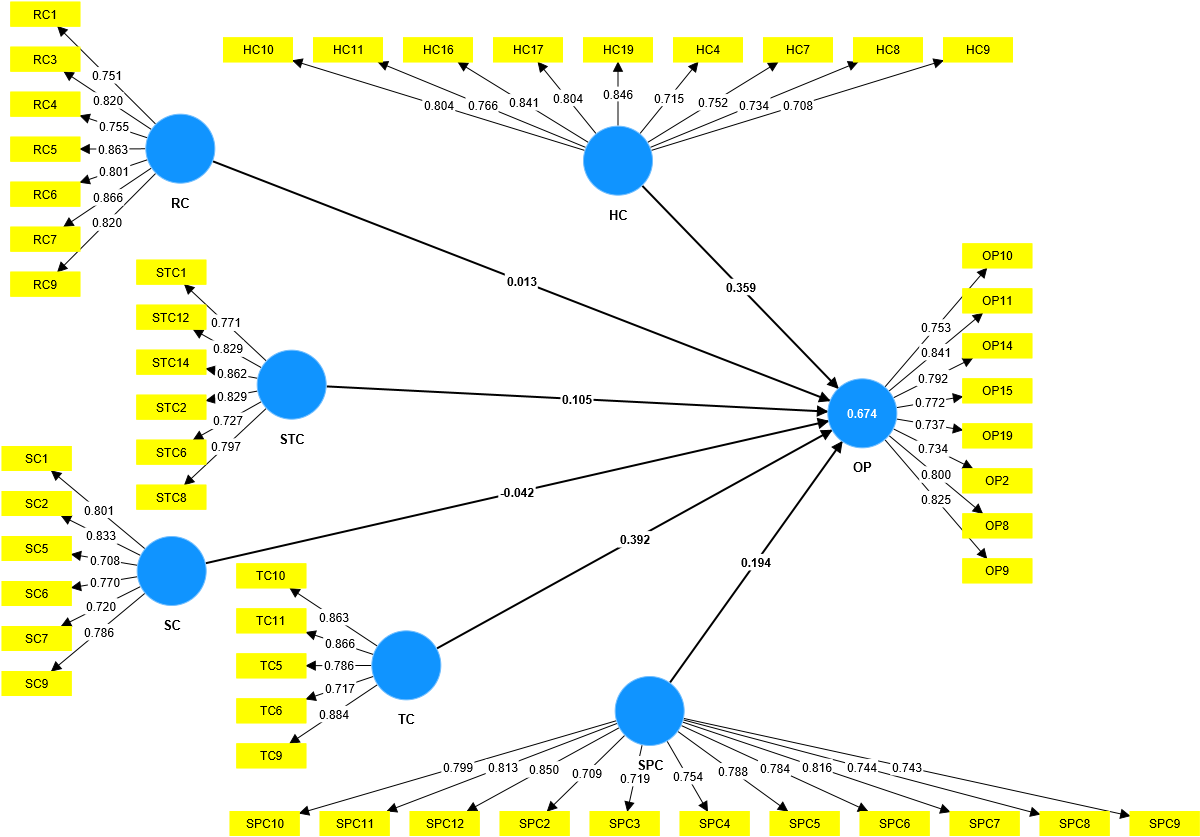
In the era of knowledge-based economies, successful organizations are those that recognize, manage, and leverage intellectual capital (IC) to enhance their activities and improve organizational performance, thereby gaining a competitive advantage. This study aims to identify and examine the role and significance of IC components within Malaysian waqf institutions. Data were collected through structured questionnaires administered to 202 waqf employees across five State Islamic Religious Councils (SIRCs) in Malaysia. The data were analyzed using Partial Least Squares Structural Equation Modelling (PLS-SEM) to test the path relationships among the study constructs.The findings indicate that human capital, technological capital, and spiritual capital are positively and significantly associated with organizational performance. In contrast, relational capital, structural capital, and social capital were not found to have a significant impact within the context of Malaysian waqf institutions. This study offers novel insights into the strategic role of IC in the performance of waqf institutions, particularly in a non-profit Islamic context. By integrating knowledge and IC concepts, the study provides a foundational framework to better understand and address long-standing challenges in waqf institutions, such as mismanagement and lack of accountability. The findings have practical implications for both Malaysian and global waqf administrators.
Downloads
References
Abd-Elrahman, A.-E. H., & Ahmed Kamal, J. M. (2022). Relational capital, service quality and organizational performance in the Egyptian telecommunication sector. International Journal of Emerging Markets, 17(1), 299–324.
Abdulkareem, A. K., Ishola, A. A., Abdulkareem, Z. J., Oladimeji, K. A., Adejumo, A., & Ayinla, A. A. (2025). Ethical behaviour, organisational support and employee outcomes in driving public sector organisational performance. RAUSP Management Journal, Vol. 60 No. 1 pp. 175–191, doi: https://doi.org/10.1108/RAUSP-06-2024-0130
Abdullah, F. (2012). The role of Islam in human capital development: a juristic analysis. Humanomics, 28(1), 64–75.
Adnan, N. S., Kamaluddi, A., & Kasim, N. (2013). Intellectual capital in religious organisations: Malaysian zakat institutions perspective. Middle-East Journal of Scientific Research, 16(3), 368–377.
Aghel, M., & Azam, S. M. F. (2026). The impact of human, structural and relational capital on financial performance: the mediating role of knowledge management in Libyan HEIs. International Journal of Productivity and Performance Management, Vol. ahead-of-print No. ahead-of-print. https://doi.org/10.1108/IJPPM-01-2025-0006
Al-Daihani, M., Dirie, K. A., Muneem, A., Abdul Lateb, N., & Bouteraa, M. (2025). Islamic social finance and its potential in addressing natural disaster emergencies and advancing sustainable development goals: a proposed model. International Journal of Ethics and Systems. Vol. ahead-of-print No. ahead-of-print. https://doi.org/10.1108/IJOES-05-2024-0138
Al-Romeedy, B. S., & Adekoya, O. D. (2025). Knowledge Workers in Africa: Igniting the Flame of Intellectual Capital for Future Careers. In Careers in Africa: Trends, Opportunities and Challenges (pp. 235–255). Springer.
Al Frijat, Y. S., & Elamer, A. A. (2025). Human capital efficiency, corporate sustainability, and performance: Evidence from emerging economies. Corporate Social Responsibility and Environmental Management, 32(2), 1457–1472.
Alshukri, T., Seun Ojekemi, O., Öz, T., & Alzubi, A. (2024). The interplay of corporate social responsibility, innovation capability, organizational learning, and sustainable value creation: does stakeholder engagement matter? Sustainability, 16(13), 5511.
Álvarez-González, L. I., Barroso-Méndez, M. J., Galera-Casquet, C., & Valero-Amaro, V. (2023). The impact of technologies on society through NPO-social enterprise value co-creation. Humanities and Social Sciences Communications, 10(1), 1–15.
Arshad, R., & Zain, N. M. (2017). Performance measurement and accountability of waqf institutions in Malaysia. SHS Web of Conferences, 36, 5.
Ascarya, A., Hosen, M. N., & Rahmawati, S. (2022). Designing simple productive waqf models for Indonesia. International Journal of Ethics and Systems, 38(3), 380-401.
Aslam, E., Ur Rehman, A., & Iqbal, A. (2024). The mediating role of intellectual capital in corporate governance and financial efficiency of Islamic banks. Corporate Governance: The International Journal of Business in Society, 24(1), 19–40.
Asrori, Mukhibad, H., Anisykurlillah, I., Rizkyana, F. W., Nurkhin, A., & Wolor, C. W. (2026). The moderating role of trust in the effect of the theory of planned behaviour factors on cash waqf donation for sustainable well-being. Management & Sustainability: An Arab Review, Vol. ahead-of-print No. ahead-of-print. https://doi.org/10.1108/MSAR-12-2024-0219
Ayub, M., Khan, K., Khan, M., & Ismail, M. (2025). Management and governance of Awqāf as social finance institutions. Qualitative Research in Financial Markets. Vol. ahead-of-print No. ahead-of-print. https://doi.org/10.1108/QRFM-01-2025-0013
Becker, J.-M., Ringle, C. M., Sarstedt, M., & Völckner, F. (2015). How collinearity affects mixture regression results. Marketing Letters, 26(4), 643–659.
Benevene, P., Kong, E., Barbieri, B., Lucchesi, M., & Cortini, M. (2017). Representation of intellectual capital’s components amongst Italian social enterprises. Journal of Intellectual Capital, 18(3), 564-587.
Gillian Ragsdell, D., Bloice, L., & Burnett, S. (2016). Barriers to knowledge sharing in third sector social care: a case study. Journal of knowledge Management, 20(1), 125-145.
Bonang, D., Sukmana, R., Alimusa, L. O., & Machfud, S. (2026). Exploring the socio-economic dimensions of Islamic charitable giving: a bibliometric review. International Journal of Ethics and Systems, Vol. ahead-of-print No. ahead-of-print. https://doi.org/10.1108/IJOES-02-2025-0086
Chin, W. W. (1998). The partial least squares approach to structural equation modeling. Modern Methods for Business Research, 295(2), 295–336.
Choudhury, M. A., Pratiwi, A., & Hoque, M. N. (2019). Waqf, perpetual charity, in a general system theory of tawhidi metascience. Thunderbird International Business Review, 61(5), 777–792.
Cohen, J. (1988). Statistical power analysis for the behavioral sciences Lawrence Earlbaum Associates. Hillsdale, NJ, 20–26.
Dong, F., & Doukas, J. (2025). The role of intangible assets in shaping firm value. European Financial Management. 31(4), 1325-1353.
Dzhengiz, T. (2020). A literature review of inter-organizational sustainability learning. Sustainability, 12(12), 4876.
Gumbau-Albert, M., & Maudos, J. (2022). The importance of intangible assets in regional economic growth: a growth accounting approach. The Annals of Regional Science, 69(2), 361–390.
Hair, J. F., Anderson, R. E., Babin, B. J., & Black, W. C. (2010). Multivariate data analysis: A global perspective (Vol. 7). Pearson Upper Saddle River, NJ.
Hair, J. F., Risher, J. J., Sarstedt, M., & Ringle, C. M. (2019). When to use and how to report the results of PLS-SEM. European business review, 31(1), 2-24.
Hair Jr, J. F., Howard, M. C., & Nitzl, C. (2020). Assessing measurement model quality in PLS-SEM using confirmatory composite analysis. Journal of Business Research, 109, 101–110.
Harandi, A. A. H., Valmohammadi, C., & Esmaeili, S. (2026). An intellectual capital model for the development of digital transformation in Iran’s national transportation sector. International Journal of Learning and Intellectual Capital. 22(4), 385-411.
Harb, Y., Khabbaz, L., Azouri, M., & Estephan, S. (2026). Sustaining non-profit organizations: Strategic, managerial and financial perspectives. PLoS One, 21(1), e0339885.
Haron, H., Abidin, Z. Z., Ramli, N. M., Ariffin, A. R. M., Jamil, N. N., & Alwi, K. (2023). Human Governance Index for State Islamic Religious Councils in Malaysia. Journal of Governance and Integrity, 6(1), 441–454.
Hassan, R., & Noor, F. M. (2025). Assessment of Good Governance Practice in Selected Corporate Waqf Institutions in Malaysia. International Journal of Islamic Economics and Finance Research, 1, 48–63.
Hassan, R., & Yusoff, A. (2020). Enhancing good governance practices of waqf institutions: learning from Shariah governance framework of Islamic financial institutions. International Journal of Islamic Economics and Finance Research, 3(2 December), 65–76.
Henseler, J., Ringle, C. M., & Sinkovics, R. R. (2009). The use of partial least squares path modeling in international marketing. In New challenges to international marketing (pp. 277–319). Emerald Group Publishing Limited.
Kamaruddin, M. I. H., & Hanefah, M. M. (2021). An empirical investigation on waqf governance practices in waqf institutions in Malaysia. Journal of Financial Reporting and Accounting, 19(3), 455–473.
Kamaruddin, M. I. H., Hanefah, M. M., & Masruki, R. (2024). Challenges and prospects in waqf reporting practices in Malaysia. Journal of Financial Reporting and Accounting, 22(3), 752–765.
Khalique, M., Hina, K., Ramayah, T., & Shaari, J. A. N. B. (2020). Intellectual capital in tourism SMEs in Azad Jammu and Kashmir, Pakistan. Journal of Intellectual Capital, 21(3), 333-355.
Khan, B., Farooq, A., & Hussain, Z. (2010). Human resource management: an Islamic perspective. Asia-Pacific Journal of Business Administration, 2(1), 17–34.
Kong, E., & Prior, D. (2008). An intellectual capital perspective of competitive advantage in nonprofit organisations. International Journal of Nonprofit and Voluntary Sector Marketing, 13(2), 119–128.
Laallam, A., Kassim, S., Adawiah, E. R., & Saiti, B. (2020). Towards Knowledge-Based Waqf Organizations. In Challenges and Impacts of Religious Endowments on Global Economics and Finance (pp. 100–120). IGI Global.
Laallam, A., Kassim, S., Adawiah, E. R., & Saiti, B. (2020). Intellectual capital in non-profit organisations: lessons learnt for waqf institutions. ISRA International Journal of Islamic Finance. 12(1), 27–48, doi: https://doi.org/10.1108/IJIF-10-2018-0111
Laallam, A., Uluyol, B., Kassim, S., & Engku Ali, E. R. A. (2022). The components of intellectual capital and organisational performance in waqf institutions: evidence from Algeria based on structural equation modelling. Journal of Islamic Accounting and Business Research, 13(7), 1110–1136.
Lahsasna, A. (2018). I have a dream: waqf market in addition to islamic banking, takaful and the islamic capital market. Journal of Wealth Management and Financial Planning, 5, 47–53.
Listiana, L., Andrian, F. K., Syahyuti, S., Silalahi, S. A. F., & Laallam, A. (2026). The role of Waqf in CSR: models from Indonesia and Malaysia and new proposals. Journal of Islamic Accounting and Business Research, 1–19.
Lumpkin, G. T., & Bacq, S. (2019). Civic wealth creation: A new view of stakeholder engagement and societal impact. Academy of Management Perspectives, 33(4), 383–404.
Majeed, M. T. (2019). Social capital and economic performance of the Muslim world: Islamic perspectives and empirical evidence. International Journal of Islamic and Middle Eastern Finance and Management, 12(4), 601–622.
Maretaniandini, S. T., Hilmiyah, F., & Akbar, S. (2025). Implementation of Advanced Technology in Waqf Management: A Systematic Literature Review. Journal of Islamic Economic Laws, 8(01), 210–236.
Marques, C., Mascarenhas, C., Mendes, T., Galvão, A. R., & Borges, N. (2025). Empowerment beyond effort: exploring the influence of intrapreneurial behavior in non-profit organizations. Journal of Entrepreneurship and Public Policy. 14(3), 415–441, doi: https://doi.org/10.1108/JEPP-07-2024-0125
Maulina, R., Dhewanto, W., Faturohman, T., & Dellyana, D. (2026). What motivates waqf-based (Islamic endowment) entrepreneurs in creating sustainable welfare? An empirical investigation in Indonesia. Journal of Islamic Accounting and Business Research, Vol. ahead-of-print No. ahead-of-print. https://doi.org/10.1108/JIABR-11-2023-0383
Mhd Sarif, S., Hidayatullah, R. A., Firmansah, Y., & Abdul Razak, D. (2026). Sacred trust and sustainable future: embedding tawhidic epistemology values in waqf enterprises. Issues and Perspectives in Business and Social Sciences, 6(2), 222–243.
Minhad, S. F. N., Ahmad, K., Abdullah, Z., Kasim, E. S., Ali, N. A. M., & Nawawi, N. H. A. (2023). Web-Based Sustainability Reporting: Evidence From State Islamic Religious Councils in Malaysia. In J. Said, D. Daud, N. Erum, N. B. Zakaria, S. Zolkaflil, & N. Yahya (Eds.), Building a Sustainable Future: Fostering Synergy Between Technology, Business and Humanity, vol 131. European Proceedings of Social and Behavioural Sciences (pp. 11-28). European Publisher. https://doi.org/10.15405/epsbs.2023.11.2.
Mohammad, M. T. S. H. (2008). Sustaining the means of Sustainability: The need for accepting Wakaf (Waqf) assets in Malaysian property market. The 14th Annual Conference of the Pacific Rim Real Estate Society, January 20 - 23.
Mohd Noor, N. H., Hajar, S. A. B., & Idris, M. A. (2015). The determinant of nonprofit external and internal effectiveness: the role of knowledge sharing, collaborative culture, and beneficiary participation. Human Service Organizations: Management, Leadership & Governance, 39(5), 459–474.
Mustaffa, J., Isa, M. Y. B. M., & Mohammed, Z. (2022). Governance structures: Dependability and efficiency of the waqf institutional system in Malaysia. Journal of Economics and Business Aseanomics, 7(2), 58–70.
Norinah, M. A. (2020). The practice of Waqf land development in Malaysia: A social enterprise business perspective/Norinah Mohd Ali (Doctoral dissertation, Universiti Malaya).
Oliveira, M., Sousa, M., Silva, R., & Santos, T. (2021). Strategy and human resources management in non-profit organizations: Its interaction with open innovation. Journal of Open Innovation: Technology, Market, and Complexity, 7(1), 75.
Rahman, S. A., Khan, G. M., AlAbri, S., & Taghizadeh, S. K. (2022). The role of intellectual capital on entrepreneurial opportunity recognition among SMEs in the Sultanate of Oman. Journal of Intellectual Capital, 23(4), 816-839.
Rehman, A. U., Aslam, E., & Iqbal, A. (2022). Intellectual capital efficiency and bank performance: Evidence from islamic banks. Borsa Istanbul Review, 22(1), 113–121.
Ringle, C. M., Sarstedt, M., & Straub, D. W. (2012). A critical look at the use of PLS-SEM in MIS quarterly. MIS Q. Manag. Inf. Syst, 36(1), 10-2307.
Salehi, M., Fahimi, M. A., Zimon, G., & Homayoun, S. (2022). The effect of knowledge management on intellectual capital, social capital, and firm innovation. Journal of Facilities Management, 20(5), 732–748.
Sanzo, M. J., Alvarez, L. I., Rey, M., & García, N. (2015). Business–nonprofit partnerships: a new form of collaboration in a corporate responsibility and social innovation context. Service Business, 9(4), 611–636.
Shabbir, M. S. (2018). Classification and prioritization of waqf lands: a Selangor case. International Journal of Islamic and Middle Eastern Finance and Management, 11(1), 40-58.
Sharabati, A.-A. A., Jawad, S. N., Bontis, N., Naji Jawad, S., & Bontis, N. (2010). Intellectual capital and business performance in the pharmaceutical sector of Jordan. Management Decision, 48(1), 105–131. https://doi.org/10.1108/00251741011014481
Sharip, S. M., Daud, D., Kamdari, N. M., Ibrahim, S. S., Awang, M., & Ismail, R. (2023). Rahmah among Muslim leaders: The case of waqf institutions. Journal of Islamic Thought and Civilization, 13(2), 242–257.
Singh, M. K. (2024). Implications of Social Capital. In Social Capital (pp. 49–64). Emerald Publishing Limited.
Stokes, P., Baker, C., & Lichy, J. (2016). The role of embedded individual values, belief and attitudes and spiritual capital in shaping everyday postsecular organizational culture. European Management Review, 13(1), 37–51.
Vasconcelos, A. F. (2021). Individual spiritual capital: meaning, a conceptual framework and implications. Journal of Work-Applied Management, 13(1), 117–141.
Vinzi, V. E., Trinchera, L., & Amato, S. (2010). PLS path modeling: from foundations to recent developments and open issues for model assessment and improvement. In Handbook of partial least squares (pp. 47–82). Springer.
Weerakoon, C., McMurray, A. J., Rametse, N. M., & Arenius, P. M. (2020). Social capital and innovativeness of social enterprises: opportunity-motivation-ability and knowledge creation as mediators. Knowledge Management Research & Practice, 18(2), 147–161.
Yusmazida, M. Y., Omar, M. K., Yusliza, M. Y., Samad, S., & Abdul Mokmin, K. (2025). Developing an Islamic structural capital model: perspectives from SMEs. Journal of Islamic Marketing. 16(11), 3413–3455, doi: https://doi.org/10.1108/JIMA-06-2024-0238
Zafar, M. B., & Jafar, A. (2024). Human capital and Islamic banking: a systematic literature review. Journal of Islamic Accounting and Business Research. Vol. ahead-of-print No. ahead-of-print. https://doi.org/10.1108/JIABR-11-2023-0376
Zakariyah, H., Salaudeen, A. O., Othman, A. H. A., & Rosman, R. (2022). Enhancing waqf management through fintech in Malaysia: a conceptual framework on the technology acceptance model (TAM). Journal of Emerging Economies & Islamic Research, 10(2), 62–73.
Zakiy, F. S., & Falikhatun, F. (2024). The role of intellectual capital on zakat performance: insight from Indonesia. Journal of Intellectual Capital, 25(5/6), 1006–1025.
Downloads
Submitted
Accepted
Published
How to Cite
Issue
Section
License
Copyright (c) 2026 Journal of Islamic Economic Laws

This work is licensed under a Creative Commons Attribution-ShareAlike 4.0 International License.