Do Institutional and Psychological Supports Foster Islamic Entrepreneurial Intention? Evidence from Productive Zakat Beneficiary Students in Indonesia and Malaysia
DOI:
https://doi.org/10.23917/jisel.v9i01.16783Keywords:
Islamic Entrepreneurship Intention, University Support, Perceived Organizational Support, Self Efficacy, Productive Zakat ScholarshipAbstract
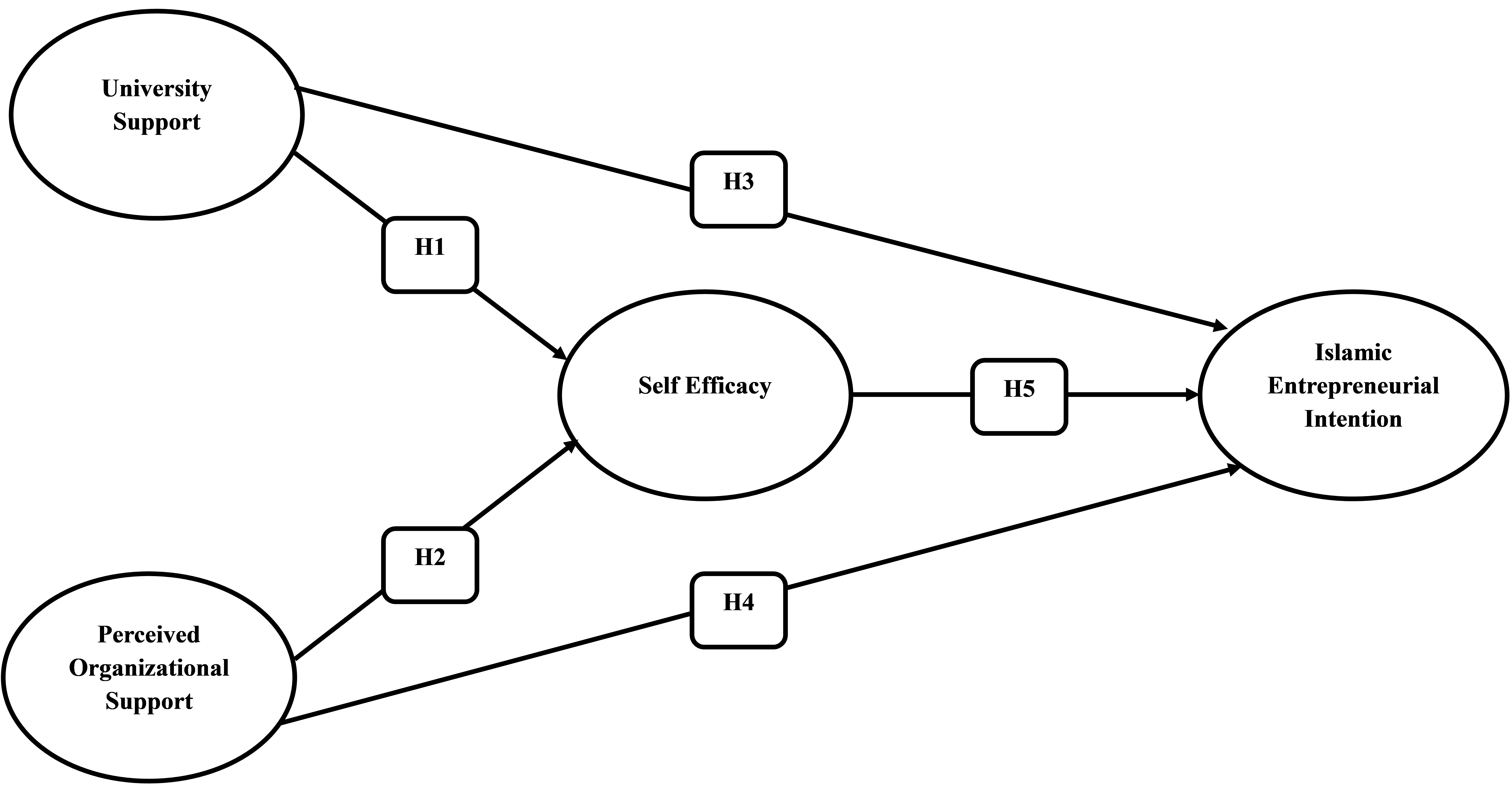
This study examines the determinants of Islamic entrepreneurial intention among productive zakat scholarship recipients in Indonesia and Malaysia. Data from 142 respondents were analyzed using Partial Least Squares Structural Equation Modeling (PLS-SEM) to assess the effects of university support, perceived organizational support, and self-efficacy. The results show that university support and perceived organizational support significantly enhance self-efficacy, indicating the importance of institutional support in strengthening entrepreneurial confidence. University support also positively influences Islamic entrepreneurial intention, while perceived organizational support does not have a direct effect on intention. Self-efficacy emerges as the strongest predictor of Islamic entrepreneurial intention, highlighting its central role in translating institutional support into entrepreneurial motivation. The multi-group analysis reveals differences between Indonesia and Malaysia: in Indonesia, perceived organizational support strongly strengthens self-efficacy, which subsequently drives entrepreneurial intention, whereas in Malaysia, university support improves self-efficacy but does not significantly translate into intention. These findings suggest that the impact of institutional support on Islamic entrepreneurial intention is context-dependent across countries. Universities and zakat institutions should complement financial assistance with mentoring, business incubation, and networking opportunities to strengthen entrepreneurial intention among scholarship recipients. The study contributes to the literature by providing comparative evidence from Indonesia and Malaysia on the role of institutional support in shaping Islamic entrepreneurial intention.
Downloads
References
Ajzen, I. (1985). From intentions to actions: a theory of planned behavior. In Action Control From Cognition To Behavior (In J. Kuhl). Springer Berlin Heidelberg.
Ahmad, S. N. B., & Malik, I. (2023). Understanding Attitude Towards Entrepreneurial Intention Among Asnāf Gen Z in Sabah BT - Research on Islamic Business Concepts (V. Ramadani, B. Alserhan, L.-P. Dana, J. Zeqiri, H. Terzi, & M. Bayirli, Eds.; pp. 221–235). Springer Nature Singapore. https://doi.org/10.1007/978-981-99-5118-5_13
Al Alawi, A. M., Al Kindi, K., Al Shukaili, A., & Ahmed, E. R. (2023). Entrepreneurial activities, innovation, and job creation: the role of demographics and creativity as moderators. International Journal of Innovation Science, 17(1), 123–147. https://doi.org/10.1108/IJIS-12-2022-0232
Al Haq, M. A., Abd Wahab, N., & Alam, M. M. (2021). Understanding the impact of institutional factors on asnāf sustainability: a PLS-SEM approach. Journal of Islamic Monetary Economics and Finance, 7(4), 759–790. https://doi.org/10.21098/jimf.v7i4.1289
Alkahlout, Ola. (2024). Zakat Applications in Peacebuilding Activities: Desired and Controversial Applications on Agreeable and Contested Projects. Case Study: Qatar. Journal of Peacebuilding & Development, 20(2), 236–252. https://doi.org/10.1177/15423166241304011
Amelia, E., & Sheptianingsih, S. (2025). Effectiveness of agronative farming cooperatives in empowering Mustahik through productive zakat: A case study of Dompet Dhuafa Farming Villages. Towards Resilient Societies: The Synergy of Religion, Education, Health, Science, and Technology, 545–549. https://doi.org/10.1201/9781003645542-87
Anwar, M. K., Ridlwan, A. A., Timur, Y. P., Dewi, T. N. L. C., Juliana, J., & Shikur, A. A. (2024). Business Success of Asnāf Women's Entrepreneur: an Islamic Law Perspective. Al-Ihkam: Jurnal Hukum Dan Pranata Sosial, 19(2), 1–26. https://doi.org/10.19105/al-lhkam.v19i1.8690
Asni, F., Yusli, Y., & Zulkifli, M. I. (2025). Empowering asnāf entrepreneurs: a sustainable zakat framework through microcredit financing – qard hasan in Malaysia. Journal of Islamic Accounting and Business Research. https://doi.org/10.1108/JIABR-11-2024-0442
Bahri, E. S., Bin Muhammad, A., & Mohammad Aslam, M. M. (2021). A Conceptual Framework on The Success Factors of Asnāf Entrepreneurs. AZKA International Journal of Zakat & Social Finance, 2(2), 105–129. https://doi.org/10.51377/azjaf.vol2no2.62
Bakar, M. S., Ramli, A., Ibrahim, N. A., & Muhammad, I. G. (2017). Entrepreneurial Self-Efficacy Dimensions and Higher Education Institution Performance. International Journal of Management Studies, 24(1), 119–137. https://doi.org/10.32890/ijms.24.1.2017.10479
Bandura, A. (2004). Social cognitive theory for personal and social change by enabling media. Entertainment-Education and Social Change: History, Research, and Practice, 75–96.
Belwal, R., Al Balushi, H., & Belwal, S. (2015). Students' perception of entrepreneurship and enterprise education in Oman. Education + Training, 57(8–9), 924–947. https://doi.org/10.1108/ET-12-2014-0149
Fajri, M. N., & Munawaroh, S. (2023). The effect of religiosity level on entrepreneurial sustainability of Muslim millennials: A case study of the Indonesian family life survey. Review of Islamic Social Finance and Entrepreneurship, 2(2), 103–116. https://doi.org/10.20885/risfe.vol2.iss2.art1
Fitria, L., & Haryadi, P. (2025). Optimizing the Productive Utilization of Zakat in the Youth Ekselensia Scholarship Dompet Dhuafa : A Most Significant Change ( MSC ) Approach. International Journal of Zakat, 10(2), 15–33. https://doi.org/10.37706/ijaz.v10i2.663
Fikriyah, K., Ridlwan, A.A., & Suryaningsih, S.A. (2019). Islamic Work Ethics in Zakat Institution in Indonesia: How does it Affect Customer Loyalty? International Journal of Civil Engineering and Technology (IJCIET), 10(2), 375–381.
Gelaidan, H. M., & Abdullateef, A. O. (2017). Entrepreneurial intentions of business students in Malaysia: The role of self-confidence, educational and relation support. Journal of Small Business and Enterprise Development, 24(1), 54–67. https://doi.org/10.1108/JSBED-06-2016-0078
Hadijah, S., M, N., Rufaida, E., Adriani, N., & Pratiwi, P. (2024). Comparative Analysis of Zakat Implementation in Three ASEAN Countries (Indonesia, Malaysia, and Singapore) from 2021 to 2023: A Study on Regulations and Practices. International Journal of Social Science and Human Research, 07. https://doi.org/10.47191/ijsshr/v7-i11-83
Hair, J. F., Risher, J. J., Sarstedt, M., & Ringle, C. M. (2018). When to use and how to report the results of PLS-SEM. European Business Review, 31(1), 2–24. https://doi.org/10.1108/EBR-11-2018-0203
Haris, M., Triono, S., Septian, F., & Umam, A. K. (2025). From Mustahik to Muzaki: Analyzing Career Outcomes and Poverty Alleviation through the Beasiswa Cendekia BAZNAS Program. International Journal of Zakat, 10(1), 2025–2038. https://doi.org/10.37706/ijaz.v10i1.655
Herani, R. (2025). Should we play an unfair game? The roles of regulatory effectiveness, government support and algorithmic bias in e-commerce entrepreneurial readiness. Journal of Entrepreneurship in Emerging Economies, 18(1), 237–265. https://doi.org/10.1108/JEEE-02-2025-0103
Herianingrum, S., Supriani, I., Sukmana, R., Effendie, E., Widiastuti, T., Fauzi, Q., & Shofawati, A. (2024). Zakat as an instrument of poverty reduction in Indonesia. Journal of Islamic Accounting and Business Research, 15(4), 643–660. https://doi.org/10.1108/JIABR-11-2021-0307
Hudaefi, F. A. (2025). Socio-economic Issues in Zakat Microfinance Innovation: Evidence from Cyberspace. Journal of Muslim Philanthropy & Civil Society, 9(2 SE-Articles).
Humairoh, G., Ayu, K. A., & Aziz, H. A. (2025). Evaluating the Effectiveness of Productive Zakat Management in Campus Scholarship. 4, 785–798.
Imanuella, S. F., Idris, A., & Kamaruddin, N. (2024). Social entrepreneurship and rural development in post-independence Indonesia. Social Enterprise Journal, 21(1), 46–66. https://doi.org/10.1108/SEJ-12-2023-0155
Iskandar, I., Rahmat, P. S., Mulyati, S., Juliana, J., Miftahuddin, A., Sojanah, Qudratov, I. (2026). Halal Entrepreneurship Intention among Muslim Students: The Mediating Role of Attitude, Risk-Taking Propensity, and Self-Efficacy. Indonesian Journal of Halal Research, 8(1), 18–33. https://doi.org/10.15575/ijhar.v8i1.51983
Juliana, J., Ismail, S., Avriliani Utami, S., Rohmana, Y., & Marlina, R. (2024). Factors Affecting Students' Intention to Donate Cash Waqf: The Mediating Role of Literacy in Indonesia. ISRA International Journal of Islamic Finance, 16(S1), 46–70. https://doi.org/10.55188/ijif.v16iS1.552
Junaidi, J., Anwar, S. M., & Sahrir, S. (2023). The role of religion and social capital on entrepreneurship self-efficacy and motivation among students in Indonesia. Cogent Business & Management, 10(3), 2265091. https://doi.org/10.1080/23311975.2023.2265091
Kamath, P. R., Pai, Y. P., & Prabhu, N. K. P. (2020). Building customer loyalty in retail banking: a serial-mediation approach. International Journal of Bank Marketing, 38(2), 456–484. https://doi.org/10.1108/IJBM-01-2019-0034
Listiana, L., Timur, Y. P., & Syahyuti. (2025). The Role of Waqf in Achieving Food Security : A Netnographic Study. International Journal of Islamic Finance and Sustainable Development, 1(1), 29–50. https://doi.org/doi.org/10.55188/ijifsd.v17i1.956
MacKenzie, S. B., & Podsakoff, P. M. (2012). Common Method Bias in Marketing: Causes, Mechanisms, and Procedural Remedies. Journal of Retailing, 88(4), 542–555. https://doi.org/10.1016/j.jretai.2012.08.001
Mahmood, T. M. A. T., Al Mamun, A., Bin Ahmad, G., & Ibrahim, M. D. (2019). Predicting entrepreneurial intentions and pre-start-up behaviour among Asnāf millennials. Sustainability (Switzerland), 11(18), 1–26. https://doi.org/10.3390/su11184939
Majeed, A. H., Younis Agha, M. N., Abbas, A. F., & Kadhim, K. G. (2024). Innovative Solutions for Sustainable Development: The Role of Social Entrepreneurship in Alleviating Poverty. Journal of Social Entrepreneurship, 1–31. https://doi.org/10.1080/19420676.2024.2431002
Marlina, L., Juliana, J., Ismail, S., Dewi, S.V. (2026). Halal industry development strategy: a bibliometric analysis. Journal of Islamic Marketing, 17 (1), 324–348, doi: https://doi.org/10.1108/JIMA-12-2024-0591
Martyajuarlinda, P., & Kusumajanto, D. D. (2018). Effect of Entrepreneurship Education and Self Efficacy Towards the Intention of Entrepreneurship. Jurnal Pendidikan Bisnis Dan Manajemen, 4(3), 142–152. https://doi.org/10.17977/um003v4i32018p142
Mohamad, Z., Alim, N. S. S. M., Rashid, N. K. A., Hassim, N. H. C., Anang, Z., Abdullah, S., & Nasir, A. (2025). the Impact of Digital Entrepreneurial Competencies, Digital Literacy and Government Support on Digital Entrepreneurship Using Regression Analysis. ECONOMICS - Innovative and Economics Research Journal, 13(1), 289–308. https://doi.org/10.2478/eoik-2025-0025
Muhamat, A. A., Jaafar, N., Emrie Rosly, H., & Abdul Manan, H. (2013). An appraisal on the business success of entrepreneurial asnāf. Journal of Financial Reporting and Accounting, 11(1), 51–63. https://doi.org/10.1108/jfra-03-2013-0012
Nurillah, S. L., Herianingrum, S., Yasin, A., Suryaningsih, S. A., Indrarini, R., & Timur, Y. P. (2025). Evaluation of Mustahik Welfare Achievement: A Case Study of BAZNAS Mojokerto Regency from the Perspective of Maqashid Sharia. Journal of Economics, Business, and Government Challenges, 7, 153–166.
Omar, A.B.T, Arshad, R., & Mat Isa, R. (2024). A tie strength framework for improving the poor asnāf students' normative commitment and behaviour. Journal of Islamic Accounting and Business Research, (July 2022), 838–858. https://doi.org/10.1108/JIABR-07-2022-0185
Poan, R., Merizka, V. E., & Komalasari, F. (2022). The importance of trust factor in the intentions to purchase Islamic insurance (takaful) in Indonesia. Journal of Islamic Marketing, 13(12), 2630–2648. https://doi.org/10.1108/JIMA-01-2021-0026
Pruett, M., Shinnar, R., Toney, B., Llopis, F., & Fox, J. (2009). Explaining entrepreneurial intentions of university students: a cross‐cultural study. International Journal of Entrepreneurial Behavior & Research, 15(6), 571–594. https://doi.org/10.1108/13552550910995443
Qoriawan, T., & Apriliyanti, I. D. (2022). Exploring connections within the technology-based entrepreneurial ecosystem (EE) in emerging economies: understanding the entrepreneurship struggle in the Indonesian EE. Journal of Entrepreneurship in Emerging Economies, 15(2), 301–332. https://doi.org/10.1108/JEEE-02-2021-0079
Raimi, L., Abdur-Rauf, I. A., & Olaide Raimi, B. (2024). Interdependence of halal entrepreneurship and Islamic finance for creating a strong halal ecosystem. Journal of Islamic Marketing, 16(3), 929–954. https://doi.org/10.1108/JIMA-05-2023-0162
Ridlwan, A. A., Fahrullah, A., Fikriyah, K., Yasin, A., & Dewi, A. S. P. (2022). Antecedents of Religiosity, Demographics, and Socio-Cultural to Succeed Woman's Entrepreneur Empowerment and Welfare through Productive Zakat. Falah: Jurnal Ekonomi Syariah, 7(2), 43–58. https://doi.org/10.22219/jes.v7i2.23680
Ridlwan, A. A., Ilmi, N., & Timur, Y. P. (2025). Does gender influence zakat compliance among Indonesian Muslim entrepreneurs ? A multi-group analysis. (August). https://doi.org/10.1108/JIABR-01-2024-0040
Ridlwan, A. A., Timur, Y. P., Ryandono, M. N. H., Takidah, E., Abdul Aziz, A. H., & Juniarti, R. P. (2025). The Impact of Digital Media Use on Muslim Entrepreneurs' Intention to Apply for Halal Certificate: Empirical Evidence from Indonesia. Indonesian Journal of Halal Research, 7(1), 1–16. https://doi.org/10.15575/ijhar.v7i1.40271
Rivai, H. A., Lukman, S., & Rahmi, H. (2019). Impact of Family Background, Perceived Organizational Support, and Organizational Culture on Entrepreneurial Intention in University Students. https://doi.org/10.4108/eai.20-1-2018.2284282
Rohendi, A., Asriani, A., & Kharisma, D. B. (2023). Regulation for startups in Indonesia: Problems and recommendations. Cogent Business & Management, 10(3), 2276993. https://doi.org/10.1080/23311975.2023.2276993
Rossello, G. (2025). The effect on science of government cuts to doctoral scholarships*. Studies in Higher Education, 1–19. https://doi.org/10.1080/03075079.2025.2484656
Rusydiana, A. S., Prakoso, M. F. D., Aslan, H., & Riani, R. (2025). Unveiling the effects of zakat toward socio-economic empowerment in OIC countries. International Journal of Ethics and Systems. https://doi.org/10.1108/IJOES-10-2024-0331
Saeed, S., Yousafzai, S., Yani-de-Soriano, M., & Muffatto, M. (2014). The Role of Perceived University Support in the Formation of Students' Entrepreneurial Intention. Journal of Small Business Management, 51. https://doi.org/10.1111/jsbm.12090
Safitri, S., & Juliana, J. (2025). Analysis Zakat's Contribution to Alleviation Poverty among the Bearer Disability in SDG's Achievement. Falah: Jurnal Ekonomi Syariah, 10(1), 42–53. https://doi.org/10.22219/jes.v10i1.39258
Saja, M., Ali, N. B., Rashid, K., Rosli, M., & Redzuan, M. (2025). Business Funding for Asnāf Zakat Entrepreneurs in Higher Education Institutions from Islamic Perspective (pp. 414–422). https://doi.org/10.1007/978-3-032-00441-3_40
Sari, D. P., Timur, Y. P., & Faza, F. T. (2025). Does Technology Drive the Intention of MSMEs in Urban & Rural Areas to Apply Halal Certification?: Integration of UTAUT & DeLone. COMPENDIUM by PaperASIA, 41(4b), 254–266. https://doi.org/https://doi.org/10.59953/paperasia.v41i4b.622
Setiawan, M. E., Suwono, H., Alias, S. H., Sulisetijono, S., & Nur, H. (2024). Qualitative exploration of factors influencing the development of entrepreneurship courses in select Indonesian universities with fuzzy logic integration. Qualitative Research Journal, 25(2), 203–226. https://doi.org/10.1108/QRJ-03-2024-0051
Singh, R. P. (2022). The need for new public policies to increase entrepreneurship and spur economic growth. Journal of Entrepreneurship and Public Policy, 11(1), 70–81. https://doi.org/10.1108/JEPP-08-2019-0067
Sørensen, S., Heidemann Lassen, A., & Hinson, R. (2007). Towards a Conceptualization of Entrepreneurship. Journal of Research in Marketing and Entrepreneurship, 9(1), 89–101. https://doi.org/10.1108/14715200780001341
Stenmark, C. K., Redfearn, R. A., & Kreitler, C. M. (2021). Self-efficacy and ethical decision-making. Ethics & Behavior, 31(5), 301–320. https://doi.org/10.1080/10508422.2020.1776617
Timur, Y. P., Ramdani, Ramis, I., Rohmaningtyas, N., Munir, M. B. B., & Mohd Kassim, S. F. B. (2025). How far cash waqf research by Indonesian researchers supports the SDGs ?: A bibliometric analysis and systematic literature reviews. Multidisciplinary Reviews, 8, e2025387. https://doi.org/https://doi.org/10.31893/multirev.2025387
Timur, Y. P., Ratnasari, R. T., Pitchay, A. A., & Jamilu, U. (2023). Public Perception of Amil Zakat Institutions in Indonesia: Insight Discovery From Machine Learning. Jurnal Ekonomi Dan Bisnis Islam (Journal of Islamic Economics and Business), 9(2), 373–400. https://doi.org/10.20473/jebis.v9i2.45416
Timur, Y. P., Ridlwan, A. A., Rahim, S. A., Fikriyah, K., Susilowati, F. D., Canggih, C., Nurafini, F., & Badrul Munir, M. B. (2025). Determinants of Muslim investors in investing through green sukuk retail: an extended pro-environmental planned behavior approach. Journal of Islamic Marketing, 16(8), 2403–2432. https://doi.org/10.1108/JIMA-07-2024-0286
Timur, Y. P., Ridlwan, A. A., Suryaningsih, S. A., Fikriyah, K., Susilowati, F. D., & Rofiqo, A. (2025). Exploring tourist switching intention to halal tourism with the push-pull-mooring theory. Journal of Islamic Marketing, 16(8), 2347–2371. https://doi.org/10.1108/JIMA-09-2024-0415
Ukil, M. I., Ukil, E. I., Ullah, M. S., & Almashayekhi, A. (2024). Factors that determine Islamic entrepreneurial intention: an empirical investigation using two country samples. Journal of Islamic Marketing, 15(11), 2841–2863. https://doi.org/10.1108/JIMA-08-2022-0208
Wei, S., Wu, Z., Stenholm, P., & Su, Z. (2025). Positive deviance: Income inequality and entrepreneurs' pursuit of innovative entrepreneurship. Journal of International Management, 31(4), 101257. https://doi.org/https://doi.org/10.1016/j.intman.2025.101257
Widiastuti, T., Cahyono, E. F., Zulaikha, S., Mawardi, I., & Al Mustofa, M. U. (2021). Optimizing zakat governance in East Java using analytical network process (ANP): the role of zakat technology (ZakaTech). Journal of Islamic Accounting and Business Research, 12(3), 301–319. https://doi.org/10.1108/JIABR-09-2020-0307
Widodo, R., Sisdianto, E., & Supriyaningsih, O. (2025). Individual Performance Level Through Self Esteem, Self Efficacy And Locus Of Control In Islamic Perspective. EKOMBIS REVIEW: Jurnal Ilmiah Ekonomi Dan Bisnis, 13(3 SE-Articles). https://doi.org/10.37676/ekombis.v13i3.7998
Zaenal, M. H., Prasetyo, A., Hadi, R., Wahyudianto, H., Hamid, I. Al, Rachmadhani, A., Masifah, U., Tarmizi, A., Farchatunnisa, H., Hasniati, Awaru, A. T., Ranggarmuti, F., & Wahyudiyono. (2025). Productive Zakat and Data-Driven Strategies as a Solution to Regional Poverty in Indonesia. Journal of Muslim Philanthrophy & CIvil Society, IX(Ii), 56–77. https://scholarworks.iu.edu/iupjournals/index.php/muslimphilanthropy/issue/view/205
Zaman, N.J.F., Ahmi, A., Ismail, S., Abd Samad, K., Juliana, J. (2025). Gig economy insights: key trends, influencers and research directions. Global Knowledge, Memory and Communication, Vol. ahead-of-print No. ahead-of-print. https://doi.org/10.1108/GKMC-07-2024-0456
Zighan, S., Abualqumboz, M., Dwaikat, N., & Alkalha, Z. (2022). The role of entrepreneurial orientation in developing SMEs resilience capabilities throughout COVID-19. International Journal of Entrepreneurship and Innovation, 23(4), 227–239. https://doi.org/10.1177/14657503211046849
Downloads
Submitted
Accepted
Published
How to Cite
Issue
Section
License
Copyright (c) 2026 Journal of Islamic Economic Laws

This work is licensed under a Creative Commons Attribution-ShareAlike 4.0 International License.