Shari’ah Compliance Perception and Non-Muslim Participation in Islamic Cooperative Microfinance: Integrating Islamic Economic Law Principles with Behavioral Intention
DOI:
https://doi.org/10.23917/jisel.v9i01.16550Keywords:
Behavior, Islamic Cooperative Microfinance, Knowledge, Non-Muslim InterestAbstract
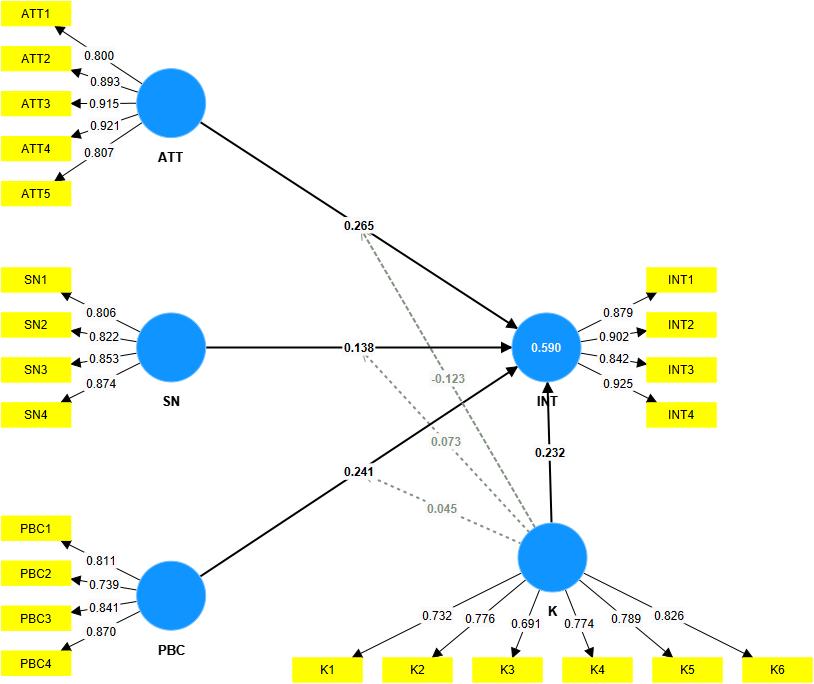
Islamic cooperative microfinance (BMT) operates on the principles of fiqh muamalah, prohibiting riba, gharar, and maisir while promoting contractual transparency, risk-sharing, and distributive justice. Despite their Islamic legal foundations, BMTs increasingly attract non-Muslims who perceive their ethical framework as legally predictable and financially equitable. This study examines non-Muslims’ intention to engage with BMTs, integrating Islamic economic laws literacy into an extended Theory of Planned Behavior (TPB). Analyzing survey data from 192 non-Muslim respondents in Indonesia, we demonstrate that attitude, subjective norms, perceived behavioral control, and knowledge of Shariah compliance collectively shape intention. These findings underscore how transparent implementation of Islamic economic law principles transcends religious boundaries, offering actionable insights for inclusive Shari’ah governance, cooperative regulation, and ethical financial inclusion.
Downloads
References
Ahmad, W. M. W., Hisham Hanifa, M., & Hyo, K. C. (2019). Are non-Muslims willing to patronize Islamic financial services? Journal of Islamic Marketing, 10(3), 743–758. https://doi.org/10.1108/JIMA-01-2017-0007
Ajzen, I. (1991). The theory of planned behavior. Organizational Behavior and Human Decision Processes, 50(2), 179–211. https://doi.org/10.1016/0749-5978(91)90020-T
Ajzen, I., & Schmidt, P. (2020). Changing Behavior Using the Theory of Planned Behavior. In The Handbook of Behavior Change. https://doi.org/10.1017/9781108677318.002
Alam, A., Septiana, S., El Asfahany, A., & Hamidah, R. A. (2023). Persepsi Perbandingan Keunggulan Pembiayaan Mudharabah Dan Murabahah Oleh Nasabah Lembaga Keuangan Mikro Islam BMT. Al Iqtishod: Jurnal Pemikiran Dan Penelitian Ekonomi Islam, 11(1), 1–20. https://doi.org/10.37812/aliqtishod.v11i1.538
Amin, M., Isa, Z., & Fontaine, R. (2013). Islamic banks. International Journal of Bank Marketing, 31(2), 79–97. https://doi.org/10.1108/02652321311298627
Anderson, J. C., & Gerbing, D. W. (1988). Structural equation modeling in practice: A review and recommended two-step approach. Psychological Bulletin, 103(3), 411–423. https://doi.org/10.1037/0033-2909.103.3.411
Andespa, R., Yeni, Y. H. H., Fernando, Y., & Sari, D. K. K. (2024). A systematic review of customer Sharia compliance behaviour in Islamic banks: determinants and behavioural intention. Journal of Islamic Marketing, 15(4), 1013–1034. https://doi.org/10.1108/JIMA-06-2023-0181
Ashfahany, A. El, Mutmainah, D. A. S., & Isman. (2023). Why non-Muslims choose Islamic banking. Extended theory of planned behavior: a moderating factor of Islamic bank knowledge. Banks and Bank Systems, 18(3), 112–125. https://doi.org/10.21511/bbs.18(3).2023.10
Baber, H. (2018). Factors Influencing the Intentions of Non-Muslims in India to Accept Islamic Finance as an Alternative Financial System. Journal of Reviews on Global Economics, 7, 317–323. https://doi.org/10.6000/1929-7092.2018.07.27
Bananuka, J., Kasera, M., Najjemba, G. M., Musimenta, D., Ssekiziyivu, B., & Kimuli, S. N. L. (2019). Attitude: mediator of subjective norm, religiosity and intention to adopt Islamic banking. Journal of Islamic Marketing, 11(1), 81–96. https://doi.org/10.1108/JIMA-02-2018-0025
Barbera, F. L., & Ajzen, I. (2020). Control interactions in the theory of planned behavior: Rethinking the role of subjective norm. Europe’s Journal of Psychology, 16(3), 401–417. https://doi.org/10.5964/ejop.v16i3.2056
Fisher, W. A., Fisher, J. D., & Harman, J. (2003). The Information‐Motivation‐Behavioral Skills Model: A General Social Psychological Approach to Understanding and Promoting Health Behavior. In Social Psychological Foundations of Health and Illness (pp. 82–106). Wiley. https://doi.org/10.1002/9780470753552.ch4
Hair, J. F., Risher, J. J., Sarstedt, M., & Ringle, C. M. (2019). When to use and how to report the results of PLS-SEM. European Business Review, 31(1), 2–24. https://doi.org/10.1108/EBR-11-2018-0203
Hair, J., Hollingsworth, C. L., Randolph, A. B., Chong, A. Y. L., Yee, A., Chong, L., Hair, J., Hollingsworth, C. L., Randolph, A. B., Yee, A., Chong, L., Hair, J., Yee, A., & Chong, L. (2017). An updated and expanded assessment of PLS-SEM in information systems research. Industrial Management and Data Systems, 117(3), 442–458. https://doi.org/10.1108/IMDS-04-2016-0130
Haq, M. E. S., Muthoifin, & Daffa Ghifari. (2024). Implementation of the Akad Murabahah Financing Program to Support SDGs: A Case Study at BMT Yaa Qawiyyu and BMT Sekawan Klaten. Profetika: Jurnal Studi Islam, 25(03), 713–730. https://doi.org/10.23917/profetika.v25i03.11329
Haron, S., Ahmad, N., & Planisek, S. L. (1994). Bank Patronage Factors of Muslim and Non‐Muslim Customers. International Journal of Bank Marketing, 12(1), 32–40. https://doi.org/10.1108/02652329410049599
Hermanita, H., & Hayati, S. (2022). Non-Muslim Customer Switching Behavior In Islamic Bank In Indonesia. WSEAS Transactions on Environment and Development, 18, 136–143. https://doi.org/10.37394/232015.2022.18.15
Hudaefi, F. A. (2025). Socioeconomic Issues in Zakat Microfinance Innovation: Evidence from Cyberspace. Journal of Muslim Philanthropy & Civil Society, 9(2). Retrieved from https://scholarworks.iu.edu/iupjournals/index.php/muslimphilanthropy/article/view/7042
Johan, Z. J., Hussain, M. Z., Mohd, R., & Kamaruddin, B. H. (2020). Muslims and non-Muslims intention to hold Shariah-compliant credit cards: a SmartPLS approach. Journal of Islamic Marketing, 12(9), 1751–1785. https://doi.org/10.1108/JIMA-12-2019-0270
Ma, Y., & Md Taib, F. (2023). An Islamic co-operative housing solution for China’s housing affordability issues. Journal of Islamic Accounting and Business Research, 14(3), 489–513. https://doi.org/10.1108/JIABR-11-2021-0299
Ma’ruf, A., Tilla Ira Sellani, Lukmanul Hakim, & Shahbaz Alam. (2025). Social and Environmental Contribution of Indonesian Baitul Maal wat Tamwil (BMT) to the SDGs Implementation. Profetika: Jurnal Studi Islam, 26(01), 81–92. https://doi.org/10.23917/profetika.v26i01.8863
Mustapha, N., Mohammad, J., Quoquab, F., & Salam, Z. A. (2023). “Should I adopt Islamic banking services?” Factors affecting non-Muslim customers’ behavioral intention in the Malaysian context. Journal of Islamic Marketing, 14(10), 2450–2465. https://doi.org/10.1108/JIMA-03-2022-0094
Novianto, A. S., Pratikto, H., Soetjipto, B. E., & Djatmika, E. T. (2025). Adoption of Islamic financing: The case of MSMEs in Indonesia. The Economics and Finance Letters, 12(3), 498–509. https://doi.org/10.18488/29.v12i3.4271
Panorama, M., & Lemiyana. (2018). Market friendly approach on Islamic bank’s non muslim customer in Palembang and its effect on attitude. Academy of Strategic Management Journal, 17.
Purwantini, A. H., Noor Athief, F. H., & Waharini, F. M. (2020). Indonesian Consumers’ Intention of Adopting Islamic Financial Technology Services. Shirkah: Journal of Economics and Business, 5(2), 171. https://doi.org/10.22515/shirkah.v5i2.304
Purwanto, P., Abdullah, I., Ghofur, A., Abdullah, S., & Elizabeth, M. Z. (2022). Adoption of Islamic microfinance in Indonesia an empirical investigation: an extension of the theory of planned behaviour. Cogent Business & Management, 9(1). https://doi.org/10.1080/23311975.2022.2087466
Putri, D. S. I., Murniati Mukhlisin, & Mohammad Hudaib. (2023). Behavioral Accounting Review For Non-Performing Customer Reporting : Case Baitul Maal Wattamwil. Riset Akuntansi Dan Keuangan Indonesia, 9(1), 87–96. https://doi.org/10.23917/reaksi.v9i1.3839
Ringle, C. M., Wende, S., & Becker, J.-M. (2024). SmartPLS 4. SmartPLS. https://www.smartpls.com
Spriggs, G. M. (2016). Knowledge and Behaviour Regarding Takāful among Non-Muslim Consumers in The United Arab Emirates. ISRA International Journal of Islamic Finance, 8(1), 9–34. https://www.scopus.com/inward/record.uri?eid=2-s2.0-85062269648&partnerID=40&md5=5ae8a6a1d92b8ff82874f576ea4f60c4
Downloads
Submitted
Accepted
Published
How to Cite
Issue
Section
License
Copyright (c) 2026 Journal of Islamic Economic Laws

This work is licensed under a Creative Commons Attribution-ShareAlike 4.0 International License.