Ethical Values, Trusted Information, and Quality Heuristics in Shaping Halal Food Purchase Commitment: Evidence from the Indonesian Muslim Diaspora in Europe
DOI:
https://doi.org/10.23917/jisel.v9i01.15900Keywords:
Halal Food Consumption, Purchase Commitment, Ethical–Moral Values, Information Trust, Muslim DiasporaAbstract
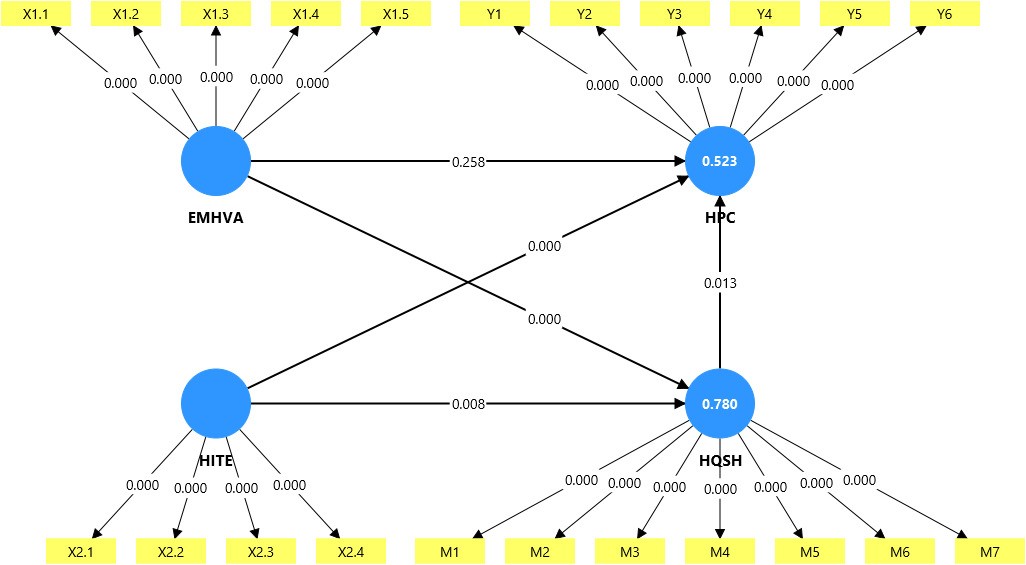
This study examines how ethical moral values and trusted halal information shape halal food purchase commitment among the Indonesian Muslim diaspora in Europe. Integrating value–cognition–behavior and information trust perspectives, this study proposes a dual-pathway model comprising Ethical–Moral Halal Value Attribution (EMHVA), the Halal Information Trust Ecosystem (HITE), and the Halal Quality and Safety Heuristic (HQSH). Data were collected from 173 respondents across nine European countries and analyzed using PLS-SEM. EMHVA does not directly influence purchase commitment but significantly affects HQSH, indicating a strong indirect effect. In contrast, HITE has a significant direct effect on purchase commitment and a weaker effect on HQSH. The mediating role of HQSH in the HITE pathway is marginal. These results suggest that ethical values operate through cognitive evaluation mechanisms, whereas trusted information directly reduces uncertainty and strengthens commitment. This study contributes to the literature by introducing a dual-pathway model that distinguishes between value- and information-driven mechanisms of halal consumption. Practically, it highlights the importance of strengthening credible halal information systems and enhancing quality signaling to support diaspora consumers in complex market environments.
Downloads
References
Ahmad, A. N., Abidin, U. F. U. Z., Othman, M., & Abdul Rahman, R. (2018). Overview of the Halal Food Control System in Malaysia. Food Control, 90, 352–363. https://doi.org/https://doi.org/10.1016/j.foodcont.2018.02.035
Ahmad, A. N., Rahman, R. A., Othman, M., Ungku, U. F., & Abidin, Z. (2017). Critical Success Factors Affecting The Implementation Of Halal Food Management Systems: Perspective Of Halal Executives, Consultants And Auditors. Food Control, 74, 1–33. https://doi.org/10.1016/j.foodcont.2016.11.031
Ahmad, N., Khan, A. H., Aziz, A., Raffi, R. M., Hasan, Q., Sumimura, Y., & Shimazono, Y. (2023). Determining Halal Food Preferences among Muslims Living in Osaka, Japan. Journal of Halal Science and Technology, 2(2), 26–40. https://doi.org/10.59202/jhst.v2i2.696
Akbar, J., Gul, M., Jahangir, M., Adnan, M., Saud, S., Hassan, S., Nawaz, T., & Fahad, S. (2023). Global Trends in Halal Food Standards : A Review. Foods, 12, 1–15. https://doi.org/10.3390/foods12234200
Akim, Sari, V. P., Konety, N., & Nidatya, N. (2024). Indonesia’s Global Halal Hub: Competitive Strategies for Leadership. Jurnal Global & Strategis, 18(1), 29–56. https://doi.org/10.20473/jgs.18.1.2024.29-56
Al-Kwifi, O. S., Abu Farha, A., & Ahmed, Z. U. (2019). Dynamics Of Muslim Consumers’ Behavior Toward Halal Products. International Journal of Emerging Markets, 14(4), 689–708. https://doi.org/https://doi.org/10.1108/IJOEM-11-2017-0486
Al-Mahmood, O. A., & Fraser, A. M. (2023). Perceived Challenges In Implementing Halal Standards by Halal Certifying Bodies in The United States. PLOS One, 18(8), 1–11. https://doi.org/10.1371/journal.pone.0290774
Ali, M. H., & Suleiman, N. (2018). Eleven Shades Of Food Integrity: A Halal Supply Chain Perspective. Trends in Food Science and Technology, 71, 216–224. https://doi.org/10.1016/j.tifs.2017.11.016
Ali, M. H., Tan, K. H., & Ismail, M. D. (2017). A Supply Chain Integrity Framework for Halal Food. British Food Journal, 119(1), 20–38. https://doi.org/10.1108/BFJ-07-2016-0345
Alqurashi, R. M., Sikora, D., & Rzymski, P. (2026). Cultured Meat and Its Acceptability in Muslim Societies: A Narrative Perspective on Halal Perspectives and Regulatory Challenges. Foods, 15(8), 1–19. https://doi.org/10.3390/foods15081288
Aslan, H. (2023). The Influence Of Halal Awareness, Halal Certificate, Subjective Norms, Perceived Behavioral Control, Attitude And Trust On Purchase Intention Of Culinary Products Among Muslim Costumers In Turkey. International Journal of Gastronomy and Food Science, 32, 1–8. https://doi.org/10.1016/j.ijgfs.2023.100726
Battour, M., Hakimian, F., Ismail, M., & Boğan, E. (2018). The Perception Of Non-Muslim Tourists Towards Halal Tourism. Journal of Islamic Marketing, 9(4), 823–840. https://doi.org/10.1108/jima-07-2017-0072
Bayatzadeh, S., & Talaie, H. (2025). An Evaluation of Traceability Dynamics in Dairy Supply Chains Through Causal Modeling in Emerging Economies. Supply Chain Analytics, 11(7), 1–13. https://doi.org/10.1016/j.sca.2025.100156
Bonne, K., Vermeir, I., Bergeaud-Blackler, F., & Verbeke, W. (2007). Determinants of Halal Meat Consumption in France. British Food Journal, 109(5), 367–386. https://doi.org/10.1108/0070700710746786
Bonne, K., Vermeir, I., & Verbeke, W. (2008). Impact of Religion on Halal Meat Consumption Decision Making in Belgium. Journal of International Food & Agribusiness Marketing, 21(1), 5–26. https://doi.org/https://doi.org/10.1080/08974430802480628
Bux, C., Varese, E., Amicarelli, V., & Lombardi, M. (2022). Halal Food Sustainability Between Certification And Blockchain: A Review. Sustainability (Switzerland), 14(4), 1–18. https://doi.org/10.3390/su14042152
Chen, S. (2025). Blockchain-Enabled Traceability Framework to Improve Transparency in Supply Chain Management. Information Resources Management Journal, 38(1), 1–13. https://doi.org/https://doi.org/10.4018/IRMJ.389708
Chong, S. C., Yeow, C. C., Low, C. W., Mah, P. Y., & Tung, D. T. (2022). Non-Muslim Malaysians’ Purchase Intention Towards Halal Products. Journal of Islamic Marketing, 13(8), 1751–1762. https://doi.org/10.1108/JIMA-10-2020-0326
DinarStandard. (2025). State of the Global Islamic Economy 2025. https://www.dinarstandard.com/insights/sgier-2024-25
Firmansyah, I., Adawiyah, W. R., & Setyorini, C. T. (2025). Challenges and Strategic Responses in Halal Supply Chain Integration: A Multi-Dimensional Literature Review. Operations and Supply Chain Management, 18(4), 617–631. http://doi.org/10.31387/oscm0630495
HalalEX. (2025). Opportunities to the Muslim market. https://halalex.org/opportunities-to-the-muslim-market/
Halder, S., Rafiqul Islam, M., Mamun, Q., Mahboubi, A., Walsh, P., & Zahidul Islam, M. (2025). A Comprehensive Survey on AI-Enabled Secure Social Industrial Internet of Things in The Agri-Food Supply Chain. Smart Agricultural Technology, 11, 100902. https://doi.org/https://doi.org/10.1016/j.atech.2025.100902
Herdiana, Y., Ferdiansyah, F., & Shamsuddin, S. (2024). Towards Halal Pharmaceutical : Exploring Alternatives to Animal-Based Ingredients. Heliyon, 10(1), 1–19. https://doi.org/10.1016/j.heliyon.2023.e23624
Hong, M., Sun, S., Beg, A. B. M. R., & Zhou, Z. (2019). Determinants Of Halal Purchasing Behaviour: Evidences From China. Journal of Islamic Marketing, 10(2), 410–425. https://doi.org/10.1108/JIMA-03-2018-0053
Ibrahim, K., Sarfo, C., & Burnett, M. (2024). Effect Of Source Credibility And Consumer Ethnocentrism On Halal Purchase Intentions In The Uk: An Elaboration Likelihood Model Approach. British Food Journal, 126(7), 2875–2894. https://doi.org/10.1108/BFJ-09-2023-0823
Ismail, I. J. (2025). Halal Brand Quality and Halal Food Purchasing Intention Among University Students: The Moderating Effect of Customer-Employee Interactions. Social Sciences & Humanities Open, 11, 1–10. https://doi.org/https://doi.org/10.1016/j.ssaho.2025.101352
Joya, K. (2025). Taste and Trust : The Impact of Psychographics on Certified Meat Demand. Future Foods, 12, 1–13. https://doi.org/10.1016/j.fufo.2025.100763
Kenresearch. (2024). Global Halal Food Market. https://www.kenresearch.com/industry-reports/global-halal-food-market
Keramati, A., Siau, B., Bellitto, T., Heydari, J., & Panchal, T. (2025). Blockchains Effects on Responsiveness to Recalls In The Food And Beverage Industry. Journal of Economy and Technology, 3, 283–298. https://doi.org/https://doi.org/10.1016/j.ject.2025.05.001
Koc, F., Ozkan, B., Komodromos, M., Efendioglu, I. H., & Baran, T. (2024). The Effects of Trust and Religiosity on Halal Products Purchase Intention: Indirect Effect of Attitude. EuroMed Journal of Business, 20(5), 141–165. https://doi.org/10.1108/EMJB-01-2024-0004
Kurniawati, D. A., & Cakravastia, A. (2023). A Review Of Halal Supply Chain Research: Sustainability And Operations Research Perspective. Cleaner Logistics and Supply Chain, 6, 1–12. https://doi.org/10.1016/j.clscn.2023.100096
Lever, J., & Miele, M. (2012). The Growth Of Halal Meat Markets In Europe: An Exploration Of The Supply Side Theory Of Religion. Journal of Rural Studies, 28(4), 528–537. https://doi.org/10.1016/j.jrurstud.2012.06.004
Lever, J., Miele, M., Dastgir, S., & Fuseini, A. (2025). Niche Market Making In The Uk Sheep Sector ; Performing The Halal Market In Uncertain Times. Journal of Rural Studies, 119, 1–9. https://doi.org/10.1016/j.jrurstud.2025.103728
Ma, Y., & Hamid, B. A. (2026). Strategic Coordination in The Halal Economy: A Cross-Regional Study of Seven Muslim-Minority Emerging Markets. International Journal of Emerging Markets, 1–22. https://doi.org/10.1108/IJOEM-06-2025-1189
Macready, A. L., Hieke, S., Klimczuk-kochańska, M., Szumiał, S., Vranken, L., & Grunert, K. G. (2020). Consumer Trust in The Food Value Chain and Its Impact on Consumer Confidence : A Model For Assessing Consumer Trust and Evidence From A 5- Country Study In Europe. Food Policy, 92, 1–15. https://doi.org/10.1016/j.foodpol.2020.101880
Mathew, V. (2022). Does Islamic Marketing Mix Affect Consumer Satisfaction? International Journal of Service Science, Management, Engineering, and Technology, 13(1), 1–13. https://doi.org/https://doi.org/10.4018/IJSSMET.297491
Matloob, R., Wood, L. C., & Bekhit, A. E. A. (2026). A Multi-Layer Industry 4 . 0 Framework For Ensuring Halal Integrity In NZ Meat Supply Chains. Food Control, 182, 1–15. https://doi.org/10.1016/j.foodcont.2025.111880
Noor, N. (2025). A Closer Look at Halal Brand Image: Systematic Review and Future Directions. Journal of Islamic Marketing, 16(10), 2900–2924. https://doi.org/10.1108/JIMA-06-2024-0259
Nor, N. F., Ahmad, H., & Ariffin, A. S. (2023). Potencies and Opportunities of Halal Market in Global Industry: An Empirical Analysis of Malaysia and Indonesia. Halal Reviews, 3(1), 1–24. https://doi.org/10.55265/halalreviews.v3i1.14
Nunes, L. C., & Deliberador, L. R. (2025). What Motivates People to Purchase Food Products with Traceability Systems? A Structural Equation Modeling Approach. Food Quality and Preference, 122, 105301. https://doi.org/https://doi.org/10.1016/j.foodqual.2024.105301
Olya, H. G. T., & Al-ansi, A. (2018). Risk Assessment of Halal Products and Services: Implication for Tourism Industry. Tourism Management, 65, 279–291. https://doi.org/https://doi.org/10.1016/j.tourman.2017.10.015
Ozkan, B., Efendioglu, I. H., Baran, T., & Koc, F. (2024). The Effects of Perceived Price, Quality, and Consumer Trust on Purchase Intentions of Halal Products BT - Contemporary Business Research in the Islamic World (J. Fraedrich, M. Pirtskalava, T. Khoshtaria, H. Terzi, M. Bayirli, & B. Al Serhan (eds.); pp. 27–43). Springer Nature Singapore.
Pinto, A., Miguel, L., & Jo, M. (2026). Trends in Food Science & Technology A Systematic Review of Food Business Operators’ Perceptions Regarding Food Fraud. Trends in Food Science & Technology, 172, 1–21. https://doi.org/10.1016/j.tifs.2026.105743
Rafiki, A., Hidayat, S. E., & Nasution, M. D. T. P. (2023). An Extensive Effect Of Religiosity On The Purchasing Decisions Of Halal Products. PSU Research Review, 8(3), 898–919. https://doi.org/10.1108/PRR-07-2022-0093
Rahayu, S., Saputra, Y. M. D., Helmi, S., & Asriadi AM, M. (2025). Promotion’S Power In Halal Product Purchases: The Mediating Role Of Trust And Knowledge. Cogent Business and Management, 12(1), 1–19. https://doi.org/10.1080/23311975.2024.2440627
Rahman, M. M., Razimi, M. S. A., Ariffin, A. S., & Hashim, N. (2024). Navigating Moral Landscape: Islamic Ethical Choices And Sustainability In Halal Meat Production And Consumption. Discover Sustainability, 5(1), 1–22. https://doi.org/10.1007/s43621-024-00388-y
Rahman, R., & Indra. (2024). The Influence Of Halal Fashion, Lifestyle, And Brand Image On Gen Z’S Hijab Fashion Preferences In Indonesia. Journal of Islamic Economics Lariba, 10(1), 251–270. https://doi.org/10.20885/jielariba.vol10.iss1.art14
Saleh, H., & Rajandran, T. (2024). Relationship between Non-Muslim consumer intention to purchase Halal Products with Halal Awareness, Halal Certification, Halal Marketing and Halal Knowledge: Systematic Review. International Journal of Academic Research in Business and Social Sciences, 14(9), 416–426. https://doi.org/10.6007/ijarbss/v14-i9/22495
Sandikci, O., Jafari, A., & Fischer, E. (2024). Claiming Market Ownership: Territorial Activism in Stigmatized Markets. Journal of Business Research, 175, 1–16. https://doi.org/10.1016/j.jbusres.2024.114574
Selim, N. I. I. B., Zailani, S., Aziz, A. A., & Rahman, M. K. (2022). Halal Logistic Services, Trust And Satisfaction Amongst Malaysian 3Pl Service Providers. Journal of Islamic Marketing, 13(1), 81–99. https://doi.org/10.1108/JIMA-05-2018-0088
Susanty, A., Budi, N., Jie, F., Akbar, F., & Jati, S. (2025). Consumer Acceptance of Halal Food Traceability Systems: A Novel Integrated Approach Using Modified Utaut and Delone & Mclean Models to Promote Sustainable Food Supply Chain Practices. Cleaner Logistics and Supply Chain, 15, 1–19. https://doi.org/10.1016/j.clscn.2025.100226
Tieman, M. (2015). Halal Clusters. Journal of Islamic Marketing, 6(1), 2–21. https://doi.org/10.1108/JIMA-05-2014-0034
Turaeva, R., & Brose, M. (2020). Halal Markets in non-Muslim Secular Societies. Sociologi of Islam, 8, 295–306. https://doi.org/10.1163/22131418-08030001
Vizano, N. A., Khamaludin, K., & Fahlevi, M. (2021). The Effect of Halal Awareness on Purchase Intention of Halal Food : A Case Study in Indonesia. Journal of Asian Finance, Economics and Business, 8(4), 441–453. https://doi.org/10.13106/jafeb.2021.vol8.no4.0441
Wilson, J. A. J., & Liu, J. (2011). The Challenges Of Islamic Branding: Navigating Emotions And Halal. Journal of Islamic Marketing, 2(1), 28–42.
Wiyono, S. N., Deliana, Y., Wulandari, E., & Kamarulzaman, N. H. (2022). The Embodiment of Muslim Intention Elements in Buying Halal Food Products: A Literature Review. Sustainability, 14(20), 1–19. https://doi.org/10.3390/su142013163
Yaman, B., Nugraha, D. P., Mubarok, F., Ahmed, A. M., Fekete-Farkas, M., Hagen, I., & Tégla, Z. (2026). The Effect of Environmental, Social, and Governance on Firm Value in Southeast Asia: The Moderating Role of Digitalization. Journal of Risk and Financial Management, 19(2), 1–24. https://doi.org/10.3390/jrfm19020133
Zafar, M. B., & Abu-Hussin, M. F. (2025). Halal Purchasing Decisions and Consumer Behavior: a Multi¬ Method Review. Journal of Islamic Marketing, 16(9), 2703–2732. https://doi.org/10.1108/JIMA-08-2024-0365
Zafar, M. B., Abu-Hussin, M. F., & Ali, H. (2024). Mapping The Research On Halal Industry: A Retrospective Analysis. Journal of Islamic Marketing, 16(6), 1770–1806. https://doi.org/10.1108/JIMA-08-2024-0348
Zailani, S., Kanapathy, K., Iranmanesh, M., & Tieman, M. (2015). Drivers of Halal Orientation Strategy Among Halal Food Firms. British Food Journal, 117(8), 2143–2160. https://doi.org/10.1108/BFJ-01-2015-0027
Downloads
Submitted
Accepted
Published
How to Cite
Issue
Section
License
Copyright (c) 2026 Journal of Islamic Economic Laws

This work is licensed under a Creative Commons Attribution-ShareAlike 4.0 International License.