Forestry Green Sukuk Model: Harmonizing Hifz al-Bi'ah for Sustainable Restoration in Indonesia
DOI:
https://doi.org/10.23917/jisel.v9i01.15356Keywords:
Green Sukuk, Forest Restoration, Ijarah Maushufah fi Zimmah, Hifz al Bi'ah,, Sustainable FinanceAbstract
The increasing intensity of hydrometeorological disasters in Indonesia, such
as flash floods and landslides, is directly proportional to the rate of national forest
degradation. Mitigation efforts through forest restoration face a structural barrier: a
funding gap that cannot be fully covered by the state budget. Although Indonesia has
issued Green Sukuk, its allocation remains concentrated in the energy and transportation
infrastructure sectors, while the high-risk forestry sector remains neglected. This study
aims to construct a Forestry Green Sukuk model that harmonizes the principle of
environmental preservation (Hifz al-Bi'ah) with modern Islamic financial engineering.
The research method employed is normative legal research using a conceptual and
statutory approach to analyze the DSN-MUI Fatwa, OJK regulations, and the Presidential
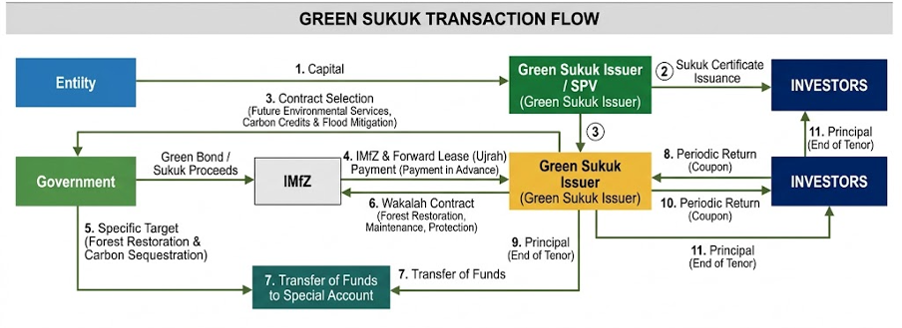
Regulation on Carbon Economic Value. The research findings indicate that the use of the
Ijarah Maushufah fi Zimmah (IMfZ) contract for the leasing of future asset benefits is
the most appropriate structure to mitigate biological risks and uncertainty (gharar) in
forestry projects. Unlike profit-sharing schemes, the IMfZ model provides cash flow
certainty by monetizing ecosystem services, specifically carbon sequestration and flood
mitigation, as valid underlying assets. This study offers a theoretical contribution to the
paradigm shift in Hifz al-Bi'ah and provides practical solutions for regulators to develop
bankable alternative financing schemes that support climate resilience and disaster risk
reduction targets in Indonesia.
Downloads
References
Abubakar, L., & Handayani, T. (2020). Green Sukuk: Sustainable Financing Instruments for
Infrastructure Development in Indonesia. 983–987.
https://doi.org/10.2991/ASSEHR.K.200529.206
Alam, A., Ratnasari, R. T., Jannah, I. L., & Ashfahany, A. El. (2023). Development and
evaluation of Islamic green financing: A systematic review of green sukuk. Environmental
Economics, 14(1), 61–72. https://doi.org/10.21511/EE.14(1).2023.06
Alatas, M. B. I. (2025, December 5). RI butuh 757,6 miliar dolar AS untuk capai target
perubahan iklim - ANTARA News. Antaranews.Com.
https://www.antaranews.com/berita/5282069/ri-butuh-7576-miliar-dolar-as-untuk-capai
target-perubahan-iklim
Alhaq, K., Nursyamsiah, T., & Muthohharoh, M. (2023). Green Sukuk Development Strategy
in Indonesia: ANP-SWOT Approach. Iqtishadia: Jurnal Kajian Ekonomi Dan Bisnis
Islam, 16(1), 101–122. https://doi.org/10.21043/IQTISHADIA.V16I1.16312
Alifia, P. I. A., & Fakhriah, N. (2024). Optimalization of Green Sukuk as an Effort to Develop
Sustainable Development (SDGs) in Review of Maqashid Sharia. Majapahit Journal of
Islamic Finance and Management, 4(1), 69–88. https://doi.org/10.31538/MJIFM.V4I1.54
Almustafa, E. (2025). Islamic Financing Mechanisms for Renewable Energy Projects:
Mapping Research Trends and Future Directions. International Journal of Energy
Economics and Policy, 15(3), 453–470. https://doi.org/10.32479/IJEEP.18866
Anjani, N., Serliana, N., & Auliah, M. (2024). Green Sukuk: Tantangan dan Strategi
Pengembangan Untuk Pembangunan Berkelanjutan Serta Menuju Ekonomi Hijau.
SANTRI : Jurnal Ekonomi Dan Keuangan Islam, 2(3), 12–20.
https://doi.org/10.61132/SANTRI.V2I3.555
Badan Nasional Penanggulangan Bencana. (2024). Data Bencana Indonesia 2024.
Blanton, A., Mohan, M., Galgamuwa, G. A. P., Watt, M. S., Montenegro, J. F., McTavish, F.,
Carlsen, S. C. H., Valasquez-Camacho, L., Bomfim, B., Pons, J., Broadbent, E. N., Kaur,
A., Direk, S., de-Miguel, S., Ortega, M., Abdullah, M., Rondon, M., Wan Mohd Jaafar,
W. S., Silva, C. A., … Ewane, E. B. (2024). The status of forest carbon markets in Latin
America. Journal of Environmental Management, 352, 119921.
https://doi.org/10.1016/J.JENVMAN.2023.119921
Bowen, G. A. (2009). Document Analysis as a Qualitative Research Method. Qualitative
Research Journal, 9(2), 27–40. https://doi.org/10.3316/QRJ0902027
Bsoul, L., Omer, A., Kucukalic, L., Archbold, R. H., Bsoul, L., Omer, A., Kucukalic, L., &
Archbold, R. H. (2022). Islam’s Perspective on Environmental Sustainability: A
Conceptual Analysis. Social Sciences 2022, Vol. 11, 11(6).
https://doi.org/10.3390/SOCSCI11060228
Candra, H., Amar, S., & Marta, J. (2024). Ecological Restoration and Sustainable
Development: The Impact of Wakaf Forest Institutions on Socio-Economic Benefits.
Journal of Ecohumanism, 3(3), 1371–1386. https://doi.org/10.62754/JOE.V3I3.3607
Debele, S. E., Leo, L. S., Kumar, P., Sahani, J., Ommer, J., Bucchignani, E., Vranić, S., Kalas,
M., Amirzada, Z., Pavlova, I., Shah, M. A. R., Gonzalez-Ollauri, A., & Di Sabatino, S.
(2023). Nature-based solutions can help reduce the impact of natural hazards: A global
analysis of NBS case studies. Science of The Total Environment, 902, 165824.
https://doi.org/10.1016/J.SCITOTENV.2023.165824
Dewi, A. (2024). Inovasi Keuangan Berbasis Nilai: Mengupas Layanan Tabungan dan
Investasi di Bank Syariah. Karimah Tauhid, 3(5), 5926–5932.
https://doi.org/10.30997/KARIMAHTAUHID.V3I5.13488
Elias, M., Yackulic, E., Duffy, K., Saksa, P., Sanchez, D. L., Pevzner, N., Plumb, S.,
Dyszynski, J., & Bracer, C. (2024). Carbon finance for forest resilience in California.
Frontiers
in
Forests
and
Global
Change,
7,
1507554.
https://doi.org/10.3389/FFGC.2024.1507554/BIBTEX
Endri, E., Hania, B. T., & Ma’ruf, A. (2022). Corporate Green Sukuk Issuance For Sustainable
Financing
In
Indonesia.
Environmental
Economics,
13(1),
38–49.
https://doi.org/10.21511/EE.13(1).2022.04
Faisal, Y. A., Gunawan, I., Cupian, Hayati, A., Apriliadi, A., Fajri, M., Faisal, Y. A., Gunawan,
I., Cupian, Hayati, A., Apriliadi, A., & Fajri, M. (2023). Examining the Purchase Intentions
of Indonesian Investors for Green Sukuk. Sustainability 2023, Vol. 15, 15(9).
https://doi.org/10.3390/SU15097430
Faizi, Kusuma, A. S., & Widodo, P. (2024). Islamic green finance: mapping the climate
funding landscape in Indonesia. International Journal of Ethics and Systems, 40(4), 711
733. https://doi.org/10.1108/IJOES-08-2023-0189
Fatwa Dewan Syariah Nasional-Majelis Ulama Indonesia Tentang Akad Al-Ijarah Al
Maushufah Fi Al-Dzimmah, Pub. L. 10l/DSN-MUIIX/2016, Majelis Ulama Indonesia
(2016).
Fatwa Dewan Syariah Nasional-Majelis Ulama Indonesia Tentang Sukuk, Majelis Ulama
Indonesia (2020).
Fatwa MUI Nomor 86 Tahun 2023 Tentang Hukum Perlindungan Perubahan Iklim Global,
Majelis Ulama Indonesia (2023).
Fitrah, R., & Soemitra, A. (2022). Green Sukuk For Sustainable Development Goals in
Indonesia: A Literature Study. Jurnal Ilmiah Ekonomi Islam, 8(1), 231–240.
https://doi.org/10.29040/JIEI.V8I1.4591
Foglie, A. D., & Keshminder, J. S. (2024). Challenges and opportunities of SRI sukuk toward
financial system sustainability: a bibliometric and systematic literature review.
International
Journal
of
Emerging
Markets,
19(10),
3202–3225.
https://doi.org/10.1108/IJOEM-04-2022-0601
Gulzar, A., Islam, T., Khan, M. A., & Haq, S. M. (2021). Environmental ethics towards the
sustainable development in Islamic perspective: A Brief Review. Ethnobotany Research
and Applications, 22(0), 1–10. https://doi.org/10.32859/era.22.39.1-10
Gustati, G. D. (2025, December 4). Banjir Sumatera: Kombinasi Faktor Alam dan Ulah
Manusia
.
Universitas
Muhammadiyah
Surakarta
(UMS).
https://www.ums.ac.id/berita/teropong-jagat/banjir-sumatera-kombinasi-faktor-alam
dan-ulah-manusia
Harahap, B., Risfandy, T., Futri, I. N., Harahap, B., Risfandy, T., & Futri, I. N. (2023). Islamic
Law, Islamic Finance, and Sustainable Development Goals: A Systematic Literature
Review. Sustainability 2023, Vol. 15, 15(8). https://doi.org/10.3390/SU15086626
Hasanudin, Mubarok, J., & Maulana, M. A. F. (2023). Progressiveness of Islamic Economic
Law in Indonesia: The Murā‘at Al-‘Ilal wa Al-Maṣāliḥ Approach. Samarah: Jurnal
Hukum
Keluarga
Dan
Hukum
Islam,
7(2),
1267–1292.
https://doi.org/10.22373/SJHK.V7I2.17601
Hiljannah, Z. Z., Desfiansyah, F., Putra, A. T., & Sarjono, O. R. (2023). The Role of Green
Sukuk for Sustainable National Development: Peran Green Sukuk terhadap Pembangunan
Nasional yang Berkelanjutan. JURNAL EKONOMI SYARIAH, 8(2), 149–157.
https://doi.org/10.37058/JES.V8I2.7577
Ibrahim, A., & Salam, A. J. (2021). A Comparative Analysis of DSN-MUI Fatwas Regarding
Murabahah Contract and the Real Context Application (A study at Islamic Banking in
Aceh). Samarah: Jurnal Hukum Keluarga Dan Hukum Islam, 5(1), 372–401.
https://doi.org/10.22373/SJHK.V5I1.8845
Journal of Islamic Economic Laws Vol. 9 No. 1, 2026
(ISSN P: 2655-9609; E: 2655-9617)
DOI: 10.23917/jisel.v9i01.15356
249
Ibrahim, J. (2006). Teori dan Metodologi Penelitian Penelitian Hukum Normatif. BayuMedia
Publishing.
Ihsan, M. (2025). Efektivitas Green Sukuk sebagai Instrumen Keuangan Syariah dalam
Mitigasi Perubahan Iklim. Journal of Islamic Finance and Syariah Banking, 3(1), 10–25.
https://doi.org/10.63321/JIFSB.V3I1.116
Indrajaya, Y., Yuwati, T. W., Lestari, S., Winarno, B., Narendra, B. H., Nugroho, H. Y. S. H.,
Rachmanadi, D., Pratiwi, Turjaman, M., Adi, R. N., Savitri, E., Putra, P. B., Santosa, P.
B., Nugroho, N. P., Cahyono, S. A., Wahyuningtyas, R. S., Prayudyaningsih, R., Halwany,
W., Siarudin, M., … Mendham, D. (2022). Tropical Forest Landscape Restoration in
Indonesia: A Review. Land 2022, Vol. 11, 11(3). https://doi.org/10.3390/LAND11030328
Irfany, M. I., Utami, A. D., Lubis, D., Ramadhini, F., Suwari, L. F., Maula, N. R.,
Fitriyatustany, & Haq, D. A. (2024). Islamic Finance and Environmental Sustainability:
Empirical Insight from OIC Countries. International Journal of Energy Economics and
Policy, 14(6), 707–715. https://doi.org/10.32479/IJEEP.17400
Jalili, I., Sitorus, I. R., Julir, N., Shulthoni, M., Ulfa, F., & Solihu, A. K. H. (2025). Role of
Qawā’id Fiqhiyyah in Promoting Green Investment within Islamic Economics:
Theoretical and Practical Frameworks. Journal of Islamic Thought and Civilization, 15(1),
202–223. https://doi.org/10.32350/JITC.151.12
Jang, E. K., Kwak, D., Choi, G., & Moon, J. (2023). Opportunities and challenges of
converging technology and blended finance for REDD+ implementation. Frontiers in
Forests
and
Global
Change,
6,
1154917.
https://doi.org/10.3389/FFGC.2023.1154917/BIBTEX
Jojo, J., & Frasipa, A. (2025). The Role Of Green Sukuk In Sustainable Financing: An
Analytical Study In Indonesia During The 2018–2024 Period: Array. TSARWATICA
(Islamic
Economic, Accounting, and Management Journal), 7(1), 43–49.
https://doi.org/10.35310/TSARWATICA.V7I1.1558
Kementrian Keuangan RI. (2018). The Republic Of Indonesia Green Bond And Green Sukuk
Framework.
https://www.icmagroup.org/assets/documents/Regulatory/Green
Bonds/GreenBondsBrochure-
Khuluq, M. K., & Asmuni, A. (2024). Hifz Al-Bi’ah as Part of Maqashid Al-Shari’ah and Its
Relevance in the Context of Global Climate Change. Indonesian Journal of
Interdisciplinary
Islamic
Studies
(IJIIS),
7(2).
https://doi.org/10.20885/IJIIS.VOL7.ISS2.ART3
Liu, F. H. M., & Lai, K. P. Y. (2021). Ecologies of green finance: Green sukuk and
development of green Islamic finance in Malaysia. Environment and Planning A, 53(8),
1896–1914. https://doi.org/10.1177/0308518X211038349
Löfqvist, S., Garrett, R. D., & Ghazoul, J. (2023). Incentives and barriers to private finance for
forest and landscape restoration. Nature Ecology & Evolution 2023 7:5, 7(5), 707–715.
https://doi.org/10.1038/s41559-023-02037-5
Lubis, S., & Windiana, W. (2024). Synergy Of Green Finance And Maqasid Sharia: A Study
Of The Development Of Green Sukuk In Indonesia. Khatulistiwa, 14(2), 147–162.
https://doi.org/10.24260/KHATULISTIWA.V14I2.2382
Mackieson, P., Shlonsky, A., & Connolly, M. (2019). Increasing rigor and reducing bias in
qualitative research: A document analysis of parliamentary debates using applied thematic
analysis.
Qualitative
Social
Work,
18(6),
965–980.
https://doi.org/10.1177/1473325018786996
Majid, R. (2024). What drives prospective investors to support small and medium enterprises
via Islamic securities crowdfunding? An empirical evidence from Indonesia. Journal of
Islamic Marketing, 15(11), 3174–3194. https://doi.org/10.1108/JIMA-11-2023-0375
Marzuki, P. M. (2017). Penelitian Hukum: Edisi Revisi. Publisher Prenada Media.
Journal of Islamic Economic Laws Vol. 9 No. 1, 2026
(ISSN P: 2655-9609; E: 2655-9617)
DOI: 10.23917/jisel.v9i01.15356
250
Menteri Keuangan RI. (2025). Indonesia’s Green Bond & Green Sukuk Initiative Ministry Of
Finance Republic Of Indonesia.
Mutmainnah, S., & Romadhon, M. R. (2023). Pendayagunaan Green Sukuk dalam Menghadapi
Perubahan Iklim di Indonesia. Jurnal Ekonomi Dan Bisnis Islam (JEBI), 3(1), 1–14.
https://doi.org/10.56013/JEBI.V3I1.2021
Niswatin, & Santoso, I. R. (2025). “Factors affecting non-performing finance in Islamic
banking in Indonesia’s agricultural sector. Banks and Bank Systems, 20(1), 323–333.
https://doi.org/10.21511/BBS.20(1).2025.26
Penerbitan Dan Persyaratan Efek Bersifat Utang Berwawasan (Green Bond), Pub. L. 60
/POJK.04/2017, OJK (2017).
PERATURAN PRESIDEN REPUBLIK INDONESIA NOMOR 98 TAHUN 2021, Pub. L.
NOMOR 98 TAHUN 2021 (2021).
Pernyataan Kesesuaian Syariah Sukuk Negara Ritel Seri SR01B Dan SR019 Tahun 2023,
Majelis Ulama Indonesia (2023).
Pujiantoro, A. S. G., Dindalila, D., & Fakhruddin, N. (2021). Narrative Review: Peluang dan
Tantangan Green Sukuk di Indonesia. Diponegoro Journal of Islamic Economics and
Business, 1(4), 208–219. https://doi.org/10.14710/DJIEB.20242
Puspitaloka, D., Kim, Y. S., Purnomo, H., & Fulé, P. Z. (2021). Analysis of challenges, costs,
and governance alternative for peatland restoration in Central Kalimantan, Indonesia.
Trees, Forests and People, 6, 100131. https://doi.org/10.1016/J.TFP.2021.100131
Quesnel Seipp, K., Maurer, T., Elias, M., Saksa, P., Keske, C., Oleson, K., Egoh, B., Cleveland,
R., Nyelele, C., Goncalves, N., Hemes, K., Wyrsch, P., Lewis, D., Chung, M. G., Guo, H.,
Conklin, M., & Bales, R. (2023). A multi-benefit framework for funding forest
management in fire-driven ecosystems across the Western U.S. Journal of Environmental
Management, 344, 118270. https://doi.org/10.1016/J.JENVMAN.2023.118270
Rahman, A., Ahmad, A. U. F., Bin-Nashwan, S. A., Muneeza, A., Abdul Halim, A. H., &
Markom, R. (2024). Policy approach adopted for issuance of Green Sukuk: is priority
given to priority needed areas? Journal of Islamic Accounting and Business Research,
15(5), 818–837. https://doi.org/10.1108/JIABR-10-2022-0279
Rahman, A., Hanife, M. A., Halim, A. H. A., & Markom, R. (2022). The Challenges of Green
Sukuk Policy Implementation for Achieving Sustainable Environment. Malaysian Journal
of
Social
Sciences
and
Humanities
(MJSSH), 7(11), e001987–e001987.
https://doi.org/10.47405/MJSSH.V7I11.1987
Riani, R. M., Utami, L., & Syifa, M. R. L. (2024). Green Sukuk: Integrating Sharia Principles,
Sustainability, and Social Welfare in Indonesia’s SDGs Framework. Proceeding
International Conference on Islam, Law, and Society (INCOILS), 3, 2022.
https://doi.org/10.70062/INCOILS.V3I1.498
Rohmah, N., Rohim, A., & Herianingrum, S. (2020). Sovereign Green Sukuk Indonesia Dalam
Tinjauan
Maqashid Shariah. Jurnal Penelitian IPTEKS, 5(2), 259–269.
https://doi.org/10.32528/IPTEKS.V5I2.3666
Rois, C., Jannani, N., & Mufid, M. H. (2024). Islamic Law Paradigm Responding Conflicts of
Interest of Economic Development and Ecological Conservation Hifdz al-Bi’ah
Perspective.
Al-Istinbath:
Jurnal
Hukum
Islam,
9(1),
193–210.
https://doi.org/10.29240/JHI.V9I1.8660
Santoso, I. R., & Olilingo, F. Z. (2019). Green sukuk dan tujuan pembangunan ekonomi
berkelanjutan peran dalam meningkatkan mitigasi terhadap perubahan iklim. Universitas
Negeri Gorontalo.
Sasmito, S. D., Basyuni, M., Kridalaksana, A., Saragi-Sasmito, M. F., Lovelock, C. E., &
Murdiyarso, D. (2023). Challenges and opportunities for achieving Sustainable
Journal of Islamic Economic Laws Vol. 9 No. 1, 2026
(ISSN P: 2655-9609; E: 2655-9617)
DOI: 10.23917/jisel.v9i01.15356
251
Development Goals through restoration of Indonesia’s mangroves. Nature Ecology &
Evolution 2023 7:1, 7(1), 62–70. https://doi.org/10.1038/s41559-022-01926-5
Sheikh, H. A., Narain, D., Bartlett, C., & Christiaen, C. (2025). Unlocking private finance for
nature: Addressing barriers and reframing risk-return dynamics. IScience, 28(11), 113669.
https://doi.org/10.1016/J.ISCI.2025.113669
Sinacore, K., García, E. H., Finkral, A., van Breugel, M., Lopez, O. R., Espinosa, C., Miller,
A., Howard, T., & Hall, J. S. (2023). Mixed success for carbon payments and subsidies in
support of forest restoration in the neotropics. Nature Communications 2023 14:1, 14(1),
8359-. https://doi.org/10.1038/s41467-023-43861-4
Sudmeier-Rieux, K., Arce-Mojica, T., Boehmer, H. J., Doswald, N., Emerton, L., Friess, D.
A., Galvin, S., Hagenlocher, M., James, H., Laban, P., Lacambra, C., Lange, W., McAdoo,
B. G., Moos, C., Mysiak, J., Narvaez, L., Nehren, U., Peduzzi, P., Renaud, F. G., … Walz,
Y. (2021). Scientific evidence for ecosystem-based disaster risk reduction. Nature
Sustainability 2021 4:9, 4(9), 803–810. https://doi.org/10.1038/s41893-021-00732-4
Sugiyono. (2017). Metode Penelitian Kuantitatif, Kualitatif, dan R&D. CV. Alfabeta.
Supangat, A. B., Basuki, T. M., Indrajaya, Y., Setiawan, O., Wahyuningrum, N., Purwanto,
Putra, P. B., Savitri, E., Indrawati, D. R., Auliyani, D., Nandini, R., Pramono, I. B.,
Nugroho, A. W., Wuryanta, A., Adi, R. N., Harjadi, B., Cahyono, S. A., Lastiantoro, C.
Y., Handayani, W., … Anggraeni, I. (2023). Sustainable Management for Healthy and
Productive
Watersheds
in
Indonesia.
Land
2023,
Vol.
12,
12(11).
https://doi.org/10.3390/LAND12111963
Supriyadi, A. P., Fidhayanti, D., Ramadhita, R., & Noh, M. S. bin M. (2023). Green Sukuk in
Indonesia: Unraveling Legal Frameworks for Sustainable Islamic Bonds. El-Mashlahah,
13(2), 151–180. https://doi.org/10.23971/EL-MASHLAHAH.V13I2.7372
Suriani, S., Masbar, R., Agustina, M., & Khairul, A. D. (2024). Do Global Green Sukuk affect
on Climate Change? Evidence in Issuing Countries. International Journal of Energy
Economics and Policy, 14(1), 98–107. https://doi.org/10.32479/IJEEP.14987
Yukun, S., & Haiquan, W. (2023). Evolutionary game analysis of forestry carbon sink trading
model
under
blockchain
technology.
Heliyon,
9(12),
e22706.
https://doi.org/10.1016/j.heliyon.2023.e22706
Yusuf, N., Sarib, S., Willya, E., & Bukido, R. (2023). The Difficulty of Finding Halal Food for
Muslim Minorities: Analysis of Maqashid Shariah. Al-Istinbath: Jurnal Hukum Islam, 8(2
November), 325–346. https://doi.org/10.29240/JHI.V8I2.8182
Zhang, Y. F., & Umair, M. (2023). Examining the interconnectedness of green finance: an
analysis of dynamic spillover effects among green bonds, renewable energy, and carbon
markets. Environmental Science and Pollution Research 2023 30:31, 30(31), 77605
Downloads
Submitted
Accepted
Published
How to Cite
Issue
Section
License
Copyright (c) 2026 Journal of Islamic Economic Laws

This work is licensed under a Creative Commons Attribution-ShareAlike 4.0 International License.