Assessing Halal Certification Compliance Through Entrepreneurial Search Patterns Within Indonesia’s Islamic Legal Framework
DOI:
https://doi.org/10.23917/jisel.v9i02.14280Keywords:
Halal Certification, Search Intent Analysis, Digital Search Behaviour, Islamic Economic GovernanceAbstract
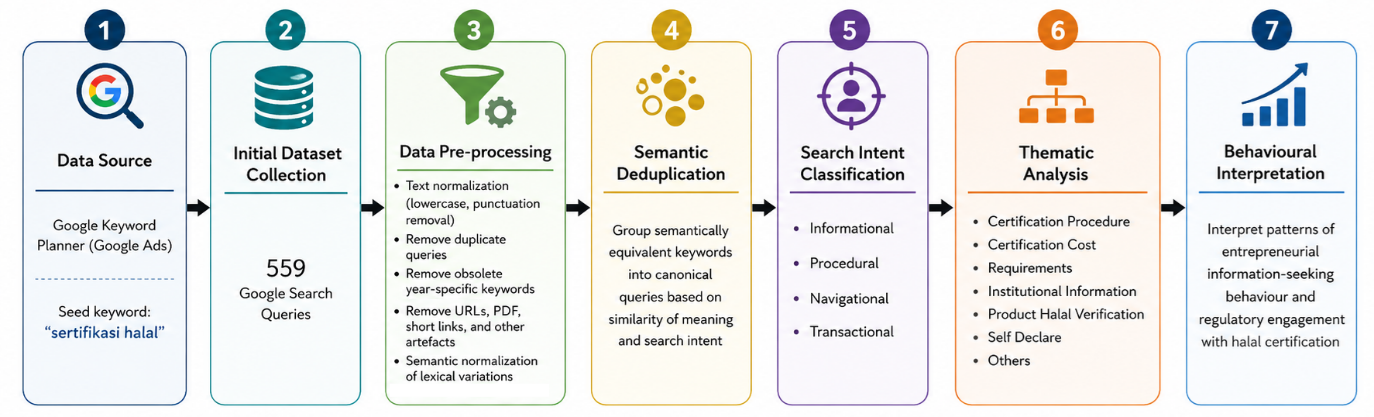
Understanding how entrepreneurs engage with regulatory information is essential for improving the implementation of mandatory halal certification. While previous studies have predominantly relied on surveys and interviews, little attention has been paid to digital behavioural evidence generated through online search activities. This study addresses this gap by investigating entrepreneurial regulatory engagement using Google search behaviour related to Indonesia's halal certification system. A total of 559 search queries were extracted from Google Keyword Planner and refined into 392 analytical queries through lexical normalization and duplicate removal. The dataset was analysed using search-intent classification, thematic analysis, descriptive statistics, and Python-based data processing. The findings indicate that informational searches dominate entrepreneurial search behaviour, followed by navigational, transactional, and procedural searches, suggesting that entrepreneurs primarily seek regulatory knowledge and institutional guidance before engaging in certification procedures. Thematic analysis further reveals that certification processes, institutional information, and general halal knowledge represent the principal information needs. This study proposes a Behavioural Information-Seeking Framework for Halal Certification, demonstrating that digital search behaviour reflects successive stages of regulatory engagement from information acquisition to compliance action. The findings contribute to the literature by extending search-intent analytics to Islamic economic governance and provide practical insights for strengthening digital communication strategies and evidence-based halal governance.
Downloads
References
Badan Penyelenggara Jaminan Produk Halal. (2024, 18 Oktober). Masa penahapan usai, kewajiban sertifikasi halal berlaku mulai 18 Oktober 2024. Kementerian Agama Republik Indonesia. BPJPH Official Website https://bpjph.halal.go.id/read/masa-penahapan-usai-kewajiban-sertifikasi-halal-berlaku-mulai-18-oktober-2024
Badan Penyelenggara Jaminan Produk Halal (BPJPH). (2025, 3 Desember). Edukasi halal penting untuk wujudkan tertib halal. Badan Penyelenggara Jaminan Produk Halal (BPJPH). https://bpjph.halal.go.id/detail/edukasi-halal-penting-untuk-wujudkan-tertib-halal
Bahrudin, M., Iqbal, M., Saefurrohman, G. U., & Walsh, J. (2025). Determinants Influencing Micro, Small, and Medium Enterprises (MSMEs) Decisions to Pursue Halal Certification. Indonesian Journal of Halal Research, 7(2), 125–139. https://doi.org/10.15575/ijhar.v7i2.39949
Broder, A. (2002). A taxonomy of web search. ACM SIGIR Forum, 36(2), 3–10. https://doi.org/10.1145/792550.792552
Case, D. O., & Given, L. M. (2016). Looking for Information: A Survey of Research on Information Seeking, Needs, and Behavior (4th ed.). Emerald Publishing.
Darmalaksana, W. (2023). How is the halal certification policy implemented? Perspective analysis of small and medium enterprises (SMEs) in Indonesia. Journal of Islamic Accounting and Business Research, 16(7), 1205–1222. https://doi.org/10.1108/jiabr-12-2022-0342
Dou, Z., & Guo, J. (2020). Query Intent Understanding. In The Information Retrieval Series (pp. 69–101). Springer International Publishing. https://doi.org/10.1007/978-3-030-58334-7_4
Fathoni, M. A., Faizi, F., Suprima, S., Wiryanto, F. S., & Suryani, S. (2024). Exploring Halal Certification Literacy Measurement for Micro Small Enterprises (MSEs). Review of Islamic Economics and Finance, 7(2). https://ejournal.upi.edu/index.php/rief/article/view/73607
Fathoni, M. A., Priyatno, P. D., Faizi, Wiryanto, F. S., Rachbini, W., & Suryani. (2025). Unlocking barriers and strategies of halal certification for micro and small enterprises in Indonesia: Analytic network process approach. Problems and Perspectives in Management, 23(1), 169–180. https://doi.org/10.21511/ppm.23(1).2025.13
Febriandika, N. R., Wijaya, V., & Hakim, L. (2023). Gen-Z Muslims’ purchase intention of halal food: Evidence from Indonesia. Innovative Marketing, 19(1), 13–25. https://doi.org/10.21511/im.19(1).2023.02
Gustiana, R. (2023). Efektifitas BPJPH terhadap Sertifikasi Halal Produk UMKM Indonesia. Al-Maqrizi: Jurnal Ekonomi Syariah Dan Studi Islam, 1(1), 1–21. https://doi.org/10.32493/amq.v1i1.31673
Henninger, M. (2017). Government information: Literacies, behaviours and practices. Government Information Quarterly, 34(1), 8–15. https://doi.org/10.1016/j.giq.2016.12.003
Ibrahim, M. Y., Fauzi, U., Fadillah, N., & Satifa, S. A. (2023). The Transformation of Halal Certification Regulations in Indonesia. Jurnal Ekonomi Syariah, 8(2), 183–195. https://doi.org/10.37058/jes.v8i2.8463
Jansen, B. J., Booth, D. L., & Spink, A. (2008). Determining the informational, navigational, and transactional intent of Web queries. Information Processing & Management, 44(3), 1251–1266. https://doi.org/10.1016/j.ipm.2007.07.015
Najla, N., & Huda, N. (2025). Halal certification policies in OIC and non-OIC countries: a comparative analysis of Indonesia, Malaysia, Thailand, and Singapore. Journal of Halal Product and Research, 8(1), 60–74. https://doi.org/10.20473/jhpr.vol.8-issue.1.60-74
Pratikto, H., Agustina, Y., & Kiranawati, T. M. (2023). The Influence of Various Factors on MSME Halal Certification Behavior: An Analysis With Intention as an Intervening Variable. International Journal of Professional Business Review, 8(9), e3444. https://doi.org/10.26668/businessreview/2023.v8i9.3444
Townley, C., & Koop, C. (2024). Exploring the potential and limits of digital tools for inclusive regulatory engagement with citizens. Government Information Quarterly, 41(1), 101901. https://doi.org/10.1016/j.giq.2023.101901
Widigdo, A. M. N., & Bayinah, A. N. (2023). Strategy to Accelerate Halal Certification for MSEs in Indonesia: An Analytic Network Process Approach. Al-Iqtishad: Jurnal Ilmu Ekonomi Syariah, 15(2). https://doi.org/10.15408/aiq.v15i2.33941
Wilson, T. D. (1999). Models in information behaviour research. Journal of Documentation, 55(3), 249–270. https://doi.org/10.1108/eum0000000007145
Yuanitasari, D., Sardjono, A., & Susetyo, H. (2024). The Implications of Halal Regulations in Indonesia: A Consumer Protection’s Legal Perspective. PADJADJARAN Jurnal Ilmu Hukum (Journal of Law), 11(3), 385–404. https://doi.org/10.22304/pjih.v11n3.a4
Zhang, J., Xu, W., Ji, J., Chen, X., Deng, H., & Yang, K. (2021). Modeling Across-Context Attention For Long-Tail Query Classification in E-commerce. In Proceedings of the 14th ACM International Conference on Web Search and Data Mining (pp. 58–66). WSDM ’21: The Fourteenth ACM International Conference on Web Search and Data Mining. ACM. https://doi.org/10.1145/3437963.3441822
Downloads
Submitted
Accepted
Published
How to Cite
Issue
Section
License
Copyright (c) 2026 Journal of Islamic Economic Laws

This work is licensed under a Creative Commons Attribution-ShareAlike 4.0 International License.