From Legal Compliance to Spiritual Authenticity: The Role of Halal Certification in Shaping Muslim Tourists’ Experiences
DOI:
https://doi.org/10.23917/jisel.v9i01.13598Keywords:
Halal Regulation, Religious Tourism, Consumer Trust, Spiritual Authenticity, Islamic GovernanceAbstract
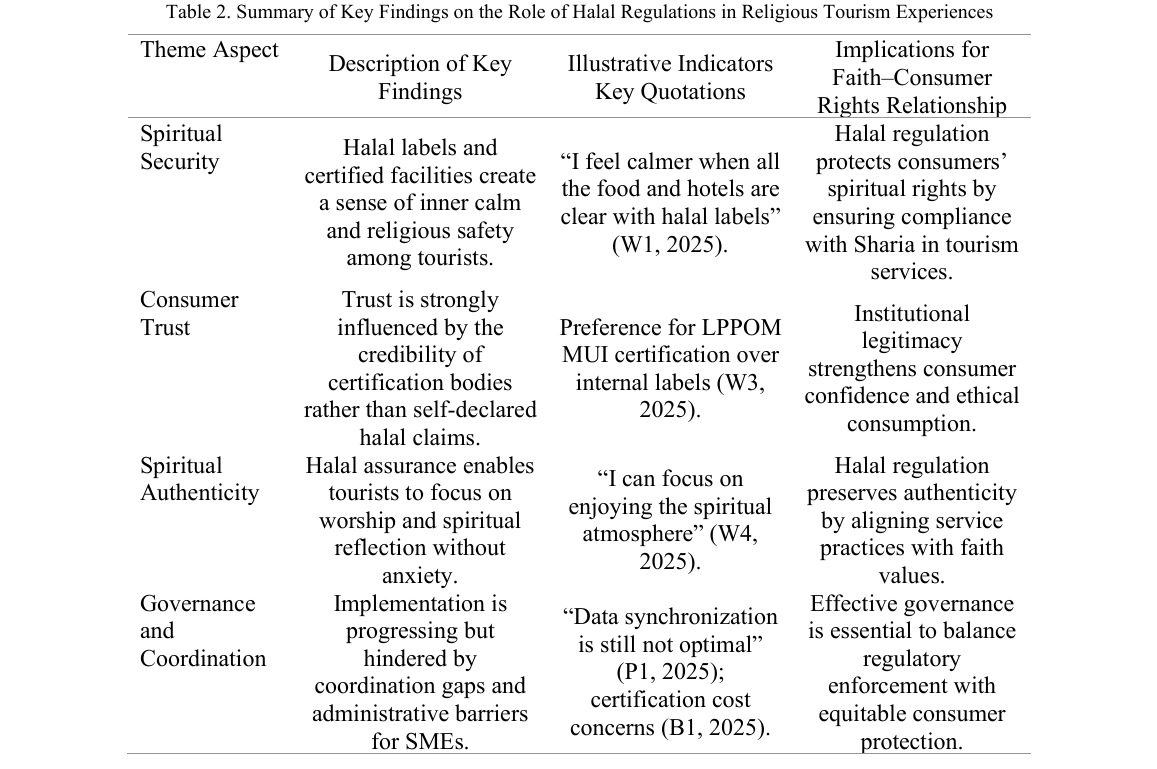
This study examines how halal regulations function as a moral and legal bridge between faith and consumer rights in religious tourism. Using a qualitative descriptive case study in Surabaya, Indonesia, this study explores how halal certification shapes Muslim tourists’ perceptions of trust, authenticity, and spiritual experience. Data were collected through in-depth interviews with eight key informants, including local and international Muslim tourists, business owners, hotel managers, and government officials, supported by document analysis of halal policies and certification frameworks. The findings indicate that halal regulations significantly strengthen tourists’ sense of spiritual security, ethical trust, and overall satisfaction. Halal certification is perceived not merely as legal compliance with Islamic principles, but also as a symbol of integrity, transparency, and respect for religious identity. Nevertheless, the study identifies key challenges, such as weak institutional coordination, limited halal literacy, and the risk of excessive commercialization of religious symbols. These issues highlight the importance of integrating legal, ethical, and spiritual dimensions within halal governance. The study concludes that sustainable halal tourism requires a careful balance between formal regulatory assurance and genuine spiritual authenticity. By integrating halal regulatory frameworks, perceived spiritual authenticity, and consumer trust, this study contributes to the halal tourism literature and offers strategic insights for policymakers and destination managers to strengthen institutional collaboration, enhance halal literacy, and promote ethical governance to support credible and sustainable halal tourism development.
Downloads
References
Ab Halim, M. A., & Mohd Salleh, M. M. (2020). Consumer rights in Halal products: A study based on legal and Syariah perspectives. Food Research, 4, 281–290. https://doi.org/10.26656/fr.2017.4(S1).S31
Adham, K. A., Nasir, N. M., Sinaau, A., Shaznie, A., & Munawar, A. (2024). Halal tourism on an island destination: Muslim travellers’ experiences in the local islands of the Maldives. Journal of Islamic Marketing. https://doi.org/10.1108/jima-07-2023-0232
Akbar, J., Gul, M., Jahangir, M., Adnan, M., Saud, S., Hassan, S., Nawaz, T., & Fahad, S. (2023). Global Trends in Halal Food Standards: A Review. In Foods (Vol. 12, Issue 23). Multidisciplinary Digital Publishing Institute (MDPI). https://doi.org/10.3390/foods12234200
Almuhrzi, H. (2020). Islamic tourism: management of travel destinations. Journal of Heritage Tourism, 15(4), 480–482. https://doi.org/10.1080/1743873x.2019.1658351
Ankiel, M., Halagarda, M., Piekara, A., Sady, S., Żmijowska, P., Popek, S., Pachołek, B., Jefmański, B., Kucia, M., & Krzywonos, M. (2025). Role of Certifications and Labelling in Ensuring Authenticity and Sustainability of Fermented Milk Products. Sustainability (Switzerland), 17(18), 1–22. https://doi.org/10.3390/su17188398
Arifin, B., Moh. Ulumuddin, & Ansori, A. I. (2025). The Dynamics of Conservatism in Halal Certification, Sharia Regional Regulations, and Moral Regulation: A Study of Islamic Legal Policy in Indonesia. At-Tahdzib: Jurnal Studi Islam Dan Muamalah, 13(1), 30–48. https://doi.org/10.61181/at-tahdzib.v13i1.525
Attwood, S., Jameel, S., Fuseini, A., AlKhalawi, E., & Hajat, C. (2023). Halal cultivated meat: an untapped opportunity. Frontiers in Nutrition, 10. https://doi.org/10.3389/fnut.2023.1196475
Azam, M. S. E., & Abdullah, M. A. (2020). Global Halal Industry : Realities and Opportunities. International Journal of Islamic Business Ethics, 5(1), 47–59.
Bahrudin, M. (2022). Halal Tourism Governance Based on the Fatwa of the National Sharia Council on Tourism Improvement. Journal of Environmental Management and Tourism, 13(7), 2058. https://doi.org/10.14505/jemt.v13.7(63).25
Calder, R. (2020). Halalization: Religious Product Certification in Secular Markets. Sociological Theory, 38(4), 334–361. https://doi.org/10.1177/0735275120973248
Christou, P., Pericleous, K., & Singleton, A. B. (2023). Spiritual tourism: understandings, perspectives, discernment, and synthesis. Current Issues in Tourism, 1–18. https://doi.org/10.1080/13683500.2023.2183819
Creswell, J. W., & Poth, C. N. (2018). Qualitative Inquiry and Research Design: Choosing Among Five Approaches (4th ed.). SAGE Publications.
Das, A., Kondasani, R. K. R., & Deb, R. (2023). Religious tourism: a bibliometric and network analysis. Tourism Review. https://doi.org/10.1108/tr-08-2022-0387
Fisher, J. (2022). Material Muslim Authority: Danish Debates about Religious Markets. Journal of Muslims in Europe, 11(1), 106–123. https://doi.org/10.1163/22117954-bja10044
Fitria, Z., & Sukardi, A. S. (2025). Effectiveness of Infaq and Shodaqoh Empowerment in Religious Tourism Areas: A Study on the Menara Kudus Mosque. Journal of Islamic Economic Laws, 8(01), 106–128. https://doi.org/10.23917/jisel.v8i01.7371
Gaffar, V., Christiyanto, W. W., Arissaputra, R., Abror, A., Achmad, N., Hidayat, E. F. F., Siregar, Q. A., & Shahril, A. (2024). Digital halal literacy and halal destination attribute as the antecedents of revisit intention. International Journal of Tourism Cities, ahead-of-print(ahead-of-print). https://doi.org/10.1108/IJTC-12-2023-0259
Garanti, Z., Ilkhanizadeh, S., & Liasidou, S. (2024). Sustainable Place Branding and Visitors’ Responses: A Systematic Literature Review. Sustainability (Switzerland) , 16(8), 1–15. https://doi.org/10.3390/su16083312
GMTI. (2024). Bridging journeys. Mastercard-Crescentrating, May, 1–73. https://www.crescentrating.com/reports/global-muslim-travel-index-2024.html
Hafid, A., Bahri, S., Marzuki, S. N., Muis, M., & Idayanti, R. (2024). The Application of Khiyar Principles to E-Commerce Transaction: The Islamic Economy Perspective. Samarah, 8(1), 403–420. https://doi.org/10.22373/sjhk.v8i1.20890
Hariani, D., Hanafiah, M. H., Anuar, N. A. M., & Ahmad, K. N. (2024). Promoting halal tourism in sharia-compliant destination: Insights on aceh competitiveness and tourist perceived value and behavior. Tourism and Hospitality Research. https://doi.org/10.1177/14673584241283902
Hua, C., Cole, S., Zhang, Y., Wang, W., & Zhao, H. (2025). Exploring Needed Support as a Motivational Factor for Travelers with Mobility Impairments: A Sequential Mixed-Methods Exploration. Journal of Travel Research, 64(2), 378–394. https://doi.org/10.1177/00472875231215017
Idris, S. H., Abdul Majeed, A. B., & Chang, L. W. (2020). Beyond Halal: Maqasid al-Shari’ah to Assess Bioethical Issues Arising from Genetically Modified Crops. Science and Engineering Ethics, 26(3), 1463–1476. https://doi.org/10.1007/s11948-020-00177-6
Irawati, N. W., Bulutoding, L., & Siradjuddin. (2024). Trilogy Halal Tourism Al Mulk. Jurnal Ilmiah Ekonomi Islam. https://doi.org/10.29040/jiei.v10i1.12380
Islam, M. S. (2024). Integrating halal tourism principles into Maslow’s Hierarchy of needs. Tourism and Hospitality Research. https://doi.org/10.1177/14673584241287508
Jeaheng, Y., Al-Ansi, A., & Han, H. (2020). Impacts of Halal-friendly services, facilities, and food and Beverages on Muslim travelers’ perceptions of service quality attributes, perceived price, satisfaction, trust, and loyalty. Journal of Hospitality Marketing & Management, 29(7), 787–811. https://doi.org/10.1080/19368623.2020.1715317
Kasdi, A., Nashirudin, M., Farida, U., & Praatmana, N. D. (2021). Potential of Kudus as a new international pilgrimage destination in Indonesia: Halal tourism optimising local wisdom. International Journal of Religious Tourism and Pilgrimage, 9(1), 96–105. https://doi.org/10.21427/6a93-zn19
Kepplinger, E. (2025). The Maqāṣid as a Means for a Contemporary, Ethically Based Muslim Thought: A Comparison of the Views of Ṭāhā ʿAbd al-Raḥmān and Ṭaha Jābir al-ʿAlwānī. Religions, 16(8). https://doi.org/10.3390/rel16081080
Kim, J.-H., Williamson, H. K., & Holiday, S. (2025). Solo traveler motivation: Identifying consumer archetypes using functional attitude theory. Journal of Vacation Marketing. https://doi.org/10.1177/13567667251361153
Marcotte, R. D. (2020). Brand Islam: The Marketing and Commodification of Piety. Islam and Christian–Muslim Relations, 31(1), 106–109. https://doi.org/10.1080/09596410.2019.1705575
Menteri Hukum dan Hak Asasi Manusia. (2014). UU No.33 Tahun 2014 (2014). UU No.33 Tahun 2014, 1. https://peraturan.bpk.go.id/Home/Details/38709/uu-no-33-tahun-2014
Moshin, A., Brochado, A., & Rodrigues, H. (2020). Halal tourism is traveling fast: Community perceptions and implications. Journal of Destination Marketing and Management, 18. https://doi.org/10.1016/j.jdmm.2020.100503
Nasution, H. M. Y., Shihab, S. A., Al-Hawary, S. I. S., Pallathadka, H., Al-Salami, A. A. A., Van, L. W., Al-khafaji, F. A. H., Morozova, T. V., & Muda, I. (2023). Values, accountability and trust among Muslim staff in Islamic organisations. Theological Studies/Teologiese Studies, 79(1). https://doi.org/10.4102/hts.v79i1.8272
Nisa, E. F. (2023). Transnational halal networks: INHART and the Islamic cultural economy in Malaysia and beyond. Global Networks, 23(3), 557–569. https://doi.org/10.1111/glob.12432
Patton, M. Q. (2015). Sampling, Qualitative (Purposeful). The Blackwell Encyclopedia of Sociology, 2–4. https://doi.org/10.1002/9781405165518.wbeoss012.pub2
Prayag, G. (2020). Halal tourism: looking into the future through the past. Tourism Recreation Research, 45(4), 557–559. https://doi.org/10.1080/02508281.2020.1762044
Rasul, T. (2019). The trends, opportunities and challenges of halal tourism: a systematic literature review. Tourism Recreation Research, 44(4), 434–450. https://doi.org/10.1080/02508281.2019.1599532
Rohmana, Y. (2022). Consumption: Ethical Perspective of Islamic Economics. Review of Islamic Economics and Finance, 5(1), 79–92. https://doi.org/10.17509/rief.v5i1.52164
Shinde, K. A. (2020). The spatial practice of religious tourism in India: a destinations perspective. Tourism Geographies, 31(2), 1–21. https://doi.org/10.1080/14616688.2020.1819400
Soehardi, D. V. L., Sudiarti, S., & Marliyah, M. (2025). The Paradigm of Fiqh Muamalah Maliyah in the Halal Tourism Ecosystem: Integration of Maqashid Syariah and Sustainable Business Models. Brilliant International Journal of Management and Tourism, 5(2), 225–235. https://doi.org/10.55606/bijmt.v5i2.4689
Sugiyono. (2019). Metodelogi Penelitian Kuantitatif dan Kualitatif Dan R&D. ALFABETA.
Suhartanto, D., Dean, D., Wibisono, N., Astor, Y., Muflih, M., Kartikasari, A., Sutrisno, R., & Hardiyanto, N. (2021). Tourist experience in Halal tourism: what leads to loyalty? Current Issues in Tourism, 24(14), 1976–1990. https://doi.org/10.1080/13683500.2020.1813092
Syed Hamzah, S. A., Johari, S., Yusof, Y. A., Ramlan, M. A., & Mohd Azmi, P. U. B. (2024). a Structured Review: Halal Regulatory System. Journal of Tourism, Hospitality and Environment Management, 9(38), 259–289. https://doi.org/10.35631/jthem.938018
Taheri, B., Gannon, M. J., & Kesgin, M. (2020). Visitors’ perceived trust in sincere, authentic, and memorable heritage experiences. Service Industries Journal, 40, 705–725. https://doi.org/10.1080/02642069.2019.1642877
Tiwari, P., & Bhalla, R. (2023). The Routledge handbook of religious and spiritual tourism. Journal of Heritage Tourism, 18(1), 142–143. https://doi.org/10.1080/1743873X.2022.2065058
Wang, S., Blasco, D., Verschuuren, B., & Hamzah, A. (2024). Seeking transcendence in the depths of the soul: an exploration into current spiritual journeys. Current Issues in Tourism, 1–13. https://doi.org/10.1080/13683500.2024.2444534
Wiyono, S. N., Deliana, Y., Wulandari, E., & Kamarulzaman, N. H. (2022). The Embodiment of Muslim Intention Elements in Buying Halal Food Products: A Literature Review. Sustainability, 14(20), 13163. https://doi.org/10.3390/su142013163
Yakin, A. U. (2025, April). Halal studies. In Oxford bibliographies in Islamic studies. Oxford University Press. https://doi.org/10.1093/obo/9780195390155-0321
Yousaf, S. (2023). Understanding Halal leisure: a preliminary view. Leisure Studies, 42(2), 314–323. https://doi.org/10.1080/02614367.2022.2115110
Zarkasyi, M. M. R., Kurniawan, D. A., & Anggara, F. (2022). Stakeholders Approach in Halal Tourism Development Strategy: A Case Study in Ponorogo District. Ekuilibrium: Jurnal Ilmiah Bidang Ilmu Ekonomi, 17(2), 171–181. https://doi.org/10.24269/ekuilibrium.v17i2.2022.pp171-181
Zuhrah, F., Imansah, R. K. S., Atieqoh, S., Kustini, K., & Suhanah, S. (2025). Halal Certification Service in Indonesia: Between Islamic Law Compliance and Satisfaction Improvement. Al-Ihkam: Jurnal Hukum Dan Pranata Sosial, 20(1), 253–283. https://doi.org/10.19105/al-lhkam.v20i1.15225
Downloads
Submitted
Accepted
Published
How to Cite
Issue
Section
License
Copyright (c) 2026 Journal of Islamic Economic Laws

This work is licensed under a Creative Commons Attribution-ShareAlike 4.0 International License.