Halal Industry and Islamic Epistemology: Implications for Policy, Ethics, and Global Practices
DOI:
https://doi.org/10.23917/jisel.v9i01.13268Keywords:
Islamic Epistemology, Halal Industry, Maqasid al-Shari'ah, Halal Governance, Public PolicyAbstract
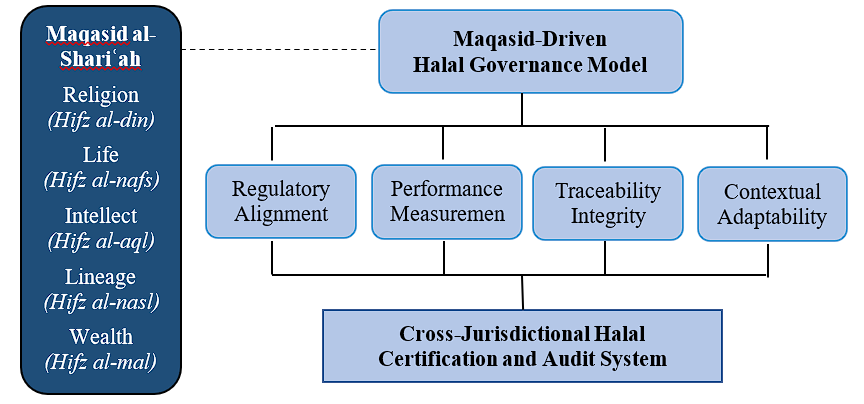
The rapid growth of the global halal industry demands an epistemological framework that is rooted in Islamic principles and aligned with international regulations. This study addresses three questions: (1) how Islamic epistemology can be systematically constructed through its ontological foundations and axiological orientations to form a coherent halal industry framework; (2) how Islamic epistemology informs public policy and ethical governance globally; and (3) what is the most effective model for integrating maqasid al-shari‘ah into cross-jurisdictional halal certification and audits. Using a qualitative conceptual research design based on integrative library research and doctrinal analysis of classical Islamic texts, contemporary maqasid literature, and international halal standards, this study develops a Maqasid-Driven Halal Governance Model (MDHGM). Within this framework, ontology clarifies the metaphysical assumptions underpinning halal norms, while axiology specifies the ethical objectives that guide epistemological reasoning and regulatory application. Findings show that embedding Islamic epistemology into regulatory practices enhances traceability, performance, and contextual adaptability. Harmonizing maqasid values with global regulations strengthens trust, interoperability, and sustainability in the halal industry. This study is limited by its conceptual and library-based design, which lacks empirical validation across diverse institutional and regulatory contexts. Future research should empirically test the proposed model across jurisdictions and industry sectors to assess its applicability and robustness.
Downloads
References
Adnan, L. (2025, May 23). The Impact of Halal Food on the Global Food Industry: US Market Insights. The Halal Times. https://www.halaltimes.com/the-impact-of-halal-food-on-the-global-food-industry-us-market-insights/
al-Ghazālī, A. H. (1993). Al-Mustasfa min ‘ilm al-usul (Muhammad Sulayman al-Ashqar). Dar al-Baz.
al-Shāṭibī, I. I. (2004). Al-Muwafaqat fi usul al-shari’ah (I. Ramadan). Beirut: Dār al-Kutub al-ʿIlmiyyah.
Alam, A., Fuadati, A. R., Fathma, A., Nordin, N., & Ullah, I. (2025). Halal Awareness In Contemporary Muslim Societies: A Systematic Review Of Scopus-Indexed Studies. Journal of Fatwa Management and Research, 30(3), 215–238. Scopus. https://doi.org/10.33102/jfatwa.vol30no3.707
Alias, M. N., Abdullah, M. N., Kamis, M. S., Afandi, A. J., & Alias, N. (2024). Scientific Approach As The Basis For The Formation Of Maqāṣid Al-Sharī‘Ah Concept And Principles: A Comparative Study. Malaysian Journal of Syariah and Law, 12(2), 350–363. https://doi.org/10.33102/mjsl.vol12no2.568
Almunawar, M. N., Almunawar, M. N., Almunawar, M. N., Ubaedillah, A., Amalia, E., Thoha, A. M., & Thoha, A. M. (Eds.). (2025). Implementing Halal Principles and Regulations in Business Governance. IGI Global. https://doi.org/10.4018/9798337339177
Atalan-Helicke, N. (2023). Halal Certification in the United States and the Expansion of Halal Markets. In R. Turaeva & M. Brose (Eds.), Religious Economies in Secular Context: Halal Markets, Practices and Landscapes (pp. 21–55). Springer International Publishing. https://doi.org/10.1007/978-3-031-18603-5_2
Auda, J. (2008). Maqasid al-Shariah as philosophy of Islamic law: A systems approach. International Institute of Islamic Thought (IIIT).
Auda, J. (2011). A maqāsidī approach to contemporary application of the Sharī’ah. Intellectual Discourse, 19(2), 193–217. https://doi.org/10.31436/id.v19i2.231
Bakhshizadeh Borj, K., Bashirpour, M., Javanshir, N., & Jahedi, P. (2025). The hidden dimensions of halal brand: Examining the role of frugality in consumer purchase decisions. Journal of Islamic Marketing. Scopus. https://doi.org/10.1108/JIMA-11-2024-0529
Belkhatir, M., Bala, S., & Belkhatir, N. (2020). Business Process Re-engineering in Supply Chains Examining the case of the expanding Halal industry (arXiv:2004.09796). arXiv. https://doi.org/10.48550/arXiv.2004.09796
Bergeaud-Blackler, F., Fischer, J., & Lever, J. (Eds.). (2016). Halal matters: Islam, politics and markets in global perspective (First edition). Routledge. https://doi.org/10.4324/9781315746128
Bima, M., Alim, M. N., & Adnan, N. I. M. (2025). Assessing the Reliability of Halal Certification Implementation: A Qualitative Study on Perceptions of Halal Supervisors and Micro Business Actors. Journal of Islamic Economic Laws, 8(01), 79–105. https://doi.org/10.23917/jisel.v8i01.7305
Boutayeba, F., Benhamida, M., & Guesmi, S. (2014). Ethics in Islamic Economics. Annales. Ethics in Economic Life, 17(4), 111–121. https://ideas.repec.org//a/ann/journl/v17y2014i4p111-121.html
Byrd, M. Y. (2024). Toward a Moral Philosophy of Ethics: The Social Justice Case. In D. F. Russ-Eft & A. Alizadeh (Eds.), Ethics and Human Resource Development: Societal and Organizational Contexts (pp. 339–356). Springer International Publishing. https://doi.org/10.1007/978-3-031-38727-2_17
Calder, R. (2024). The paradox of Islamic finance: How Shariah scholars reconcile religion and capitalism. Princeton University Press.
Casais, B., & Faria, J. (2021). The Intention-Behavior gap in Ethical Consumption: Mediators, Moderators and Consumer Profiles Based on Ethical Priorities. Journal Od Macromarketing, 42(1). https://doi.org/10.1177/02761467211054836
Chikaputri, K. K., Sutrisno, W., Helia, V. N., & Yanti, R. (2023). Effect of Inventory and Facilities on Service Quality: A Case Study in Sharia Hotel in Indonesia. 2680(1). Scopus. https://doi.org/10.1063/5.0126057
Choudhury, M. A., & Hoque, M. Z. (2006). Corporate governance in Islamic perspective. Corporate Governance, 6(2), 116–128. https://doi.org/10.1108/14720700610655132
Dabamona, S. A., Chompupor, P., & Ghuangpeng, S. (2025). We are ready for halal tourism, aren’t we? Exploring readiness of non-Muslim perspective in Thailand. Journal of Islamic Marketing, 16(5), 1410–1428. https://doi.org/10.1108/JIMA-10-2023-0337
DinarStandard. (2024). State of the Global Islamic Economy Report 2024/25. Salaam Gateway. https://salaamgateway.com/specialcoverage/SGIE24
Ellahi, R. M., Wood, L. C., Khan, M., & Bekhit, A. E.-D. A. (2025). Integrity Challenges in Halal Meat Supply Chain: Potential Industry 4.0 Technologies as Catalysts for Resolution. Foods (Basel, Switzerland), 14(7), 1135. https://doi.org/10.3390/foods14071135
Elouazzani, L. (2024). Human dignity and the pursuit of knowledge in Islamic thought: Insights from the Quran. Journal of Infrastructure, Policy and Development, 8(12). https://doi.org/10.24294/jipd.v8i12.9129
Fatchurrohman, M., Takhim, M., & Irhamni, M. R. (2025). Advancing Halal Creative Industry Exports: Strengthening Advocacy and Codification in HPPA Performance to Boost Indonesia’s Economic Growth. Mazahib Jurnal Pemikiran Hukum Islam, 24(1), 62–100. https://doi.org/10.21093/mj.v24i1.9593
Güney, N. (2024). Maqāsid al-Sharī‘a in Islamic Finance: A Critical Analysis of Modern Discourses. Religions, 15(1). https://doi.org/10.3390/rel15010114
Harahap, I. T. S., Balqis, K. P., Syahputra, M. A., & Zein, A. W. (2024). Ontologi Sebagai Landasan Teologi Ekonomi Islam Konsep Tauhid dan Konsep Keadilan. Journal of Religion and Social Community, 1(2), 78–83. https://doi.org/10.62379/jrsc.v1i2.123
Harits Nu’man, A., Mulyaningsih, H. D., Saraswati, N., Rachmawati, A. W., & Saripudin, U. (2023). Global Halal Industry Outlook: Current Issues and Development. In Technologies and Trends in the Halal Industry (pp. 7–22). Scopus. https://doi.org/10.4324/9781003368519-3
Hasan, M. R., & Latif, M. S. A. (2024). Towards a Holistic Halal Certification Self-Declare System: An Analysis of Maqāṣid al-Sharīʿah-Based Approaches in Indonesia and Malaysia. Mazahib Jurnal Pemikiran Hukum Islam, 23(1), 41–78. https://doi.org/10.21093/mj.v23i1.6529
Hashim, Y. Z. H.-Y., Ahmad, A. N., Samsudin, N., Al-saari, N., Yusof, M. A., Shogar, I., & Mohamad Tauhid, D. K. (2025). Revisiting contemporary halal research from the perspective of the tawhidic paradigm. Halalsphere, 5(2), 30–52. https://doi.org/10.31436/hs.v5i2.123
Hidayat, Y., Machmud, A., Zulhuda, S., & Suartini, S. (2025). Legal aspects and government policy in increasing the role of MSMEs in the Halal ecosystem. F1000Research. https://doi.org/10.12688/f1000research.148322.4
Hilme, S. I., & Raffi, R. M. (2024). Maqasid Approach and Shariah Rules Towards Halal Industry. Journal of Halal Science, Industry, and Business, 2(2), 1–14. https://doi.org/10.31098/jhasib.v2i2.2691
Hindolia, A., Arya, J., Pathak, R., & Kazmi, A. (2024). Halal B2B marketing in the metaverse: Crafting a conceptual framework to pinpoint opportunities and challenges, outlining the agenda for future research. Journal of Islamic Marketing. Scopus. https://doi.org/10.1108/JIMA-02-2024-0054
Ibn ʿĀshūr, M. al-T. (2006). Ibn Ashur: Treatise on Maqasid al-Shariah (M. el-Tahir el-Mesawi, Trans.). International Institute of Islamic Thought (IIIT).
Idris, N. R. A. B., Sirat, M., & Da Wan, C. (2019). Toward sustainable islamic communities in Malaysia: The role of islamic-based higher education institutions (IHEIs). In Education in the Asia-Pacific Region (Vol. 49, pp. 27–40). Springer Nature. https://doi.org/10.1007/978-981-13-6532-4_3
Islam, M. M. (2025). Ontology, Epistemology and Axiology in Halal Research: Empirical Evidence from Hajj Pilgrimage. International Journal of Religious Tourism and Pilgrimage, 13(1). https://doi.org/10.21427/5jph-kc64
Ismaeel, M., & Blaim, K. (2012). Toward applied Islamic business ethics: Responsible halal business. Journal of Management Development, 31(10), 1090–1100. https://doi.org/10.1108/02621711211281889
Ismail Ahmad, M., Othman, R., Ismail, M. N., & Ismail, M. S. (2018). Islamic Epistemology-Based Approach Citation Analysis in Halal Research. In N. Muhammad Hashim, N. N. Md Shariff, S. F. Mahamood, H. M. Fathullah Harun, M. S. Shahruddin, & A. Bhari (Eds.), Proceedings of the 3rd International Halal Conference (INHAC 2016) (pp. 3–15). Springer. https://doi.org/10.1007/978-981-10-7257-4_1
Jaber, D., Salman, N., Al Tabbah, S., El-Sharif, A.-R., Alkilani, A. Z., & Qourshah, A. (2025). Evaluating the Knowledge, Attitude, and Practices of Jordanian Society Towards Halal Pharmaceuticals. Open Public Health Journal, 18. https://doi.org/10.2174/0118749445359631250105142907
Jah, J. I., & Tie, M. H. (2024). Konsep Halal Haram dalam Ekonomi Islam. J-EBI: Jurnal Ekonomi Bisnis Islam, 3(02). https://doi.org/10.57210/j-ebi.v3i02.307
Karia, N. (2025). Halal as Competitive Advantage: The Role of Resource-based Halal Logistics. In R. Idris, M. A. Tareq, S. F. Pehin Dato Musa, & W. H. Sumardi (Eds.), The Halal Industry in Asia: Perspectives from Brunei Darussalam, Malaysia, Japan, Indonesia and China (pp. 243–259). Springer Nature. https://doi.org/10.1007/978-981-96-0393-0_13
Khaleel, F. (2016). Epistemological Crisis in Ethical Governance and Constructing a New Islamic Episteme as an Ethical Theory: A Case of Institution of Hisbah [Doctoral, Durham University]. https://etheses.dur.ac.uk/12123/
Khan, N., Falahat, M., Ullah, I., Sikandar, H., & Van, N. T. (2025). Integrating halal tourism with sustainable development goals through Islamic values environmental responsibility and technological innovation. Discover Sustainability, 6(1), 648. https://doi.org/10.1007/s43621-025-01503-3
Kirihara, M. (2025). The Dual Nature of Syariah Compliance and the Diversity of Halal Standardisation: A Comparative Study of Malaysia and Japan. In The Halal Industry in Asia: Perspectives from Brunei Darussalam, Malaysia, Japan, Indonesia and China (pp. 41–55). Scopus. https://doi.org/10.1007/978-981-96-0393-0_3
Kurth, L., & Glasbergen, P. (2017). Serving a heterogeneous Muslim identity? Private governance arrangements of halal food in the Netherlands. Agriculture and Human Values, 34(1), 103–118. https://doi.org/10.1007/s10460-016-9698-z
Laksana, A. W., Lubis, M. R., Suwondo, D., Ngazis, M., & Sari, R. M. P. (2025). Integrating Maqasid al-Shari’ah in Contemporary Islamic Legal Reform on Drug Policy. MILRev: Metro Islamic Law Review, 4(1), 416–439. https://doi.org/10.32332/milrev.v4i1.10665
Lestianingsih, E. N., Ahyani, H., Muharir, Lathif, A. M. M., Lousada, S. A. N., Mutmainah, N., & Atiqoh, U. (2025). Maqāṣid Al-Sharīʿah Al-Shatibi In The Digital Era: Contemporary Perspectives On Halal Lifestyle And Technology In Indonesia. Al-Mawarid Jurnal Syariah Dan Hukum (JSYH), 7(1), 57–76. https://doi.org/10.20885/mawarid.vol7.iss1.art4
Lutfi, C. (2025). Critical Review of Halal Industry Policy in Indonesia. Ascarya: Journal of Islamic Science, Culture and Social Studies, 5(1), 1–12. https://doi.org/10.53754/iscs.v5i1.717
Malik, A., Romadhon, M. F., Putri, N. C., & Pratama, R. A. (2025). Produksi Halal Dan Standar Syariah Dalam Industri. Al-A’mal : Jurnal Manajemen Bisnis Syariah, 2(1), 97–103. https://journal.staittd.ac.id/index.php/ai/article/view/382
Masood, A., Mohd Soffian Lee, U. H., & Abdul Rahim, A. (2025). Halal Reimagined: IR4.0 Tech Drives Sustainability And Inclusivity In Islamic Monetary Economics. Malaysian Journal of Syariah and Law, 13(1), 164–178. Scopus. https://doi.org/10.33102/mjsl.vol13no1.736
Mas’ud, R., & Muwazir, M. R. (2025). The Role of Legal and Regulatory Frameworks for Sharia-Compliant Financing in Promoting Innovation and Quality Enhancement in Indonesia’s Halal Industry. Khazanah Hukum, 7(2), 174–189. https://doi.org/10.15575/kh.v7i2.43440
Memon, S. B., Syed, S., & Dahri, A. S. (2025). Embedding Social Responsibility in Islamic Banking: Ethical Foundations and Modern Practices. In M. Ali, S. A. Raza, N. S. Abdul Wahab, C.-H. Puah, H. Amin, & A. Abadullah (Eds.), Islamic Finance and Corporate Governance: Synergies for Sustainable Growth (pp. 57–74). Emerald Group Publishing Ltd. https://doi.org/10.1108/978-1-83662-346-520251008
Mergaliyev, A., Asutay, M., Avdukic, A., & Karbhari, Y. (2021). Higher Ethical Objective (Maqasid al-Shari’ah) Augmented Framework for Islamic Banks: Assessing Ethical Performance and Exploring Its Determinants. Journal of Business Ethics, 170(4), 797–834. https://doi.org/10.1007/s10551-019-04331-4
Mohamed, M. F., Mutalib, L. A., Sahid, M. M., Baharudin, A. S., Ismail, W. A. F. W., Murad, A. H. A., & Wafa, K. A. (2019). Islamic epistemology and its relations to scientific method in Islamic law of evidence. International Journal of Recent Technology and Engineering, 8(3), 4350–4352. https://doi.org/10.35940/ijrte.C5502.098319
Mohammed, J. A. (2013). A conceptual framework of business ethics in islam. In C. Luetge (Ed.), Handbook of the Philosophical Foundations of Business Ethics (pp. 899–932). Springer Netherlands. https://doi.org/10.1007/978-94-007-1494-6_5
Mubarrak, Z., Bakar, I. A., Hamdani, M., Musrizal, & Khalilullah. (2025). The Urgency of the Islamic Law and Contemporary Societal Challenges: The Flexibility of al-Maslahah in Determining the Hierarchy of Maqāṣid al-Sharīʿah. El-Usrah, 8(1), 344–365. https://doi.org/10.22373/pxydd884
Muhamed, N. A., Ramli, N. M., Abd Aziz, S. A., & Yaakub, N. A. (2014). Integrating islamic financing and halal industry: A survey on current practices of the selected Malaysian authority bodies. Asian Social Science, 10(17), 120–126. Scopus. https://doi.org/10.5539/ass.v10n17p120
Mustafid, F., Nasution, K., & Sodiqin, A. (2024). Positivization of the Council of Indonesian Ulema’s Halal Fatwa: Policy and Position in Indonesian Legislation. JURIS (Jurnal Ilmiah Syariah), 23(1), 155. https://doi.org/10.31958/juris.v23i1.10859
Napitupulu, R. M., Sukmana, R., Rusydiana, A. S., Cahyani, U. E., & Wibawa, B. M. (2024). The nexus between halal industry and Islamic green finance: A bibliometric analysis. Journal of Islamic Marketing, 15(10), 2508–2527. https://doi.org/10.1108/JIMA-06-2023-0192
Nashirudin, Muh., Ramadhan, & Ulfah, A. K. (2024). Strengthening Maqāṣid al-Sharī’ah Values in Halal Traceability: Evidence and Analysis of Block Chain Based on Halal Supply Chain Applications. Al-Manahij: Jurnal Kajian Hukum Islam, 18(1), 95–108. https://doi.org/10.24090/mnh.v18i1.9883
Nugraha, A. L. (2025). The Rise of The Global Halal Industry: Trends and Key Sectors for Future Directio. ResearchGate. https://doi.org/doi:%252010.13140/RG.2.2.12345.67890
Omar, N., Abdul Aziz, S., Mahaiyadin, M. H., Zainuzzaman, A. K., & Muda, Z. (2024). The Influence of Islamic Consumerism Principles and the Maqasid Daruriyyah Framework on Halal Product Innovation in Malaysia. Global Journal Al-Thaqafah, DECEMBER2024(SPECIALISSUE), 304–325. https://doi.org/10.7187/GJATSI122024-20
Pamukcu, H., & Tanrisever, C. (2022). A New Favorite for Tourists: Halal Tourism in Future. In Future of Tourism in Asia (pp. 267–277). Scopus. https://doi.org/10.1007/978-981-16-1669-3_16
Rahim, N. F. (2023). Rapid scoping review of blockchain adoption in halal industry supply chain. AIP Conf. Proc., 2827(1). https://doi.org/10.1063/5.0166546
Rahim, R. T. A., Zuki, M. F. M., & Noor, N. S. M. (2022). Perspective Of Gravity Model Towards Halal Export: A Conceptual Study. Journal of Fatwa Management and Research, 27(2-SE), 56–67. Scopus. https://doi.org/10.33102/jfatwa.vol27no2-SE.483
Rahman, F. K., Tareq, M. A., Yunanda, R. A., & Mahdzir, A. (2017). Maqashid Al-Shari’ah-based performance measurement for the halal industry. Humanomics, 33(3), 357–370. Scopus. https://doi.org/10.1108/H-03-2017-0054
Rahman, M. M., Razimi, M. S. A., Ariffin, A. S., & Hashim, N. (2024). Navigating moral landscape: Islamic ethical choices and sustainability in Halal meat production and consumption. Discover Sustainability, 5(1). https://doi.org/10.1007/s43621-024-00388-y
Rahman, S. bin A., Razak, N. I. B. A., & Nusran, M. (2023). Halal Standards and Their Contributions to the Growth of Halal Economy in Malaysia and Indonesia. International Journal of Halal System and Sustainability, 3(2), 54–68. https://doi.org/10.33096/injhss.v3i2.278
Raimi, L. (2024). Do Islamic epistemology and ethics advance the understanding and promotion of sustainable development? A systematic review using PRISMA. International Journal of Ethics and Systems. https://doi.org/10.1108/IJOES-04-2024-0115
Raimi, L. (2025). Development of Shari’ah Framework for Halal Policy and Standards for Integrating Blue Economy for Halal Industry Sustainability. In M. A. Salisu, L. Raimi, N. B. Bamiro, & I. O. Elegbede (Eds.), Green and Blue Economy Frameworks for Halal Industry Sustainability (pp. 151–170). Springer Nature. https://doi.org/10.1007/978-981-96-1729-6_9
Raimi, L., & Animashaun, U. A. (2025). Contemporary Discourse on the Farm-to-Fork Concept of the Blue Economy: Exploration for Halal Industry Sustainability. In M. A. Salisu, L. Raimi, N. B. Bamiro, & I. O. Elegbede (Eds.), Green and Blue Economy Frameworks for Halal Industry Sustainability (pp. 301–325). Springer Nature. https://doi.org/10.1007/978-981-96-1729-6_16
Ramli, M. A., Abd Razak, M. A., & Jaafar, M. H. (2023). Understanding non-Muslims’ reluctance to halal food: A systematic review. Journal of Islamic Marketing, 14(2), 544–561. Scopus. https://doi.org/10.1108/JIMA-05-2021-0134
Rangkuti, M. Y. (2023). Toward a Holistic Framework of Islamic Business Ethics: Insights from Leadership, Halal Practices, and Finance in a Digital Age. Sinergi International Journal of Islamic Studies, 1(3), 114–127. https://doi.org/10.61194/ijis.v1i3.593
Repelita, Iskandar, N., & Mursal. (2024). Halal Without Label: Implementation Of Maqāṣid Al-Sharī’ah In Community-Based Tourism In Kerinci, Indonesia. Malaysian Journal of Syariah and Law, 12(1), 192–205. https://doi.org/10.33102/mjsl.vol12no1.477
Research and Markets. (2025). Halal Food Market: Global Industry Trends, Share, Size, Growth, Opportunity and Forecast 2024-2033. https://www.researchandmarkets.com/report/halal-food
Restuti, D. P., Kasdi, A., & Cahya, B. T. (2025). Economics issues of halal industry. In Exploring the Halal Industry and Its Business Ecosystem Prospects (pp. 1–22). Scopus. https://doi.org/10.4018/979-8-3693-8618-7.ch001
Risnawati, H., Nadhifah, T., & Rosita, D. (2024). Jual Beli Online Dalam Perspektif Hukum Islam. Jurnal Magister Ekonomi Syariah, 3(1 Juni), 125–134. https://doi.org/10.14421/jmes.2024.031-08
Rojak, J. A., Darmawan, D., & Jahroni. (2021). Implementation of Halal Standards to Strengthen Global HalalMarket and International Trade. Journal of Social Science Studies, 1(2), 1–6. https://jos3journals.id/index.php/jos3/article/view/52
Sencal, H., & Asutay, M. (2021). Rethinking Halal: Hegemony, Agency, and Process. In Rethinking Halal (pp. 11–42). Edinburgh University Press.
Shah, S. A., Bhutto, M. H., & Azhar, S. M. (2022). Integrative review of Islamic marketing. Journal of Islamic Marketing, 13(6), 1264–1287. Scopus. https://doi.org/10.1108/JIMA-07-2020-0216
Shahabuddin, A. S. Md., Sukor, M. E. A., & Hashim, N. H. (2020). Product-centric halal business: A critique from an Islamic perspective. Journal of Islamic Marketing, 11(6), 1707–1724. https://doi.org/10.1108/JIMA-06-2019-0129
Snyder, H. (2019). Literature review as a research methodology: An overview and guidelines. Journal of Business Research, 104, 333–339. https://doi.org/10.1016/j.jbusres.2019.07.039
Sobari, N., Kurniati, A., & Usman, H. (2022). The influence of Islamic attributes and religious commitments toward halal wellness services customer satisfaction and loyalty. Journal of Islamic Marketing, 13(1), 177–197. Scopus. https://doi.org/10.1108/JIMA-11-2018-0221
Susanti, S. & Mashudi. (2022). Analisis Pandangan Masyarakat Bangkalan terhadap Produk dengan Label Halal. Istithmar : Jurnal Studi Ekonomi Syariah, 6(2), 146–158. https://doi.org/10.30762/istithmar.v6i2.300
Swastika, P. (2024). The eternality of islamic teachings: The adaptability of islamic finance principles. In E. Smolo & M. M. Raheem (Eds.), The Future of Islamic Finance: From Shari’ah Law to Fintech (pp. 29–47). Emerald Publishing. https://doi.org/10.1108/978-1-83549-906-120241003
Thévenot, L. (2022). A New Calculable Global World in the Making: Governing Through Transnational Certification Standards. In A. Mennicken & R. Salais (Eds.), The New Politics of Numbers: Utopia, Evidence and Democracy (pp. 197–252). Springer International Publishing. https://doi.org/10.1007/978-3-030-78201-6_7
Tumiran, M. A., Mohammad, N., & Ruzulan, Z. (2021). Understanding Level of Science-Related Halal Academic Courses Among Malaysian University Students: An Experimental Approach. In N. N. Md Shariff, N. Lateh, N. F. Zarmani, Z. S. Hamidi, Z. A. Abdulrazzak Aghwan, N. Binti Dato Haji Mahalle, H. Haji Yaacob, & T. Hisao (Eds.), Enhancing Halal Sustainability (pp. 17–25). Springer. https://doi.org/10.1007/978-981-33-4854-7_2
Ubaidillah, F. (2024). Analysis of the Implementation of Halal Principles in the Food Industry in Indonesia: Challenges and Opportunities. ICO EDUSHA, 5(1), 377–395. Retrieved from https://prosiding.stainim.ac.id/index.php/prd/article/view/535
Wadud, A. M. A., & Ali, K. M. (2023). Halal in Islamic Business. In A. Rafiki (Ed.), Digitalization in Halal Management (pp. 139–149). Springer Nature Singapore. https://doi.org/10.1007/978-981-99-5146-8_10
Wazin, & Suryanto, T. (2023). Constructing Islamic Law and Islamic Business Ethics for a Sustainable Halal Industry Economy. Manchester Journal of Transnational Islamic Law and Practice, 19(3), 212–223. https://www.electronicpublications.org/stuff/999
Yakubu, M. M., Hassan, M. F. B., Danyaro, K. U., Yakubu, B. M., Alabdulatif, A. A., Beevi, S. Z., & Garba, A. (2025). HalalChain: A decentralized blockchain model for enhanced data integrity, real-time compliance, and automated verification in halal food supply chain. Results in Engineering, 27, 106591. https://doi.org/10.1016/j.rineng.2025.106591
Downloads
Submitted
Accepted
Published
How to Cite
Issue
Section
License
Copyright (c) 2026 Journal of Islamic Economic Laws

This work is licensed under a Creative Commons Attribution-ShareAlike 4.0 International License.