Integrating Religiosity and Public Policy to Foster Green Behavior: A Muslim Perspective
DOI:
https://doi.org/10.23917/jisel.v8i02.13105Keywords:
Muslim Consumers, Religiosity, Plastic Ban Policies, Islamic Green Ethics, Green BehaviorAbstract
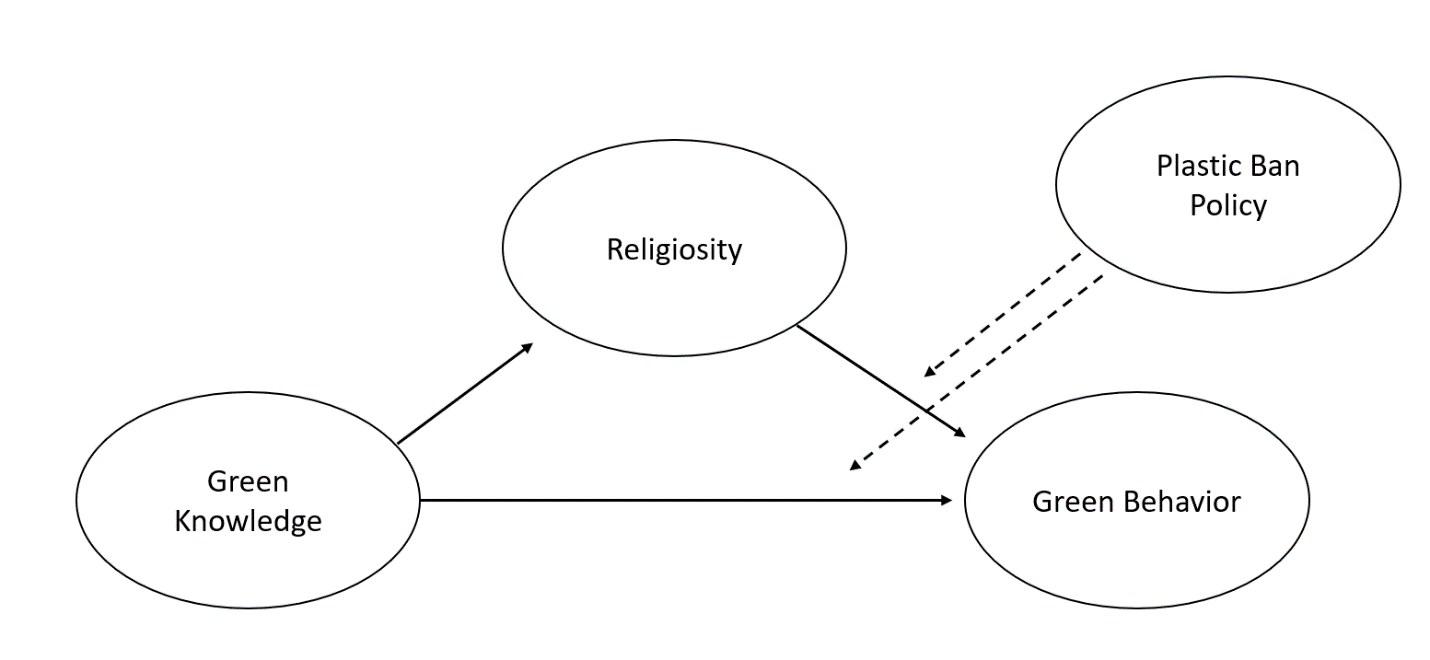
Plastic pollution has become one of the most pressing environmental challenges of our time, yet the role of faith and knowledge in driving sustainable consumer behavior remains underexplored. This study investigates how religiosity, green knowledge, and plastic ban policies interact to shape green behavior among Muslim consumers. By integrating the Norm Activation Theory (NAT) and Institutional Theory, it develops a novel framework for understanding sustainability within a religious context. A survey of 210 Muslim consumers in Banjarmasin, Indonesia, was conducted using a five-point Likert scale to measure green knowledge, religiosity, perceptions of plastic ban policies, and green behavior, with data analyzed through structural equation modeling (SEM) to assess causal relationships. The results show that green knowledge is a strong predictor of green behavior, reinforcing personal norms aligned with Islamic values. In contrast, religiosity demonstrates a negative association with green behavior, reflecting barriers such as higher costs and limited access to eco-friendly products. Plastic ban policies strengthen social norms but, when interacting with religiosity, reduce individual responsibility. The originality of this study lies in its integration of religious values into NAT and Institutional Theory, providing new insights into how personal norms and institutional pressures interact to drive sustainability. The study is limited by its reliance on self-reported data and a localized sample, and future research is encouraged to expand to cross-cultural contexts and incorporate observed behavioral data.
Downloads
References
Abutaleb, S., El-Bassiouny, N. M., & Hamed, S. (2021). A conceptualization of the role of religiosity in online collaborative consumption behavior. Journal of Islamic Marketing, 12(1), 180–198. https://doi.org/10.1108/JIMA-09-2019-0186
Aggarwal, P., & Agarwala, T. (2025). Relationship between leadership, sustainable practices and green behaviour of students in higher education institutions: the mediating role of sustainability policy. International Journal of Sustainability in Higher Education. https://doi.org/10.1108/IJSHE-08-2024-0586
Alam, S. S., Mohd, R., & Hisham, B. (2011). Is religiosity an important determinant on Muslim consumer behaviour in Malaysia? Journal of Islamic Marketing, 2(1), 83–96. https://doi.org/10.1108/17590831111115268/FULL/XML
Al Farisi, S., & Ibadurrahman, Y. (2023). The Role of Zakat in Advancing Environmental Initiatives and Empowering Communities through a Green Economy-Based Approach. Indonesian Conference of Zakat-Proceedings, 743–759. https://doi.org/10.37706/iconz.2023.611
Allport, G. W., & Ross, J. M. (1967). Personal religious orientation and prejudice. Journal of Personality and Social Psychology, 5(4), 432–443. https://psycnet.apa.org/doi/10.1037/h0021212
Alotaibi, A., & Abbas, A. (2023). Islamic religiosity and green purchase intention: a perspective of food selection in millennials. Journal of Islamic Marketing, 14(9), 2323–2342. https://doi.org/10.1108/JIMA-06-2021-0189
Anderson, J. C., & Gerbing, D. W. (1988). Structural Equation Model in Practice: A Review Recommended Two-Step Approach . Psychological Bulletin, 103(3), 411–423. https://psycnet.apa.org/doi/10.1037/0033-2909.103.3.411
Ariswibowo, N., & Ghazali, E. (2017). Green purchase behaviours of Muslim consumers: An examination of religious value and environmental knowledge. Journal of Organisational Studies & Innovation, 4(1).
Azmin Shompa, Z., Akbar, M. A., & Mohd Mohadis, H. (2025). Harmonizing Maqasid al-Shari’ah with sustainable waste management practices: a conceptual framework for principles and implementation. International Journal of Islamic and Middle Eastern Finance and Management, 18(1), 142–165. https://doi.org/10.1108/IMEFM-02-2024-0061
Barbier, E. B. (2020). Is green rural transformation possible in developing countries? World Development, 131, 104955. https://doi.org/10.1016/j.worlddev.2020.104955
Bhuian, S. N., Sharma, S. K., Butt, I., & Ahmed, Z. U. (2018). Antecedents and pro-environmental consumer behavior (PECB): the moderating role of religiosity. Journal of Consumer Marketing, 35(3), 287–299. https://doi.org/10.1108/JCM-02-2017-2076
Buerke, A., Straatmann, T., Lin-Hi, N., & Müller, K. (2017). Consumer awareness and sustainability-focused value orientation as motivating factors of responsible consumer behavior. Review of Managerial Science, 11, 959–991. https://doi.org/10.1007/s11846-016-0211-2
Carlsson, F., Gravert, C., Johansson-Stenman, O., & Kurz, V. (2021). The use of green nudges as an environmental policy instrument. Review of Environmental Economics and Policy, 15(2), 216–237. https://doi.org/10.1086/715524
Chekima, B., Chekima, S., Syed Khalid Wafa, S. A. W., Igau, O. A., & Sondoh Jr, S. L. (2016). Sustainable consumption: the effects of knowledge, cultural values, environmental advertising, and demographics. International Journal of Sustainable Development & World Ecology, 23(2), 210–220. https://doi.org/10.1080/13504509.2015.1114043
Dauvergne, P. (2018). Why is the global governance of plastic failing the oceans? Global Environmental Change, 51, 22–31. https://doi.org/https://doi.org/10.1016/j.gloenvcha.2018.05.002
Gifford, R., & Nilsson, A. (2014). Personal and social factors that influence pro‐environmental concern and behaviour: A review. International Journal of Psychology, 49(3), 141–157. https://doi.org/10.1002/ijop.12034
Graham, S. (2020). An attributional theory of motivation. Contemporary Educational Psychology, 61, 101861. https://doi.org/10.1016/j.cedpsych.2020.101861
Hari Adi, P., & Adawiyah, W. R. (2018). The impact of religiosity, environmental marketing orientation and practices on performance: A case of Muslim entrepreneurs in Indonesia. Journal of Islamic Marketing, 9(4), 841–862. https://doi.org/10.1108/JIMA-09-2016-0067
Hasnah Hassan, S. (2014). The role of Islamic values on green purchase intention. Journal of Islamic Marketing, 5(3), 379–395. https://doi.org/10.1108/JIMA-11-2013-0080
Heidbreder, L. M., Tröger, J., & Schmitt, M. (2023). Exploring the psychological antecedents of private and public sphere behaviours to reduce household plastic consumption. Environment, Development and Sustainability, 25(4), 3405–3428. https://doi.org/10.1007/s10668-022-02186-w
Huda, M., Sudrajat, A., Muhamat, R., Mat Teh, K. S., & Jalal, B. (2019). Strengthening divine values for self-regulation in religiosity: insights from Tawakkul (trust in God). International Journal of Ethics and Systems, 35(3), 323–344. https://doi.org/10.1108/IJOES-02-2018-0025
Iqbal, S., & Khan, M. I. (2020). Spirituality as a predictor of psychological well-being: An explanatory mechanism of religiosity and sustainable consumption. Religions, 11(12), 634. https://doi.org/10.3390/rel11120634
Islam, T., & Chandrasekaran, U. (2019). Religiosity, values and consumer behaviour: a study of young Indian Muslim consumers. Journal of Consumer Marketing, 36(7), 948–961. https://doi.org/10.1108/JCM-10-2017-2415
Islam, T., & Chandrasekaran, U. (2020). Religiosity and consumer decision making styles of young Indian Muslim consumers. Journal of Global Scholars of Marketing Science, 30(2), 147–169. https://doi.org/10.1080/21639159.2019.1679031
Kader, H. (2021). Human well-being, morality and the economy: an Islamic perspective. Islamic Economic Studies, 28(2), 102–123. https://doi.org/10.1108/IES-07-2020-0026
Kautish, P., & Sharma, R. (2020). Determinants of pro‐environmental behavior and environmentally conscious consumer behavior: An empirical investigation from emerging market. Business Strategy & Development, 3(1), 112–127. https://doi.org/10.1002/bsd2.82
Kim, M.-S., & Stepchenkova, S. (2020). Altruistic values and environmental knowledge as triggers of pro-environmental behavior among tourists. Current Issues in Tourism, 23(13), 1575–1580. https://doi.org/10.1080/13683500.2019.1628188
Koehrsen, J. (2021). Muslims and climate change: How Islam, Muslim organizations, and religious leaders influence climate change perceptions and mitigation activities. Wiley Interdisciplinary Reviews: Climate Change, 12(3), e702. https://doi.org/10.1002/wcc.702
Konalingam, K., Thivaakaran, T., Kengatharan, N., Sivapalan, A., Hensman, G. H., & Harishangar, A. (2024). Exploring the drivers of pro-environmental behavioral intentions in an emerging nation. Social Responsibility Journal, 20(9), 1697–1723. https://doi.org/10.1108/SRJ-09-2023-0517
Laheri, V. K., Lim, W. M., Arya, P. K., & Kumar, S. (2024). A multidimensional lens of environmental consciousness: towards an environmentally conscious theory of planned behavior. Journal of Consumer Marketing, 41(3), 281–297. https://doi.org/10.1108/JCM-03-2023-5875
Lanzini, P. (2017). Responsible citizens and sustainable consumer behavior: New interpretive frameworks. Routledge.
Laroche, M., Bergeron, J., & Barbaro‐Forleo, G. (2001). Targeting consumers who are willing to pay more for environmentally friendly products. Journal of Consumer Marketing, 18(6), 503–520. https://doi.org/10.1108/EUM0000000006155
Lindridge, A. (2005). Religiosity and the construction of a cultural‐consumption identity. Journal of Consumer Marketing, 22(3), 142–151. https://doi.org/10.1108/07363760510595968
Maior, R. Â. M. S., de Oliveira Junior, E. R., Ribeiro, A. R. B., & Fernandes, L. M. A. (2022). Consumer Behavior Variables in Relation to Green Products: A Systematic Literature Review. REMark, 21(4), 1307. https://doi.org/10.5585/remark.v21i4.20016
Maksimovic, M. (2018). Greening the future: Green Internet of Things (G-IoT) as a key technological enabler of sustainable development. Internet of Things and Big Data Analytics toward Next-Generation Intelligence, 283–313. https://doi.org/10.1007/978-3-319-60435-0_12
Miller, R. M. (2012). Plastic Shopping Bags: An Analysis of Policy Instruments for Plastic Bag Reduction. Universiteit Utrecht.
Moser, A. K. (2015). Thinking green, buying green? Drivers of pro-environmental purchasing behavior. Journal of Consumer Marketing, 32(3), 167–175. https://doi.org/10.1108/JCM-10-2014-1179
Nguyen, N., & Johnson, L. W. (2020). Consumer behaviour and environmental sustainability. Journal of Consumer Behaviour, 19(6), 539–541. https://doi.org/https://doi.org/10.1002/cb.1892
Ninin, R. H., & Rachman, N. F. (2022). Religious Self and Sustainability Ideation: Islamic Perspective and Indonesian Context. In L. Hufnagel (Ed.), Ecotheology (p. Ch. 13). IntechOpen. https://doi.org/10.5772/intechopen.105127
Norton, T. A., Zacher, H., Parker, S. L., & Ashkanasy, N. M. (2017). Bridging the gap between green behavioral intentions and employee green behavior: The role of green psychological climate. Journal of Organizational Behavior, 38(7), 996–1015. https://doi.org/10.1002/job.2178
Nurhidayati, S., & Sukri, A. (2025). Validation of Students’ Green Behavior Instrument Based on Local Potential Using Structural Equation Modeling With Smart Partial Least Squares. European Journal of Educational Research, 14(1). https://doi.org/10.12973/eu-jer.11.2.859
Perreard, S., Boucher, J., Gallato, M., Gomis, M. I., Mazzatorta, P., Gaboury, A., & Voirin, N. (2024). Plastic Overshoot Day.
Perrucci, R., & Perrucci, C. C. (2014). The good society: Core social values, social norms, and public policy. Sociological Forum, 29(1), 245–258. https://doi.org/10.1111/socf.12078
Pinelli, M., & Einstein, M. (2019). Religion, science and secularization: a consumer-centric analysis of religion’s functional obsolescence. Journal of Consumer Marketing, 36(5), 582–591. https://doi.org/10.1108/JCM-11-2017-2451
Rahman, A. A., Asrarhaghighi, E., & Rahman, S. A. (2015). Consumers and Halal cosmetic product: knowledge, religiosity, attitude and intention. Journal of Islamic Marketing, 6(1), 148–163. https://doi.org/10.1108/JIMA-09-2013-0068
Rifat, M. R., Toriq, T., & Ahmed, S. I. (2020). Religion and sustainability: Lessons of sustainable computing from Islamic religious communities. Proceedings of the ACM on Human-Computer Interaction, 4(CSCW2), 1–32. https://doi.org/10.1145/3415199
Sampene, A. K., Li, C., Wiredu, J., Agyeman, F. O., & Brenya, R. (2024). Examining the nexus between social cognition, biospheric values, moral norms, corporate environmental responsibility and pro-environmental behaviour. Does environmental knowledge matter? Current Psychology, 43(7), 6549–6569. https://psycnet.apa.org/doi/10.1007/s12144-023-04832-6
Schwartz, S. H. (1977). Normative influences on altruism. In Advances in experimental social psychology (Vol. 10, pp. 221–279). Elsevier. https://doi.org/10.1016/S0065-2601(08)60358-5
Shaharil, N. H., Abdullah, S. I. S. S., Fakhruddin, F. M., Rahman, N. A., & Ramlan, M. A. (2024). Spiritual Impact of Theocentric Outdoor Environmental Education on Affective Disposition among Malaysian Pre-service Science Teachers. International Journal of Religion, 5(11), 6031–6041. https://doi.org/10.61707/w9k3z481
Sh. Ahmad, F., Rosli, N. T., & Quoquab, F. (2022). Environmental quality awareness, green trust, green self-efficacy and environmental attitude in influencing green purchase behaviour. International Journal of Ethics and Systems, 38(1), 68–90. https://doi.org/10.1108/IJOES-05-2020-0072
Sreen, N., Yadav, R., Kumar, S., & Gleim, M. (2021). The impact of the institutional environment on green consumption in India. Journal of Consumer Marketing, 38(1), 47–57. https://doi.org/10.1108/JCM-12-2019-3536
Taufique, K. M. R. (2022). Integrating environmental values and emotion in green marketing communications inducing sustainable consumer behaviour. Journal of Marketing Communications, 28(3), 272–290. https://doi.org/10.1080/13527266.2020.1866645
Wang, L., Weng Wong, P. P., & Elangkovan, N. A. (2020). The influence of religiosity on consumer’s green purchase intention towards green hotel selection in China. Journal of China Tourism Research, 16(3), 319–345. https://doi.org/10.1080/19388160.2019.1637318
World Bank. (2021). Plastic Waste Discharges from Rivers and Coastlines in Indonesia. Plastic Waste Discharges from Rivers and Coastlines in Indonesia. World Bank. https://doi.org/10.1596/35607
Wulandari, D. S., Angriani, M. R., & Aina, D. (2022). Pengaruh Peraturan Daerah Tentang Larangan Penggunaan Kantong Plastik pada Perusahaan Retail di Kota Banjarmasin. J-MAS (Jurnal Manajemen Dan Sains), 7(1), 183–185. http://dx.doi.org/10.33087/jmas.v7i1.359
Yandri, P., Budi, S., & Putri, I. A. P. (2023). Waste sadaqah: a new community-based waste-management practice in Java, Indonesia. Sustainability: Science, Practice and Policy, 19(1), 2212510. https://doi.org/10.1080/15487733.2023.2212510
Zsóka, Á., Szerényi, Z. M., Széchy, A., & Kocsis, T. (2013). Greening due to environmental education? Environmental knowledge, attitudes, consumer behavior and everyday pro-environmental activities of Hungarian high school and university students. Journal of Cleaner Production, 48, 126–138. https://doi.org/10.1016/j.jclepro.2012.11.030
Downloads
Submitted
Accepted
Published
How to Cite
Issue
Section
License
Copyright (c) 2025 Journal of Islamic Economic Laws

This work is licensed under a Creative Commons Attribution-ShareAlike 4.0 International License.